
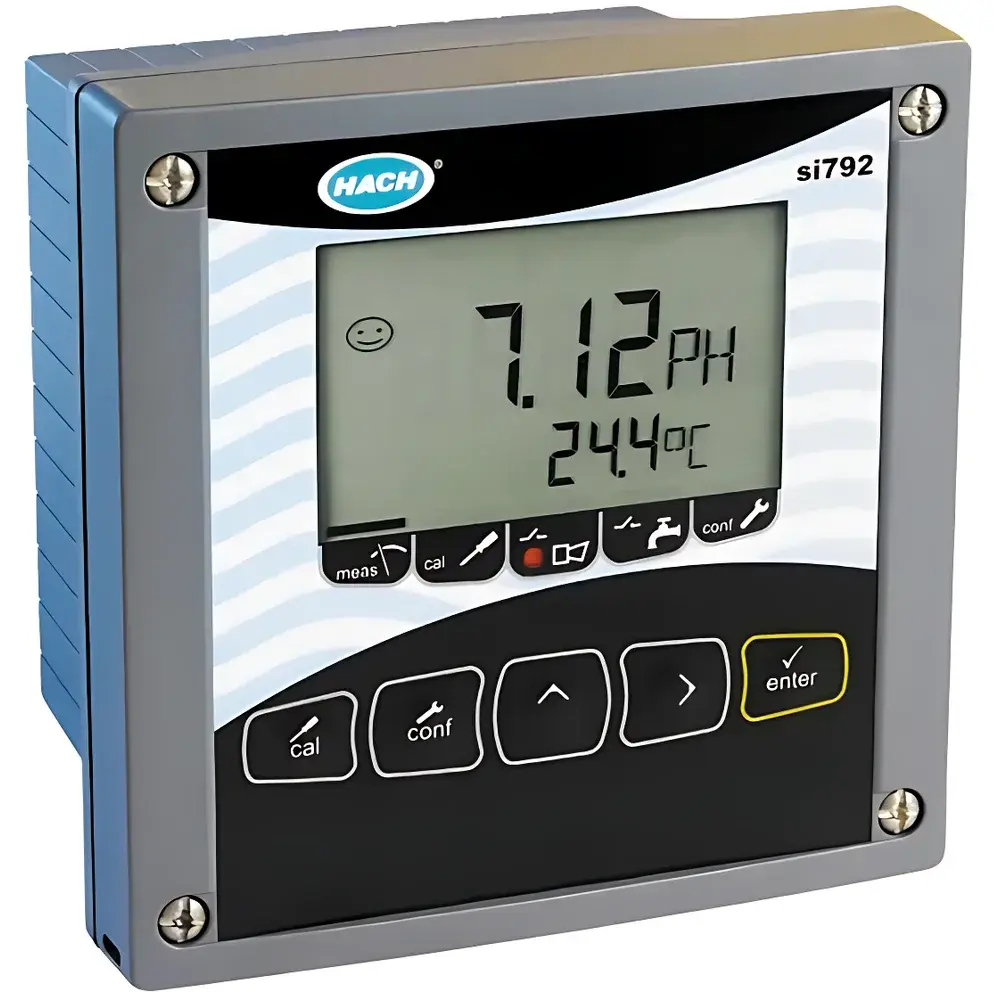
HACH si792 Intrinsically Safe Transmitter
| Brand | HACH |
|---|---|
| Origin | Imported |
| Manufacturer Type | Manufacturer |
| Model | si792 |
| Communication Protocols | HART®, PROFIBUS PA, Foundation® Fieldbus |
| Hazardous Area Certifications | FM, CSA, ATEX |
| Intrinsically Safe Rating | Class I, Division 1 (IS), Class I, Division 2 |
| Sensor Compatibility | GLI pH (differential & combination), ORP, Inductive Conductivity (GLI 3400 series), Electrodeless Conductivity (GLI 3700 series) |
| Diagnostic Capabilities | Asymmetry voltage monitoring, electrode slope tracking, response time evaluation, cable integrity check, glass electrode health assessment |
| Security Levels | Three-tier password protection (sensor calibration, transmitter configuration, administrator access) |
Overview
The HACH si792 Intrinsically Safe Transmitter is an industrial-grade, two-wire loop-powered analyzer designed for continuous, reliable measurement of critical water quality parameters—including pH, ORP, and conductivity—in hazardous environments. Engineered to comply with stringent intrinsic safety requirements, the si792 operates under low-energy conditions that prevent ignition of flammable gases or vapors, making it suitable for deployment in petrochemical refineries, offshore platforms, pharmaceutical clean utilities, and wastewater treatment facilities where explosive atmospheres are present. Its core architecture follows the principle of galvanic isolation and energy limitation per IEC 60079-11, ensuring safe signal transmission without compromising measurement fidelity. Unlike general-purpose transmitters, the si792 integrates native support for multiple fieldbus topologies—enabling seamless integration into modern distributed control systems (DCS) and asset management platforms while maintaining full compliance with hazardous area zoning regulations.
Key Features
- Intrinsically safe design certified to FM, CSA, and ATEX standards for Class I, Division 1 (IS) and Class I, Division 2 applications—enabling installation in Zone 0/1 (ATEX) and Class I, Div 1 groups A–D environments.
- Native multi-protocol support: configurable HART® 7, PROFIBUS PA (IEC 61158-2), and Foundation® Fieldbus (H1) communication, allowing interoperability across legacy and next-generation automation infrastructures.
- Advanced sensor diagnostics engine continuously monitors electrode asymmetry voltage, Nernstian slope deviation, response time drift, cable resistance, and glass membrane integrity—providing actionable status indicators (e.g., “Good,” “Fair – Replace Soon,” “Fault”)
- Three-level password protection system: distinct access tiers for sensor calibration (Level 1), transmitter configuration (Level 2), and full administrative functions including firmware updates and diagnostic log review (Level 3).
- Two-wire 4–20 mA analog output with digital superimposition, supporting simultaneous analog transmission and bidirectional digital communication over the same pair.
- Robust aluminum housing rated IP66/NEMA 4X, with operating temperature range of –20 °C to +60 °C and relative humidity tolerance up to 95 % non-condensing.
Sample Compatibility & Compliance
The si792 is exclusively compatible with HACH GLI-series sensors, including differential and combination pH/ORP electrodes, GLI 3400 inductive conductivity cells (for high-conductivity or aggressive media), and GLI 3700 electrodeless conductivity sensors (ideal for ultrapure water, CIP validation, and concentration analysis). All sensor-transmitter interactions adhere to GLI’s proprietary digital interface protocol, ensuring automatic recognition, parameter auto-loading, and sensor-specific compensation algorithms. From a regulatory standpoint, the si792 meets requirements for use in facilities governed by FDA 21 CFR Part 11 (when paired with compliant SCADA/HMI systems), supports audit-trail-capable calibration records, and conforms to ISO/IEC 17025 traceability frameworks when used within accredited laboratory or process QC workflows.
Software & Data Management
Configuration and diagnostics are performed via HACH’s GLI Device Manager software (Windows-based), which provides intuitive graphical interfaces for sensor setup, calibration scheduling, diagnostic history review, and firmware version management. The transmitter stores up to 30 days of timestamped diagnostic logs internally, including slope values, asymmetry readings, and response time trends—exportable as CSV for trending analysis. When integrated into FOUNDATION Fieldbus networks, the si792 supports EDDL (Electronic Device Description Language) and FDT/DTM frameworks, enabling plug-and-play device integration in Emerson DeltaV, Honeywell Experion, or Siemens Desigo CC systems. All configuration changes are logged with user ID, timestamp, and parameter delta—supporting GLP/GMP-aligned change control practices.
Applications
- Chemical process monitoring in explosion-hazard zones (e.g., chlorine dosing, acid/base neutralization loops)
- Pharmaceutical water-for-injection (WFI) and pure steam condensate conductivity verification in Class A/B cleanrooms
- Oil & gas produced water treatment—pH and conductivity control in desalination skids and reinjection lines
- Municipal wastewater influent/effluent monitoring at lift stations located in classified areas
- Power plant condensate polishing systems requiring intrinsically safe instrumentation near turbine halls
FAQ
What hazardous area certifications does the si792 hold?
The si792 carries FM, CSA, and ATEX certifications for Class I, Division 1 (intrinsically safe) and Class I, Division 2 operation. Specific approvals include FM Class I, Div 1, Groups A–D; CSA Class I, Div 1, Groups A–D; and ATEX II 1G Ex ia IIC T4 Ga.
Can the si792 be used with non-GLI sensors?
No. The si792 is engineered exclusively for HACH GLI digital sensors and does not support third-party or analog-only probes due to proprietary signal encoding and diagnostic handshake protocols.
Does the transmitter support remote calibration validation?
Yes—via HART or Fieldbus, users can initiate automated calibration checks, retrieve slope and offset values, and verify sensor readiness without physical access, provided the connected sensor supports digital calibration routines.
Is firmware update capability available in the field?
Yes. Firmware upgrades are performed through GLI Device Manager using a USB-to-HART modem or Fieldbus segment interface, with version rollback and checksum verification to ensure integrity.
How is sensor health status communicated to the control system?
Diagnostic status is transmitted as discrete status bits (via HART dynamic variables or Fieldbus function blocks) and mapped to DCS alarm tags—enabling predictive maintenance alerts based on predefined thresholds for slope decay or response lag.







