
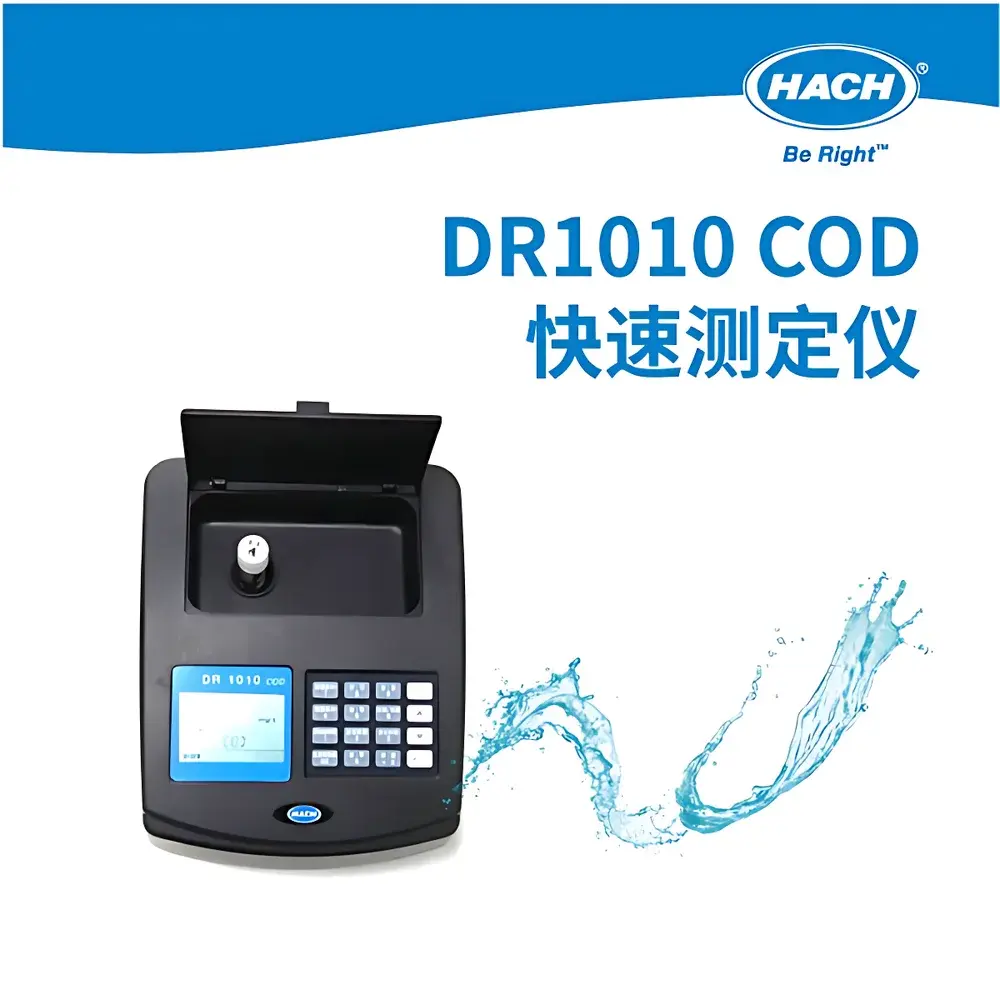
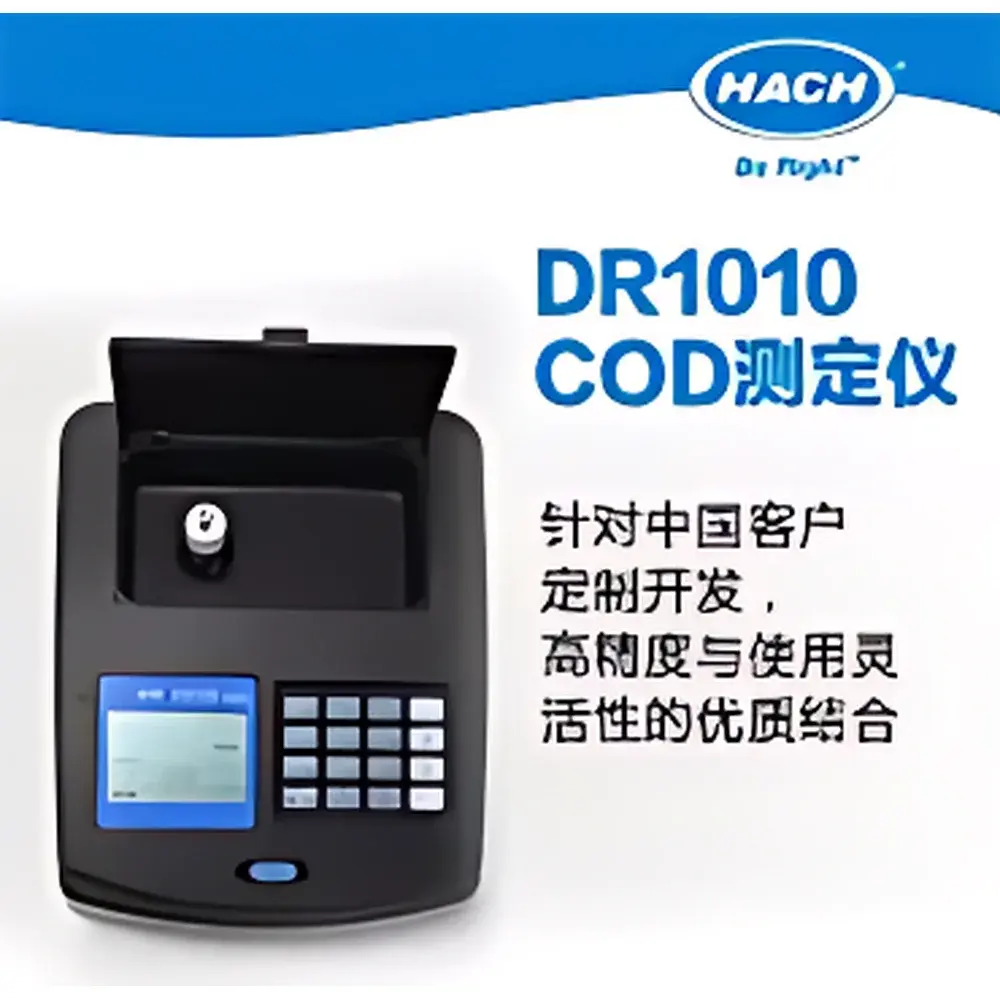
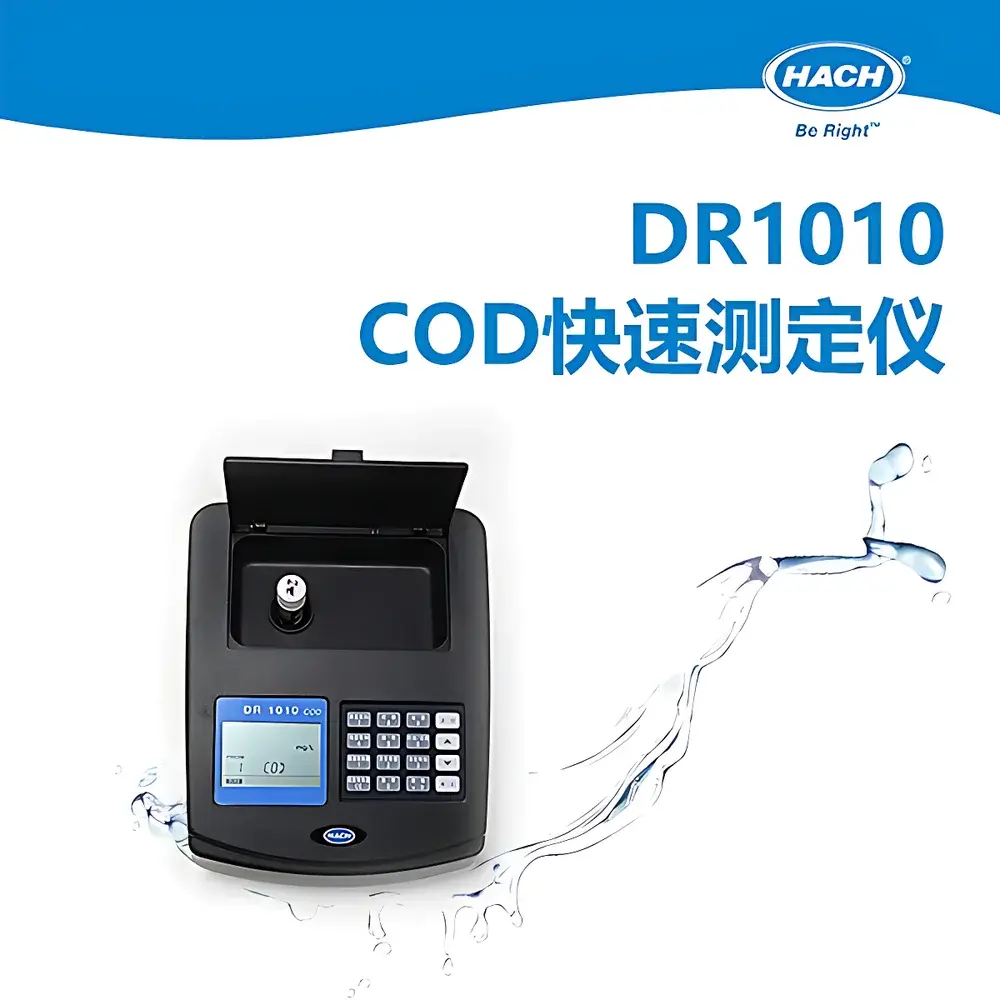
Hach DR1010 Chemical Oxygen Demand (COD) Analyzer
| Brand | Hach |
|---|---|
| Origin | Imported |
| Manufacturer Type | Manufacturer |
| Instrument Type | Benchtop Laboratory Analyzer |
| Measurement Principle | Dichromate Digestion Method (Portable-Compatible Design) |
| Wavelength Options | 420 nm and 610 nm |
| Wavelength Accuracy | ±1 nm |
| Photometric Linearity | ±0.002 A (0–1 A) |
| Photometric Repeatability | ±0.005 A (0–1 A) |
| Photometric Accuracy | ±0.005 A at 1.0 ABS |
| Stray Light | <1.0% at 400 nm |
| Light Source | LED |
| Detector | Silicon Photodiode |
| Display | 4-digit LCD, 15 mm character height |
| Optical Range | 0–2 A |
| Readout Modes | % Transmittance, Absorbance, Concentration |
| Operating Temperature | 0–50 °C |
| Storage Temperature | −20–60 °C |
| Humidity Limit | 80% RH at 40 °C |
| Ingress Protection | IP41 |
| Power Supply | 190–240 VAC/50 Hz adapter (6 VDC output) or 4 × AA alkaline batteries |
| Battery Life | Up to 6 months (typical usage) |
| Dimensions | 24.0 × 19.8 × 12.0 cm |
| Weight | 2.0 kg |
| Batch Capacity | 0–30 samples per run |
| Digestion Time | 20–120 min |
| Detection Limit & Range | Defined by reagent vial selection (e.g., 0–150 mg/L, 0–1500 mg/L) |
| Measurement Error | ≤8% (15–150 mg/L) |
| Data Interface | RS232 serial port for printer or PC connectivity |
Overview
The Hach DR1010 Chemical Oxygen Demand (COD) Analyzer is a benchtop photometric instrument engineered for precise, regulatory-compliant COD determination in wastewater, surface water, and industrial effluent samples. It implements the standardized dichromate digestion method—aligned with EPA Method 410.4, ISO 6060, and China’s HJ/T 399-2007—wherein organic matter is oxidized under acidic, high-temperature conditions using potassium dichromate as the oxidant. Post-digestion, the residual dichromate is quantified spectrophotometrically at either 420 nm (for low-range COD, e.g., 0–150 mg/L) or 610 nm (for high-range COD, e.g., 0–1500 mg/L), enabling dual-range flexibility without manual wavelength adjustment. The instrument’s optical architecture employs stable LED light sources and silicon photodiodes to ensure long-term photometric integrity, while its IP41-rated enclosure supports operation in controlled laboratory environments and transitional field deployment when powered by AA batteries.
Key Features
- Automated dual-wavelength selection (420 nm / 610 nm) triggered by preloaded or user-defined test programs—eliminating manual filter changes and reducing operator error.
- Built-in calibration curves compliant with Hach TNTplus® and LCK vial-based COD methods, plus support for up to 20 user-customized calibration functions using linear, quadratic, or polynomial regression models.
- Integrated reagent blank correction and standard adjustment routines to compensate for vial-to-vial variability and matrix interferences—critical for accurate reporting under GLP and ISO/IEC 17025 frameworks.
- Real-time graphical prompts and icon-driven workflow guidance throughout digestion and measurement phases, improving procedural adherence for junior analysts and minimizing training overhead.
- Dual power architecture: AC adapter (190–240 VAC) for continuous lab use; four AA alkaline cells for mobile applications—enabling full functionality during site audits or emergency response scenarios.
- RS232 interface supporting direct data export to PCs or microprinters; compatible with Hach’s LabStation™ software for audit-trail-enabled data logging, report generation, and electronic signature workflows aligned with FDA 21 CFR Part 11 requirements.
Sample Compatibility & Compliance
The DR1010 accommodates standard 16-mm round glass or plastic COD vials (e.g., TNTplus 820, LCK 114), ensuring compatibility with globally recognized Hach reagent systems. Its optical path length and detector sensitivity are optimized for both low-concentration municipal influent and high-strength industrial discharges. The analyzer meets performance criteria specified in ISO 6060:1989 (Water quality — Determination of chemical oxygen demand), ASTM D1253-21 (Standard Test Method for Residual Chlorine in Water), and China’s HJ/T 399-2007 (Determination of Chemical Oxygen Demand in Water by Rapid Digestion Spectrophotometry). All firmware and calibration records maintain traceable timestamps, supporting internal QA/QC reviews and external accreditation assessments per CNAS-CL01 or ILAC-G8.
Software & Data Management
Data acquisition and reporting are managed via embedded firmware with non-volatile memory storing up to 500 test results—including sample ID, date/time stamp, operator code, absorbance value, concentration, and curve ID. Exported datasets include metadata fields required for regulatory submission (e.g., EPA Form 3300). When connected to LabStation™ software, users gain access to automated uncertainty calculation per GUM (Guide to the Expression of Uncertainty in Measurement), trend analysis across multiple batches, and configurable PDF report templates compliant with ISO 17025 clause 7.8. Audit trails record all parameter modifications, curve edits, and calibration events—with immutable timestamps and user authentication logs.
Applications
- Routine monitoring of influent and effluent COD in municipal wastewater treatment plants (WWTPs) for process control and discharge compliance.
- Industrial pretreatment verification for textile, food processing, pharmaceutical, and electroplating facilities subject to local effluent limits.
- Environmental impact assessment (EIA) sampling campaigns requiring portable yet lab-grade accuracy in remote locations.
- Educational laboratories teaching standard methods for water quality analysis, including method validation exercises and inter-laboratory comparison studies.
- Third-party testing labs performing certified analyses under ISO/IEC 17025 accreditation scopes covering wastewater parameters.
FAQ
Does the DR1010 support EPA-approved digestion protocols?
Yes—it is validated for use with Hach’s EPA-accepted TNTplus® reagents and supports both rapid digestion (20–30 min at 150 °C) and classical 2-hour digestion per Standard Methods 5220B.
Can custom calibration curves be validated and locked for routine use?
Yes—user-defined curves can be assigned unique IDs, tagged with creation date and operator credentials, and optionally password-protected to prevent unauthorized modification.
Is the instrument suitable for GLP-regulated environments?
Yes—the firmware enforces electronic signatures for calibration, includes full audit trail logging, and supports 21 CFR Part 11-compliant configurations when paired with LabStation™ software.
What maintenance is required to sustain photometric accuracy?
Annual verification using NIST-traceable neutral density filters is recommended; LED source lifetime exceeds 100,000 hours, eliminating lamp replacement concerns.
How does the DR1010 handle turbid or colored samples?
The instrument applies fixed-pathlength geometry and dual-wavelength referencing where applicable; for highly interfering matrices, users may apply the optional “color compensation” algorithm embedded in advanced firmware versions.







