
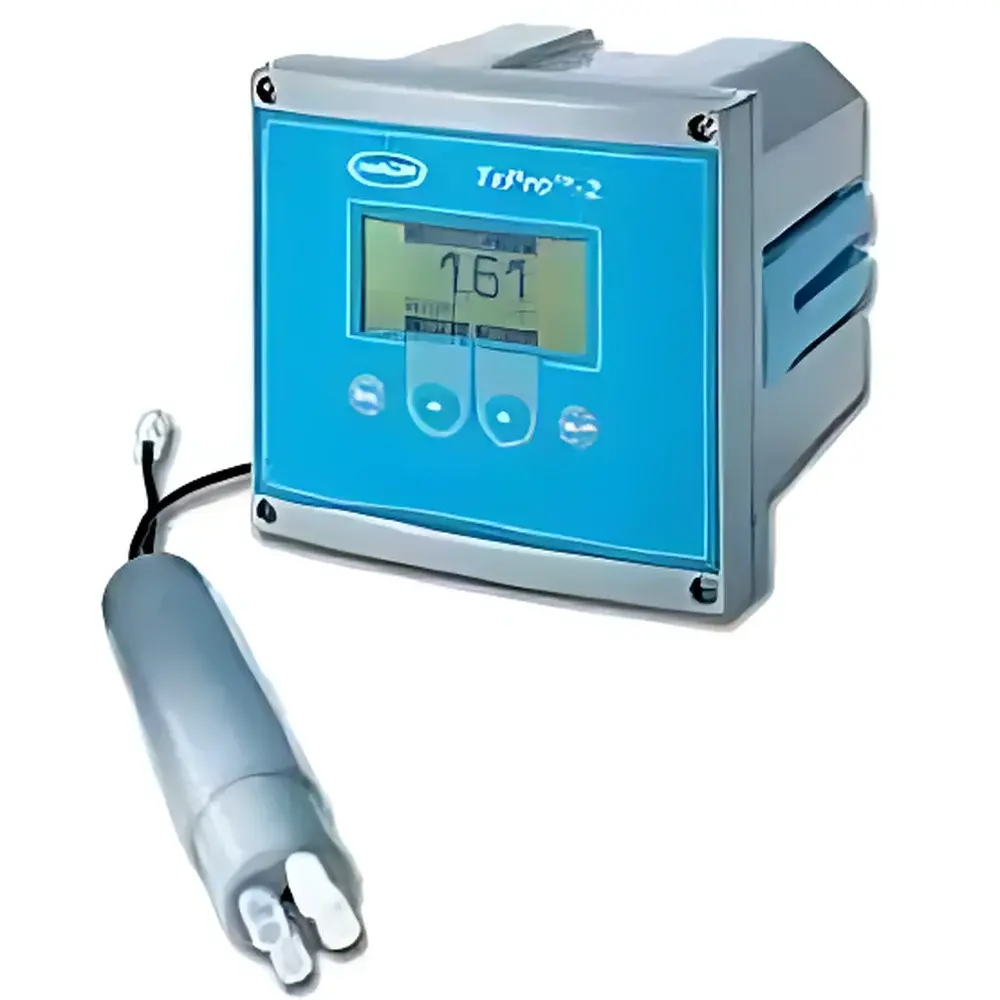
HACH Txpro-2 Online Suspended Solids (MLSS) Analyzer
| Brand | HACH |
|---|---|
| Model | Txpro-2 |
| Measurement Principle | Quadruple-beam Optical Transmission/Scattering |
| Measurement Range (RD240/242) | 0–10 g/L |
| Measurement Range (RD260/262) | 0–25 g/L |
| Accuracy (RD240/242) | ±2% of reading or ±0.1 g/L, whichever is greater |
| Accuracy (RD260/262) | ±2% of reading or ±0.2 g/L, whichever is greater |
| Repeatability (RD240/242) | ±2% of reading or ±0.05 g/L, whichever is greater |
| Repeatability (RD260/262) | ±2% of reading or ±0.1 g/L, whichever is greater |
| Operating Temperature | –20 °C to +55 °C |
| Analog Outputs | Two isolated 0/4–20 mA outputs, max. load 800 Ω |
| Relays | Three SPDT relays, 2 A @ 250 VAC |
| Signal Averaging | Adjustable from 1 second to 5 minutes |
| Power Supply | 90–265 VAC, 50/60 Hz |
| Max. Power Consumption | 25 VA |
| Enclosure Rating | NEMA 4X (IP66) |
| Mounting | Pipe clamp for up to 50 mm OD pipe |
| Compliance | CE, UL 61010-1, CSA C22.2 No. 61010-1 |
| Dimensions | 144 × 144 × 150 mm |
Overview
The HACH Txpro-2 Online Suspended Solids (MLSS) Analyzer is an industrial-grade optical sensor system engineered for continuous, real-time monitoring of mixed liquor suspended solids (MLSS) concentration in activated sludge processes. It employs a proprietary quadruple-beam optical architecture—comprising two independent light emitters and two matched photodetectors—to generate a multi-path signal matrix. Unlike conventional single-beam or dual-beam turbidimeters, this configuration enables robust compensation for optical fouling, surface coating, lamp aging, and variable particle size distribution. The resulting signal ratios are processed via embedded algorithms to deliver stable, drift-resistant MLSS quantification across dynamic wastewater matrices. Designed for unattended operation in primary clarifiers, aeration basins, secondary clarifiers, and return activated sludge (RAS) lines, the Txpro-2 meets the functional reliability requirements of modern water resource recovery facilities (WRRFs) operating under stringent regulatory oversight—including EPA NPDES permit compliance and ISO 5667-3 water sampling standards.
Key Features
- Quadruple-beam optical design ensures high immunity to sensor window fouling and signal drift—critical for long-term deployment in high-solids, high-fouling environments.
- Dual-channel controller supports simultaneous integration of one or two RD-series suspended solids sensors (e.g., RD240/242 and RD260/262), enabling differential measurement or redundancy configurations.
- Configurable probe mounting: insertion-type (for pressurized pipes or channels) or immersion-type (for open tanks and basins), with optional integrated air/water purge ports actuated via external solenoid valves.
- Wide dynamic range: RD240/242 variant optimized for low-to-moderate MLSS (0–10 g/L); RD260/262 variant extends upper limit to 25 g/L—suitable for high-loading MBR or SBR systems.
- Self-diagnostic firmware continuously monitors LED intensity, detector response, signal-to-noise ratio, and purge valve status—logging events with timestamps for predictive maintenance planning.
- NEMA 4X (IP66)-rated enclosure with corrosion-resistant housing and modular terminal block simplifies field wiring and withstands ambient humidity, condensation, and chemical exposure typical in pump stations and headworks.
Sample Compatibility & Compliance
The Txpro-2 is validated for use in municipal and industrial wastewater streams containing biological flocs, filamentous bacteria, inorganic precipitates, and fine particulates typical of aerobic and anoxic bioreactors. It is not intended for raw influent with >100 mg/L total suspended solids (TSS) unless preceded by coarse screening. Sensor calibration is traceable to gravimetric reference methods per ASTM D5907 and ISO 11923. System-level documentation supports GLP-compliant validation protocols, including IQ/OQ documentation templates aligned with FDA 21 CFR Part 11 data integrity expectations when paired with HACH’s SCADA-integrated software platforms. Electrical safety certification includes UL 61010-1 and CSA C22.2 No. 61010-1; electromagnetic compatibility conforms to EN 61326-1.
Software & Data Management
The Txpro-2 operates autonomously but interfaces seamlessly with HACH’s PlantVision™ and Asset Insight™ platforms via Modbus RTU/ASCII or 4–20 mA analog signals. Its onboard memory stores up to 30 days of minute-averaged data (configurable averaging interval: 1 s to 5 min) with time-stamped event logs for power cycles, relay activations, and diagnostic alerts. All analog outputs support HART 7 protocol for remote configuration and diagnostics using standard handheld communicators. Audit trails for calibration adjustments, range changes, and firmware updates are retained locally and exportable via USB or serial interface—supporting GMP-aligned record retention policies. Firmware updates are performed via secure, signed binary packages verified at boot.
Applications
- Real-time control of wasting rate in activated sludge systems to maintain optimal F/M ratio and prevent over-aeration.
- Monitoring MLSS gradients across sequential bioreactor zones (e.g., anaerobic/anoxic/oxic) to verify denitrification efficiency and nitrifier health.
- Optimizing polymer dosing in dewatering centrifuges and belt presses by correlating MLSS with cake solids content.
- Supporting model-based process control (e.g., BioWin, GPS-X) with high-frequency input for dynamic simulation and predictive setpoint adjustment.
- Regulatory reporting for NPDES permit conditions requiring periodic MLSS verification—reducing manual grab sampling frequency by up to 70%.
- Troubleshooting filamentous bulking events through rapid detection of abnormal floc density shifts preceding settleability deterioration.
FAQ
What calibration standards are recommended for field verification?
Gravimetrically prepared suspensions of kaolin clay or synthetic activated sludge (per ASTM D5907 Annex A) are recommended. HACH provides certified calibration kits (Cat. No. 2856900) traceable to NIST SRM 2800.
Can the Txpro-2 be used in seawater or brackish influent applications?
Yes—optical path compensation accommodates salinity-induced refractive index shifts up to 35 ppt; however, biofouling mitigation requires more frequent purge cycles, and sensor window material (sapphire) must be specified for chloride resistance.
Is the system compatible with third-party SCADA systems?
Yes—Modbus RTU/ASCII communication is fully implemented and tested with Siemens Desigo, Schneider EcoStruxure, and Emerson DeltaV systems; register maps and device profiles are available in HACH’s Integration Guide (Doc. No. TXPRO2-IG-EN).
How does the quadruple-beam method improve accuracy over traditional turbidity sensors?
By measuring four independent optical paths and computing normalized ratios, the system decouples true particle concentration from path-length-dependent attenuation and detector saturation effects—yielding linear response across the full 0–25 g/L range without algorithmic curve-fitting.
What maintenance intervals are required for reliable long-term operation?
Sensor window inspection every 3 months; mechanical purge valve testing every 6 months; full calibration verification annually or after any major process upset affecting solids characteristics.







