
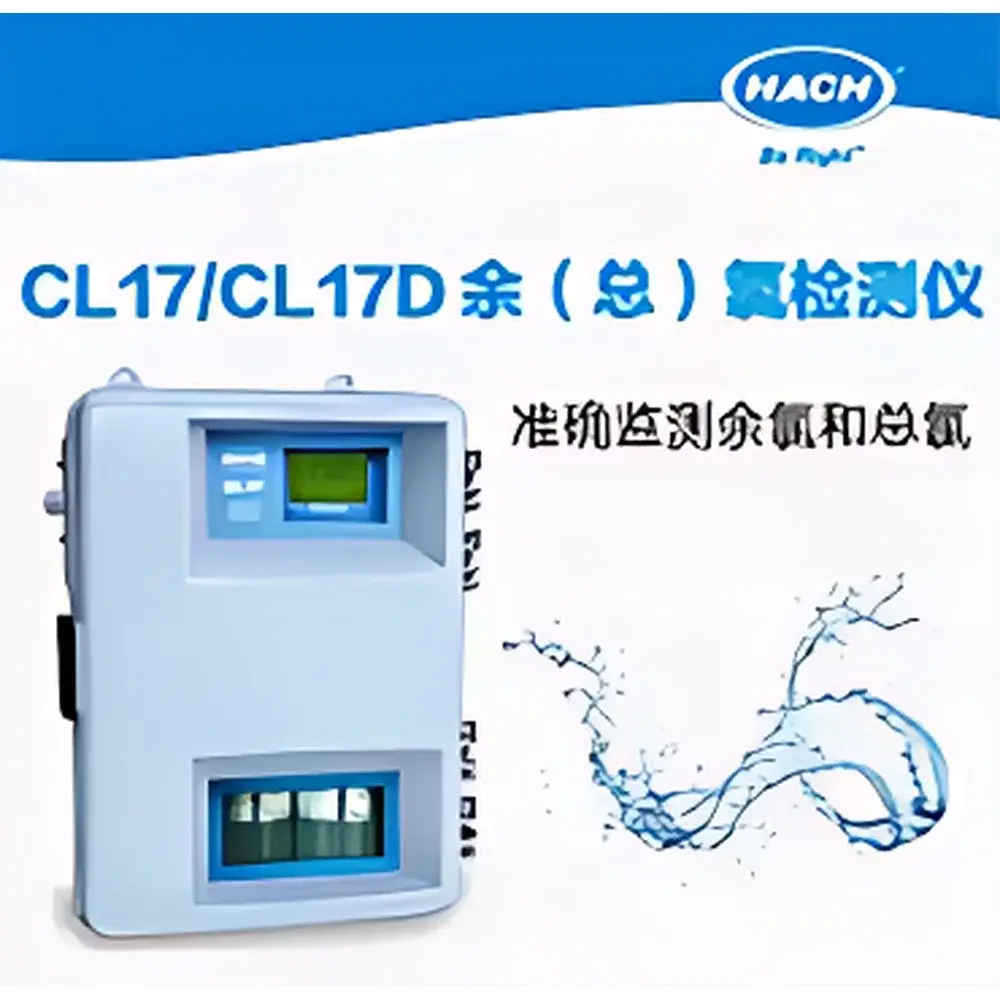
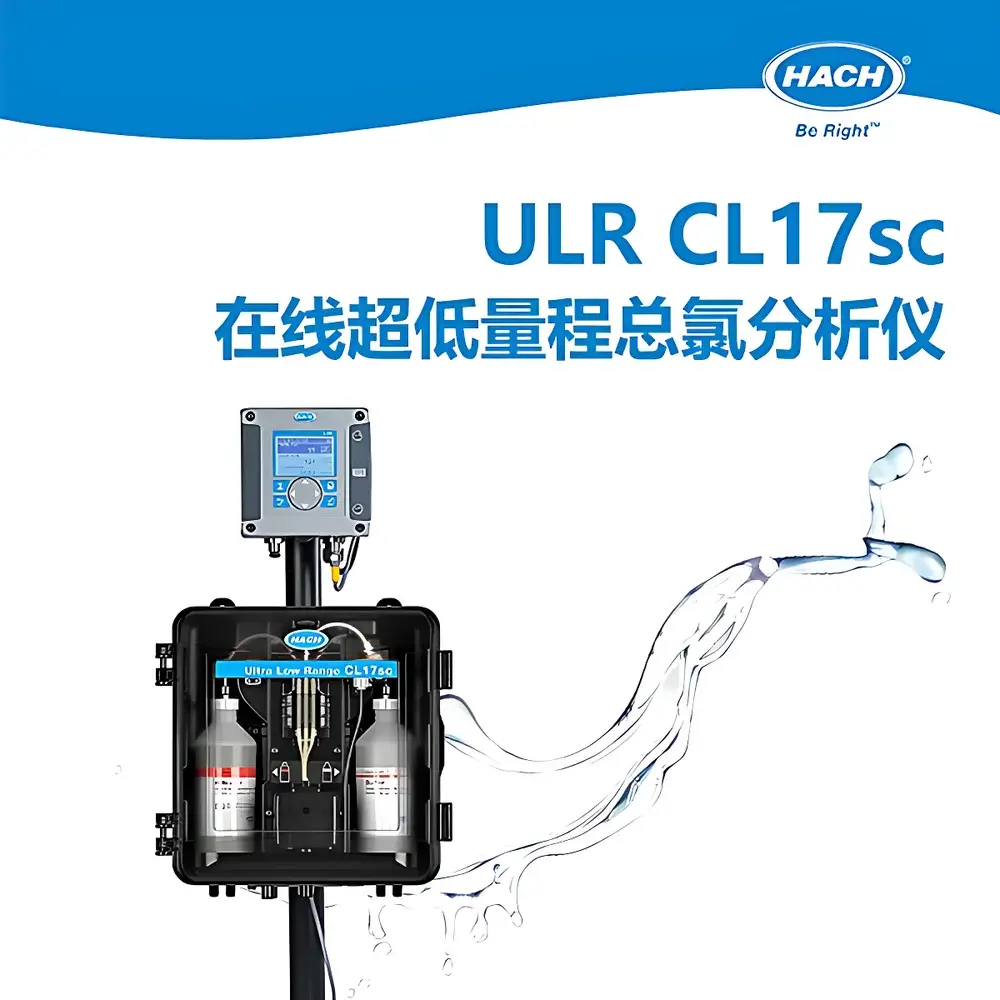
Hach CL17 Residual and Total Chlorine Analyzer
| Brand | Hach |
|---|---|
| Origin | USA |
| Manufacturer Type | Original Equipment Manufacturer (OEM) |
| Product Origin | Imported |
| Model | CL17 |
| Instrument Type | Online Analyzer |
| Measurement Principle | DPD Colorimetric Method (N,N-Diethyl-p-phenylenediamine) |
| Measured Parameter | Residual Chlorine and Total Chlorine |
| Range | 0–5 mg/L as Cl₂ |
| Accuracy | ±5% or ±0.035 mg/L as Cl₂ (whichever is greater) |
| Repeatability | 0.02 mg/L as Cl₂ |
| Resolution | 0.001 mg/L as Cl₂ |
| Detection Limit | 0.035 mg/L as Cl₂ |
| Sample Temperature Range | 5–40 °C |
| Analog Output | 4–20 mA, scalable within 0–5 mg/L range |
| Alarm Outputs | Two user-configurable concentration alarms, each with SPDT relay (5 A, 230 VAC) |
| Dimensions | 42 mm (H) × 32 mm (W) × 18 mm (D) |
Overview
The Hach CL17 Residual and Total Chlorine Analyzer is a compact, microprocessor-controlled online instrument engineered for continuous, real-time monitoring of free residual chlorine and total chlorine in potable water distribution systems, wastewater effluent streams, and industrial cooling water circuits. It operates on the standardized DPD (N,N-diethyl-p-phenylenediamine) colorimetric method—fully compliant with EPA Method 334.0 and ISO 7393-2—where chlorine species oxidize DPD to form a stable magenta-colored quinoneimine dye, quantified photometrically at 515 nm. The analyzer’s optical path is housed in a sealed, temperature-stabilized flow cell to ensure high reproducibility under variable ambient conditions. Designed for unattended operation in remote or networked telemetry environments, the CL17 delivers measurement results every 2.5 minutes with minimal operator intervention.
Key Features
- Simultaneous selectable measurement modes for free residual chlorine or total chlorine via programmable reagent addition sequence
- Integrated turbidity and color compensation algorithms that dynamically correct for sample interferences without requiring manual filtration or pre-treatment
- Auto-calibration capability using built-in reference curves traceable to NIST-certified chlorine standards
- Onboard diagnostics including flow verification, LED intensity monitoring, reagent depletion alerts, and optical path integrity checks
- 30-day reagent autonomy with factory-prepackaged DPD powder and buffer tablets—reducing maintenance frequency and operational overhead
- Robust industrial enclosure rated IP65, suitable for wall-mount or panel-integrated deployment in pump stations, treatment plants, and SCADA-equipped facilities
Sample Compatibility & Compliance
The CL17 accepts raw or filtered aqueous samples within pH 4.0–8.0 and conductivity ≤ 2,000 µS/cm. It is validated for use with drinking water (per US EPA 40 CFR Part 141), secondary-treated wastewater (per EPA NPDES discharge guidelines), and recirculating cooling water per ASHRAE Guideline 12-2020. All firmware and calibration protocols adhere to GLP-compliant data handling principles; audit trails, user access logs, and configuration change records are retained onboard for regulatory review. While not inherently 21 CFR Part 11-compliant out-of-the-box, the CL17 supports external secure logging via Modbus TCP or HART when integrated into validated plant-wide control architectures.
Software & Data Management
Configuration, calibration, and alarm thresholds are managed via the intuitive Hach Link software (Windows-based) or through local front-panel navigation. The device supports dual analog outputs (4–20 mA) mapped independently to residual or total chlorine channels. Optional Hach DataStream™ connectivity enables encrypted cloud upload to centralized dashboards, supporting time-series trending, threshold-based SMS/email alerts, and automated report generation. All measurement data include embedded timestamps, instrument ID, and status flags (e.g., “low reagent”, “flow fault”, “calibration due”)—ensuring full traceability required for ISO/IEC 17025-accredited laboratories and municipal compliance reporting.
Applications
- Real-time optimization of chlorine dosing at water treatment plant clearwells and booster stations
- Regulatory compliance monitoring at point-of-entry and point-of-use locations in municipal distribution networks
- Effluent quality assurance for wastewater disinfection contact basins prior to environmental discharge
- Process control of chlorination in food & beverage processing lines and pharmaceutical purified water loops
- Remote surveillance of rural or decentralized water kiosks where power and technician access are constrained
FAQ
Does the CL17 require daily manual calibration?
No. The CL17 performs automatic zero and span verification during each analysis cycle using internal optical references and reagent blanks. Manual calibration is recommended only after reagent replacement or following extended downtime.
Can the CL17 distinguish between free chlorine and combined chlorine?
It measures free residual chlorine directly and total chlorine after potassium iodide-mediated oxidation. Combined chlorine is calculated by difference (Total – Free), but this value is not reported independently due to propagation of uncertainty per ASTM D1253.
Is the instrument compatible with existing SCADA systems?
Yes. It provides native 4–20 mA analog output and optional HART 7 or Modbus RTU/TCP digital interfaces for seamless integration with Allen-Bradley, Siemens, or Schneider Electric PLC platforms.
What maintenance intervals are required for reliable operation?
Reagents must be replaced every 30 days under typical usage. Flow cell cleaning and LED verification are advised quarterly; no optical alignment or lamp replacement is needed during the instrument’s nominal 5-year service life.
How does the CL17 handle high-turbidity samples?
Its proprietary dual-wavelength photometric algorithm compensates for light scattering up to 100 NTU without external filtration—validated against spiked turbid standards per ISO 7027.
Related Products







