
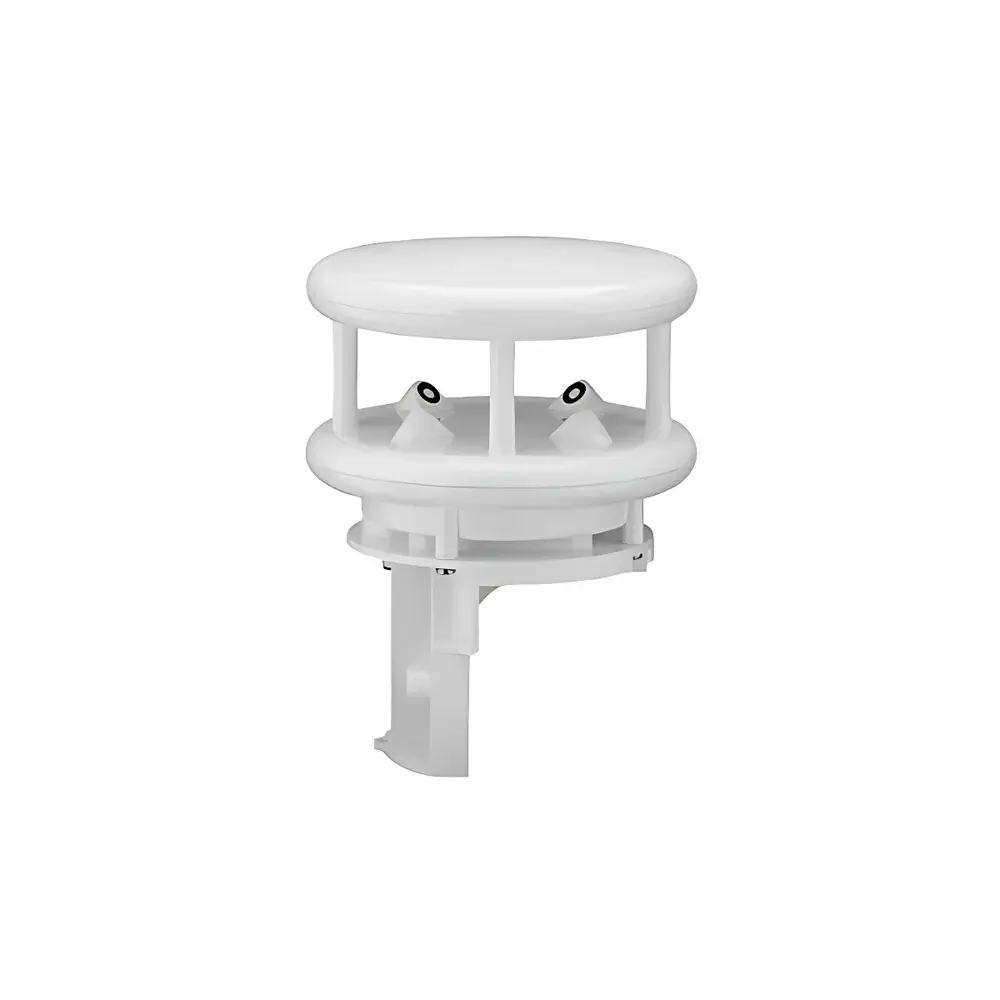
Lufft WS200-UMB Ultrasonic Weather Station
| Brand | Lufft |
|---|---|
| Origin | Germany |
| Model | WS200-UMB |
| Measurement Principle | Ultrasonic time-of-flight anemometry |
| Wind Speed Range | 0–60 m/s |
| Wind Direction Range | 0–360° |
| Power Supply | 12–24 VDC, solar-compatible |
| Operating Temperature | −40 to +70 °C |
| IP Rating | IP66 |
| Communication Protocols | SDI-12, RS-232/485, Modbus RTU, CAN bus, MQTT (optional) |
| Integrated Electronic Compass | Yes |
| Heating Function | Integrated ultrasonic transducer heating |
| Output Parameters | Wind speed (m/s), wind direction (°), wind quality index (WQI), status diagnostics |
| External Sensor Support | Rain gauge, temperature/humidity probe, barometric pressure sensor |
| Compliance | CE, RoHS, WMO Guide to Instruments and Methods of Observation (CIMO) |
Overview
The Lufft WS200-UMB is a high-reliability, maintenance-free ultrasonic weather station engineered for continuous, all-weather environmental monitoring in demanding operational environments. Unlike mechanical cup-and-vane anemometers, the WS200-UMB employs ultrasonic time-of-flight (TOF) technology to measure wind velocity and direction with no moving parts—eliminating mechanical wear, inertia lag, and icing-related measurement drift. Paired with a solid-state electronic compass, it delivers true north-referenced directional data independent of magnetic interference. Designed and manufactured in Germany, the system adheres to the World Meteorological Organization’s (WMO) CIMO Guide standards for accuracy, stability, and long-term traceability. Its robust aluminum housing, IP66-rated enclosure, and integrated transducer heating ensure uninterrupted operation across extreme climatic conditions—from arctic winter deployments to desert solar farms.
Key Features
- Ultrasonic anemometry with dual-axis transducer array for simultaneous wind speed and direction determination via precise time-difference-of-flight calculation
- Integrated solid-state electronic compass calibrated for tilt compensation and magnetic declination correction
- Active transducer heating system prevents ice, snow, or condensation accumulation—critical for high-latitude and alpine installations
- Low-power architecture (typical consumption <1.5 W @ 12 VDC) enabling seamless integration with solar-charged battery systems
- Real-time wind quality index (WQI) output—quantifying signal integrity, turbulence-induced noise, and measurement confidence per IEC 61400-12-1 Annex D guidelines
- Modular interface design supporting plug-and-play expansion with certified third-party sensors (e.g., tipping-bucket rain gauges, PT100 temperature probes, capacitive humidity modules)
- Multi-protocol communication stack including SDI-12 (for legacy hydrological networks), RS-485 Modbus RTU (industrial SCADA), CAN bus (transport infrastructure), and MQTT (IoT/cloud telemetry)
Sample Compatibility & Compliance
The WS200-UMB is validated for deployment across heterogeneous environmental monitoring infrastructures. It meets CE marking requirements under the EU Electromagnetic Compatibility (2014/30/EU) and Low Voltage (2014/35/EU) Directives. Its measurement methodology aligns with WMO Recommendation No. 8 (CIMO Guide, Chapter 5) for wind instrumentation performance criteria—including start-up threshold (<0.1 m/s), directional resolution (±0.1°), and dynamic response time (<1 s for 90% step response). For regulated applications—including aviation meteorological services (ICAO Annex 3), road weather information systems (RWIS), and renewable energy site assessment—the device supports audit-ready data logging with UTC-synchronized timestamps and configurable metadata tagging. While not FDA-regulated, its firmware architecture accommodates GLP/GMP-aligned validation protocols through deterministic boot sequence logging and non-volatile parameter storage.
Software & Data Management
The WS200-UMB operates autonomously without embedded OS dependencies. Configuration, calibration, and diagnostics are managed via Lufft’s UMB-ConfigTool (Windows/Linux), which provides secure firmware updates, sensor registration, and protocol mapping. Raw and processed measurements are streamed in ASCII or binary frame formats compatible with industry-standard platforms including Campbell Scientific LoggerNet, OSIsoft PI System, and AWS IoT Core. Optional cloud integration enables TLS-encrypted MQTT publishing with QoS Level 1, payload compression, and configurable publish intervals (1 s to 1 h). All internal diagnostics—including heater duty cycle, transducer impedance drift, and compass alignment deviation—are logged with millisecond-resolution timestamps, facilitating predictive maintenance and root-cause analysis during regulatory audits.
Applications
- Roadway meteorology: Real-time crosswind alerts for highway safety management and bridge operation control systems
- Photovoltaic plant performance modeling: Correlating wind-cooling effects on panel temperature with energy yield loss estimation
- Hydrometeorological networks: Integration into national water resource monitoring programs requiring WMO-compliant wind inputs for evapotranspiration modeling
- Airport surface observation systems (ASOS/AWOS): Supplementing conventional anemometers with redundancy and icing resilience
- Wind resource assessment: Long-term mast-mounted deployment for pre-construction energy yield forecasting per IEC 61400-12-1 Class A requirements
- Port and maritime terminal operations: Gust detection and wind shear profiling for container crane safety interlocks
FAQ
Does the WS200-UMB require periodic mechanical recalibration?
No—ultrasonic transducers are factory-calibrated using NIST-traceable wind tunnel reference standards; zero-point and gain coefficients are stored in EEPROM and remain stable over the instrument’s service life.
Can the electronic compass be affected by nearby metallic structures?
Yes—though tilt-compensated, the compass requires installation per Lufft’s mounting guidelines (minimum 1 m clearance from ferrous materials); optional hard-iron calibration is supported via UMB-ConfigTool.
Is the heater function controllable remotely?
Yes—operating mode (auto, manual-on, manual-off) and temperature setpoint (−20 to +10 °C) are configurable via serial command or Modbus register write.
What is the maximum cable length for RS-485 communication?
Up to 1,200 meters at 9.6 kbps using twisted-pair shielded cable meeting EIA/TIA-485-A specifications.
Does the device support NTP time synchronization?
Not natively—but when connected to a host controller with NTP capability (e.g., Raspberry Pi gateway), timestamped data frames inherit synchronized UTC time via serial framing.







