
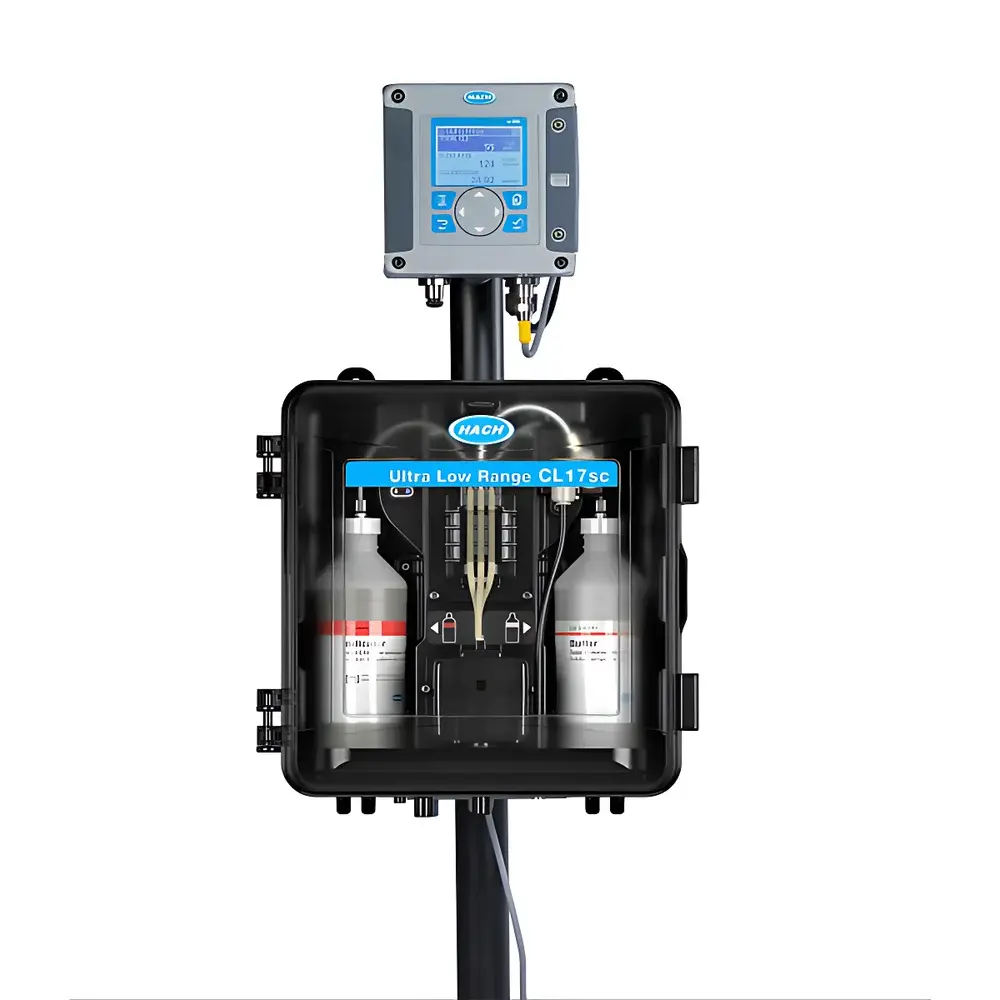
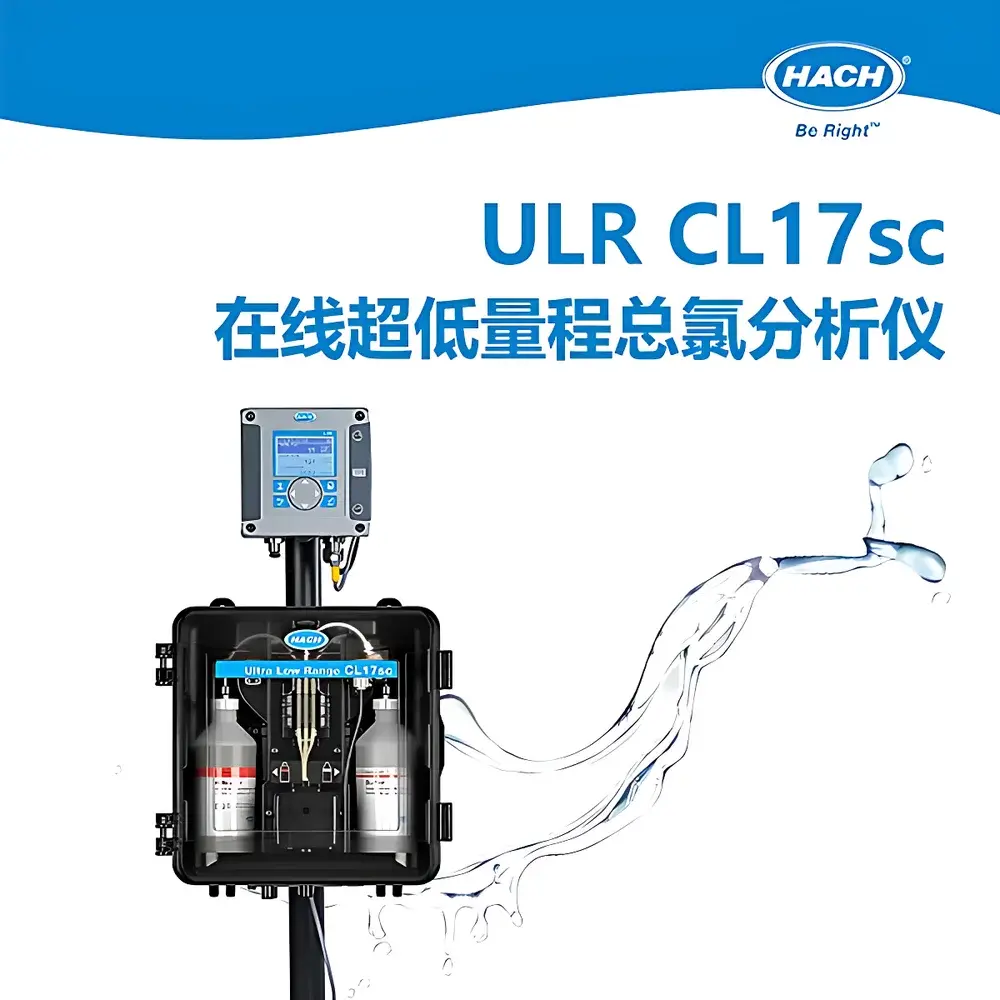
HACH ULR CL17 sc Ultra-Low-Range Total Chlorine Analyzer
| Brand | HACH |
|---|---|
| Origin | USA |
| Manufacturer | HACH Company |
| Product Type | Imported |
| Model | ULR CL17 sc |
| Instrument Category | Online Analyzer |
| Measurement Principle | DPD Colorimetric Method (ASTM D1253, ISO 7393-2) |
| Measured Parameter | Total Chlorine (as Cl₂) |
| Measurement Range | 0.008–5 mg/L Cl₂ |
| Accuracy | ±5% or ±0.01 mg/L (whichever is greater) for 0–4 mg/L |
| Detection Limit | 0.008 mg/L Cl₂ at 25 °C |
Overview
The HACH ULR CL17 sc Ultra-Low-Range Total Chlorine Analyzer is an online, laboratory-grade photometric instrument engineered for continuous, high-sensitivity monitoring of total chlorine concentration in critical water streams. It employs the standardized N,N-diethyl-p-phenylenediamine (DPD) colorimetric method—specifically aligned with ASTM D1253 and ISO 7393-2—where total chlorine oxidizes DPD to form a stable pink-colored quinoneimine dye, quantified at 515 nm. Unlike amperometric or ORP-based proxies, the ULR CL17 sc delivers direct, speciation-independent measurement of total chlorine (free + combined), eliminating interference from pH shifts, temperature fluctuations (25 °C calibrated), flow rate variations, pressure changes, conductivity gradients, or dissolved oxygen transients. Its sub-ppb-level detection capability (0.008 mg/L Cl₂) makes it uniquely suited for applications where trace chlorine residuals must be tightly controlled—particularly upstream of sensitive unit operations such as reverse osmosis (RO) membranes, ion exchange resins, or ultrapure water polishing systems.
Key Features
- Ultra-low detection limit of 0.008 mg/L Cl₂—validated per EPA Method 334.0 and HACH Standard Method 4500-Cl G
- Integrated reagent delivery system with precise metering pumps and dual-reagent (DPD + buffer) chemistry for robust total chlorine oxidation
- Automatic zero and span calibration with built-in reference standards and programmable calibration frequency
- Real-time cumulative chlorine exposure calculation—enabling predictive RO membrane lifetime modeling based on integrated Cl₂ dose (mg·min/L)
- IP66-rated enclosure with NEMA 4X compatibility for harsh industrial environments including wastewater plants and pharmaceutical clean utility areas
- Modbus RTU/ASCII and Ethernet/IP communication protocols for seamless integration into DCS, SCADA, and PLC-based control architectures
Sample Compatibility & Compliance
The ULR CL17 sc is validated for use with potable water, process water, wastewater effluent, and ultrapure water (UPW) recirculation loops. It meets performance requirements outlined in US EPA Clean Water Act compliance monitoring, FDA 21 CFR Part 11 for electronic records integrity (when paired with Claros Data Management Software), and EU Drinking Water Directive (2020/2184) Annex I parameter 3.2 (total chlorine). The analyzer supports GLP/GMP-aligned audit trails—including operator login, method version, calibration history, and raw absorbance logs—with time-stamped, non-erasable entries. All wetted materials comply with NSF/ANSI Standard 61 and USP for pharmaceutical water systems.
Software & Data Management
The ULR CL17 sc natively integrates with HACH Claros Intelligent Water Platform—a cloud-connected, browser-based software suite supporting remote configuration, real-time trend visualization, alarm management, and automated report generation (PDF/CSV). Claros enforces role-based access control, electronic signatures, and full 21 CFR Part 11 compliance—including audit trail archiving, electronic record retention, and secure data encryption (TLS 1.2+). Historical absorbance spectra, calibration curves, and QC check results are retained for ≥12 months and exportable for regulatory submission. Optional Claros Edge gateway enables offline operation with local data buffering during network outages.
Applications
- Reverse Osmosis Protection: Continuous monitoring of pre-RO chlorine to prevent oxidative degradation of polyamide membranes and extend service life by up to 40%
- Pharmaceutical Water Systems: Validation-grade total chlorine surveillance in Purified Water (PW) and Water for Injection (WFI) distribution loops per USP
- Food & Beverage Process Control: Ensuring chlorine residuals remain within 0.1–0.5 mg/L limits during CIP rinse cycles without compromising microbial safety
- Power Plant Condensate Polishing: Detecting breakthrough chlorine from cooling tower make-up water that could corrode stainless steel condensers
- Microelectronics UPW Loops: Verifying dechlorination efficacy prior to UV oxidation and mixed-bed resin polishing stages
FAQ
What is the difference between free chlorine and total chlorine measurement in this analyzer?
The ULR CL17 sc measures total chlorine exclusively—defined as the sum of free chlorine (HOCl/OCl⁻) and combined chlorine (chloramines). It does not provide separate free chlorine output; for that, a dedicated free chlorine analyzer (e.g., HACH CL17 DPD Free) is required.
Can the ULR CL17 sc operate unattended for extended periods?
Yes—typical reagent consumption allows ≥30 days of continuous operation at 6-minute cycle intervals. Scheduled maintenance (e.g., tubing replacement, optical cell cleaning) is recommended every 90 days under standard operating conditions.
Is temperature compensation automatic?
The analyzer includes a built-in Pt1000 temperature sensor and applies NIST-traceable correction algorithms per ASTM D1253, ensuring accuracy across 5–40 °C sample temperatures.
Does it support regulatory reporting formats?
Yes—Claros generates compliant reports aligned with ISO/IEC 17025, EPA Form 3340A, and EU Annex VII templates, including uncertainty budgets derived from method validation data.
How is reagent stability managed?
DPD reagent is supplied in vacuum-sealed, light-protected cartridges with lot-specific expiration dates and stability verification per ICH Q5C guidelines; buffer reagent remains stable for 12 months when stored at 4–30 °C.
Related Products







