
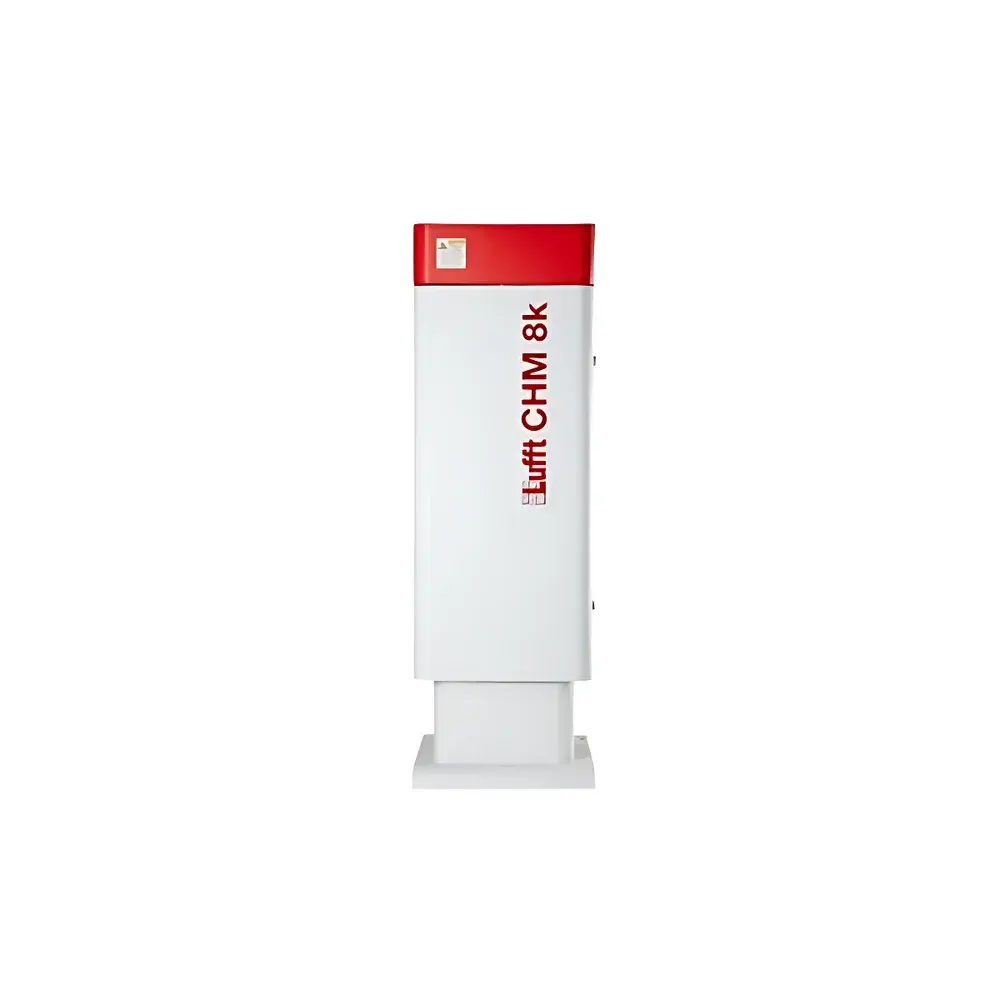
Lufft CHM8K Laser Ceilometer
| Brand | Lufft |
|---|---|
| Origin | Imported |
| Model | CHM8K |
| Laser Source | Laser Diode |
| Detector | Avalanche Photodiode (APD) |
| Operating Wavelength | 905 nm |
| Maximum Detection Height | 8 km |
| Pulse Repetition Frequency | 100 Hz |
| Data Output Formats | NetCDF, ASCII, BUFR |
| Communication Interfaces | Ethernet (TCP/IP), RS-485 |
| Environmental Operating Range | −40 °C to +60 °C (with integrated heating/cooling system) |
| Cloud Layer Detection Capacity | Up to 9 cloud layers + 2 aerosol layers |
| Signal Processing | Real-time enhanced wavelet transform algorithm |
Overview
The Lufft CHM8K Laser Ceilometer is a high-performance, eye-safe, single-laser-pulse backscatter lidar system engineered for continuous, unattended vertical profiling of the lower troposphere. Operating at a near-infrared wavelength of 905 nm, it emits short-duration laser pulses and measures time-resolved atmospheric backscatter signals to derive precise cloud base height (CBH), cloud layer structure, vertical visibility (VV), sky condition index (SCI), planetary boundary layer (PBL) height, and aerosol backscatter profiles. Its measurement principle relies on photon time-of-flight analysis: each pulse travels upward, interacts with atmospheric constituents (hydrometeors, aerosols, molecules), and generates backscattered radiation proportional to particle concentration and size distribution. The returned signal is captured by a high-sensitivity avalanche photodiode (APD) detector and processed via an embedded real-time enhanced wavelet algorithm—enabling robust discrimination between cloud layers, fog, precipitation, and aerosol plumes even under low signal-to-noise conditions.
Key Features
- Extended detection range up to 8 km altitude with high vertical resolution (5 m native sampling interval)
- Simultaneous detection of up to 9 distinct cloud layers and 2 aerosol layers per profile
- Integrated dual-chamber mechanical design with active heating and cooling subsystems for stable operation across −40 °C to +60 °C ambient conditions
- Real-time onboard processing using an optimized wavelet-based de-noising and layer identification algorithm
- Compliant with WMO CIMO Guide requirements for ceilometer classification (Class I)
- Eye-safe Class 1M laser emission per IEC 60825-1:2014 standards
- Redundant data output via Ethernet (TCP/IP, HTTP, FTP) and RS-485 serial interface
- Web-based configuration and status monitoring interface with secure HTTPS authentication
Sample Compatibility & Compliance
The CHM8K is designed for long-term deployment in diverse environmental regimes—including coastal, alpine, polar, and urban sites—without requiring routine optical recalibration. It meets international observational standards for automated weather stations and aviation meteorological systems. Data products comply with WMO BUFR templates (code table 3–11) and NetCDF-4 conventions aligned with CF Metadata Conventions v1.8. The instrument supports traceable calibration via built-in internal reference channel and optional external reference target protocols. Its operational firmware implements audit-trail logging and timestamp synchronization via NTP or GPS PPS input, satisfying GLP/GMP-aligned data integrity requirements for regulatory-grade environmental monitoring networks.
Software & Data Management
The CHM8K runs on a Linux-based embedded OS with deterministic real-time scheduling. Firmware includes native support for automatic FTP/SFTP upload of processed profiles (NetCDF, ASCII, BUFR), event-triggered alerts (e.g., CBH < 100 m), and configurable data retention policies. Optional Lufft METEON software provides centralized fleet management, quality control flagging (based on SNR thresholds and temporal consistency checks), and integration with EUMETCast, NOAA’s MADIS, or custom SCADA platforms. All data exports include full metadata: GPS position, instrument status flags, background noise levels, and raw waveform checksums—ensuring full reproducibility and FAIR (Findable, Accessible, Interoperable, Reusable) data principles.
Applications
- Meteorological observatories and national weather services for synoptic cloud climatology and PBL height trend analysis
- International and regional airports implementing ICAO Annex 3-compliant Automatic Weather Observing Systems (AWOS) and Automated Surface Observing Systems (ASOS)
- Atmospheric research programs studying aerosol-cloud interactions, fog formation dynamics, and boundary-layer evolution
- Environmental monitoring networks tracking industrial plume dispersion, volcanic ash transport, and wildfire smoke vertical distribution
- Maritime platforms and offshore wind farms requiring real-time ceiling and visibility assessment under marine boundary layer conditions
- Spaceport and launch range safety operations where vertical visibility and cloud ceiling constraints govern mission windows
FAQ
What is the minimum detectable cloud base height under typical fog conditions?
Under homogeneous fog with liquid water content ≥ 0.05 g/m³, the CHM8K reliably detects cloud base at heights ≥ 10 m above sensor level with >95% confidence over 1-minute averaging intervals.
Does the CHM8K support remote firmware updates and diagnostic telemetry?
Yes—via secure HTTPS or SFTP, with signed firmware packages and rollback capability; diagnostic logs include detector gain history, laser diode temperature drift, and pulse energy monitoring.
How does the system handle solar interference during daytime operation?
The optical receiver incorporates narrowband spectral filtering (±1 nm FWHM at 905 nm) and synchronized gated detection, reducing solar background noise to <1% of maximum signal amplitude during midday clear-sky conditions.
Is the instrument certified for use in regulated aviation environments?
Yes—the CHM8K holds EASA ED-137B and FAA AC 150/5220-22C compliance documentation and is listed in the WMO GAW Station Certification Database for Class I ceilometers.
Can raw photon count waveforms be accessed for custom post-processing?
Yes—raw analog-to-digital converter (ADC) waveforms are available via Ethernet binary streaming mode (16-bit resolution, 5 MHz sampling) with full timing metadata for advanced scattering inversion modeling.
Related Products







