
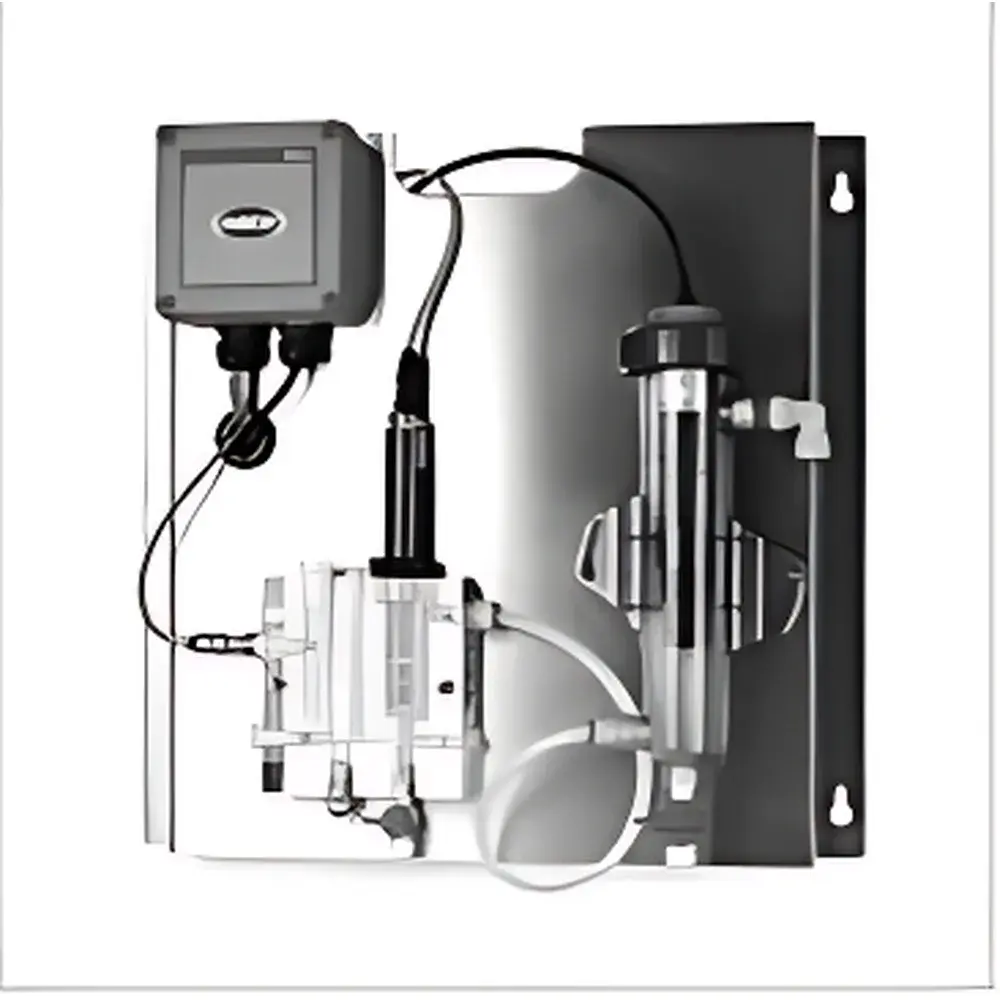
Hach CLF10sc and CLT10sc Amperometric Residual and Total Chlorine Analyzers
| Brand | Hach |
|---|---|
| Origin | Imported |
| Manufacturer Type | Manufacturer |
| Model | CLF10sc / CLT10sc |
| Instrument Type | Laboratory-Grade Analyzer |
| Measurement Principle | Amperometric (Three-Electrode Electrochemical Detection) |
| Measured Parameters | Free Chlorine, Total Chlorine |
| Measurement Range | 0–10 ppm |
| LOD | ≤30 ppb (0.030 ppm) |
| Resolution | 0.001 ppm (1 ppb) |
| Accuracy | ±3% for free chlorine |
| Repeatability | ±30 ppb or ±3%, whichever is greater |
| Operating Temperature | 0–45 °C (32–113 °F) |
| Compliance | EPA Method 334.0 |
Overview
The Hach CLF10sc and CLT10sc analyzers are laboratory-grade, reagent-free amperometric instruments engineered for precise, continuous measurement of free chlorine (CLF10sc) and total chlorine (CLT10sc) in potable water, process streams, and wastewater effluents. These analyzers operate on a three-electrode amperometric detection principle—comprising a working electrode, a reference electrode, and a counter (auxiliary) electrode—enabling stable, drift-resistant electrochemical quantification without chemical reagents or consumables. Unlike conventional two-electrode amperometric sensors, the tri-electrode architecture decouples potential control from current measurement, significantly enhancing long-term stability, electrode lifetime, and immunity to solution conductivity variations. Designed specifically for compliance with U.S. EPA Method 334.0, the system delivers trace-level sensitivity down to 30 ppb with sub-ppb resolution (0.001 ppm), making it suitable for regulatory monitoring, disinfection validation, and real-time process optimization across municipal, industrial, and power generation applications.
Key Features
- Reagent-free operation: Eliminates calibration drift caused by reagent degradation and removes hazardous waste streams associated with DPD-based colorimetric methods.
- Integrated self-diagnostic capability: Continuously monitors electrode health, membrane integrity, and electrolyte status—providing actionable fault alerts prior to measurement deviation.
- Digital compatibility: Native support for Hach SC1000, SC200, and other Hach digital controllers via 4–20 mA analog output and Modbus RTU over RS-485.
- Robust tri-electrode sensor design: Extends operational lifetime of both working and reference electrodes under variable pH (pH 4–9) and temperature (0–45 °C) conditions typical in distribution systems and cooling towers.
- Low-maintenance architecture: No moving parts, no pumps, no reagent dosing modules—reducing mean time between failures and minimizing lifecycle cost of ownership.
Sample Compatibility & Compliance
The CLF10sc and CLT10sc analyzers are validated for use with clarified, low-turbidity (<5 NTU) aqueous samples containing residual chlorine species in the form of hypochlorous acid (HOCl), hypochlorite ion (OCl⁻), and chloramines. They meet the performance criteria outlined in U.S. EPA Method 334.0 for amperometric determination of residual chlorine in drinking water. While not certified for GLP or 21 CFR Part 11 out-of-the-box, the instruments support audit-ready data logging when integrated with Hach’s DataStream™ software or third-party SCADA platforms compliant with IEC 62443-3-3 security requirements. Calibration verification protocols align with ASTM D1253 and ISO 7393-2 standards for chlorine measurement uncertainty assessment.
Software & Data Management
Data acquisition and instrument configuration are managed via Hach’s proprietary LinkComm™ PC software or through Hach’s cloud-enabled DataStream™ platform. The analyzers support timestamped, linearized output with configurable averaging intervals (1–60 seconds), automatic zero/slope calibration logging, and event-triggered data capture (e.g., upon alarm activation or manual calibration). All calibration records—including date, operator ID, standard concentration, measured response, and % recovery—are stored internally with non-volatile memory retention exceeding 10,000 entries. When deployed in regulated environments, optional firmware upgrades enable secure user authentication, electronic signature capture, and tamper-evident audit trails compatible with FDA 21 CFR Part 11 Annex 11 expectations.
Applications
- Drinking water distribution: Real-time monitoring of free chlorine residuals at entry points, storage reservoirs, and critical nodes to ensure CT compliance per EPA LT2ESWTR.
- Power plant boiler feedwater and cooling tower circuits: Detection of chlorination breakthrough and residual decay kinetics to prevent microbiologically influenced corrosion (MIC).
- Wastewater disinfection contact basins: Verification of total chlorine residual prior to discharge, supporting NPDES permit reporting and chlorine demand profiling.
- Pharmaceutical water systems (PW/WFI): Non-invasive, low-contamination-risk monitoring during sanitization cycles where oxidant carryover must be verified below 100 ppb.
- Food & beverage process lines: Inline verification of sanitizer efficacy during CIP rinse phases without introducing reagent interference or particulate residue.
FAQ
How does the three-electrode amperometric system improve measurement stability compared to two-electrode sensors?
The independent reference electrode maintains a fixed potential regardless of sample conductivity or polarization effects, while the auxiliary electrode handles current flow—preventing reference electrode contamination and enabling consistent applied voltage across the working electrode surface.
Can the CLF10sc and CLT10sc be used for total chlorine measurement in chloraminated systems?
Yes—the CLT10sc employs an integrated iodide-mediated electrochemical oxidation step to convert monochloramine, dichloramine, and nitrogen trichloride into measurable free chlorine equivalents, meeting EPA 334.0 specificity requirements for total residual oxidants.
Is routine membrane replacement required?
The gas-permeable PTFE membrane is designed for ≥6 months of continuous operation in clean, low-fouling water matrices; replacement frequency increases only under high-suspended-solid or organic-rich conditions.
What calibration standards are recommended for daily verification?
NIST-traceable chlorine standard solutions prepared from potassium permanganate-stabilized sodium hypochlorite (e.g., Hach Chlorine Standard Set, Cat. No. 2626300) are recommended for initial calibration and periodic verification.
Does the analyzer require temperature compensation?
Yes—integrated Pt1000 RTD provides automatic temperature compensation across the full operating range (0–45 °C), applying empirically derived correction factors to maintain accuracy within ±3% across thermal gradients.







