
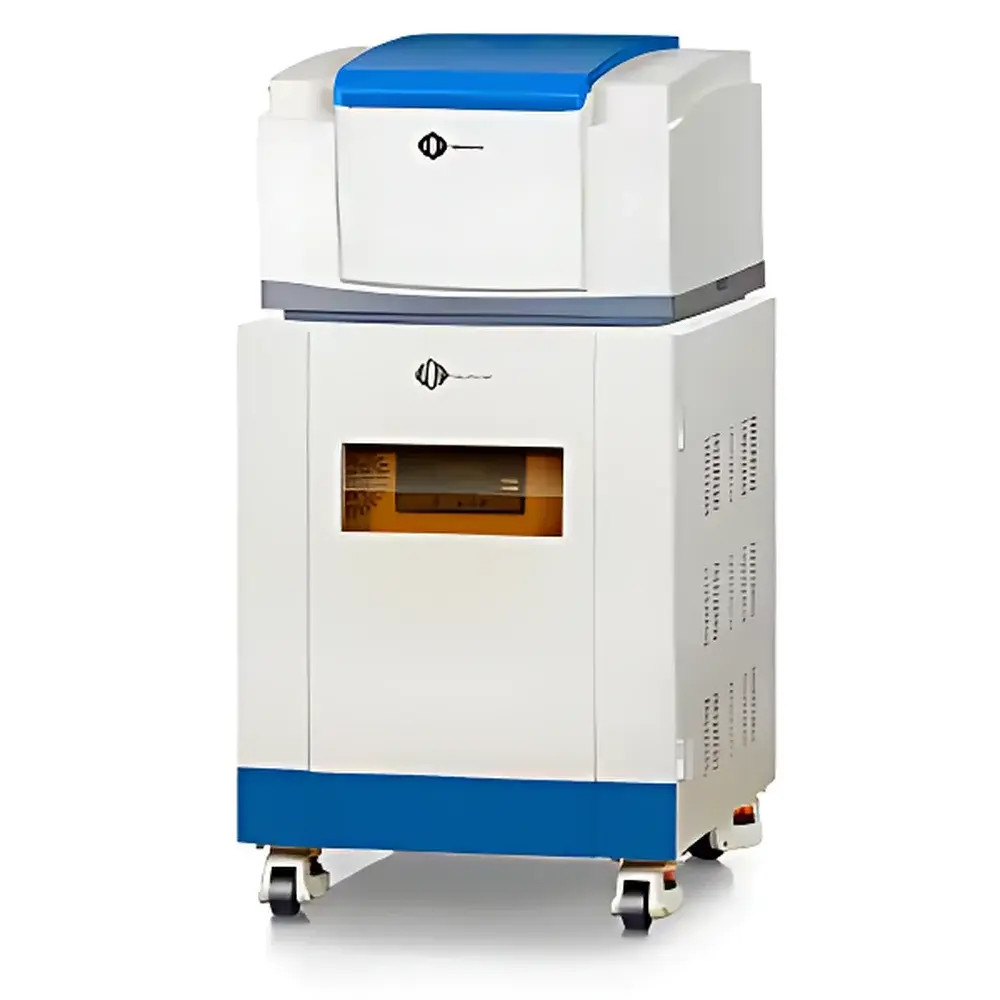
NIUMAG PQ001-NMR Low-Field Nuclear Magnetic Resonance Analyzer
| Brand | NIUMAG |
|---|---|
| Origin | Jiangsu, China |
| Manufacturer Type | Authorized Distributor |
| Instrument Type | Low-Field NMR Analyzer |
| Sample Compatibility | Solid-Liquid Dual-Phase Samples |
| Operating Frequency Range | 1–30 MHz |
| Detectable Nucleus | ¹H |
| Magnet Type | Permanent Magnet |
| Power Supply | 220 V, 50 Hz |
| Typical Measurement Time | 1–3 min per sample |
| Software | Integrated NMR Relaxometry Suite with Real-Time Display |
Overview
The NIUMAG PQ001-NMR is a benchtop low-field nuclear magnetic resonance (NMR) relaxometer engineered for rapid, non-destructive characterization of molecular dynamics and physical structure in heterogeneous materials. Unlike high-field superconducting NMR spectrometers used for structural elucidation, the PQ001-NMR operates on the principle of time-domain NMR (TD-NMR), measuring spin-lattice (T₁) and spin-spin (T₂) relaxation times of hydrogen nuclei (¹H) in bulk samples. Its permanent magnet architecture delivers stable, homogeneous fields in the 0.02–0.05 T range—corresponding to proton Larmor frequencies between 1 and 30 MHz—enabling robust quantification of mobility, porosity, phase distribution, and bound/free fluid ratios without sample preparation or ionizing radiation. Designed for routine industrial QC, R&D laboratories, and academic core facilities, the system prioritizes operational simplicity, measurement reproducibility, and integration into standardized workflows.
Key Features
- Compact permanent-magnet design with passive temperature stabilization, eliminating cryogen dependency and reducing total cost of ownership.
- Dedicated ¹H detection channel optimized for signal-to-noise ratio in low-field regimes; no shimming or tuning required prior to analysis.
- Pre-configured pulse sequences for T₁ inversion recovery and T₂ Carr–Purcell–Meiboom–Gill (CPMG) acquisition, compliant with ISO 17893:2016 for porous media characterization.
- Real-time data acquisition and visualization: raw FID decay curves and fitted relaxation distributions displayed synchronously during measurement.
- Modular hardware interface supporting optional accessories including variable-temperature probe units (−10 °C to +80 °C) and automated sample changers for unattended batch operation.
- Compliance-ready architecture: audit trail logging, user access levels, and electronic signature support align with GLP and FDA 21 CFR Part 11 requirements when deployed with validated software configurations.
Sample Compatibility & Compliance
The PQ001-NMR accommodates solid-liquid dual-phase samples—including polymers, pharmaceutical tablets, food matrices, rocks, soils, and battery electrolytes—in standard 10–25 mm OD glass or plastic tubes. No vacuum, dehydration, or conductive coating is required. Its non-invasive nature ensures sample integrity preservation across repeated measurements. The instrument conforms to IEC 61000-6-3 (EMC emission standards) and IEC 61010-1 (safety requirements for electrical equipment). Method validation documentation supports alignment with ASTM D8255–21 (Standard Guide for Low-Field NMR in Polymer Characterization) and USP Analytical Instrument Qualification frameworks.
Software & Data Management
The integrated NMR Studio software provides a unified environment for instrument control, sequence editing, spectral processing, and report generation. All operations—from parameter setup to exponential fitting (mono-, bi-, or multi-exponential models)—are executed via intuitive graphical interfaces. Raw time-domain data (.fid) and processed results (.csv, .xlsx) are stored with embedded metadata (operator ID, timestamp, instrument serial number, calibration status). Data export supports LIMS integration via ODBC drivers. Optional 21 CFR Part 11-compliant mode enables role-based permissions, electronic signatures, and immutable audit logs for regulated environments.
Applications
- Quantitative moisture mapping and water mobility profiling in cereals, dairy powders, and freeze-dried biologics.
- Pore-size distribution analysis in catalysts, cementitious materials, and shale rock cores using T₂ spectra inversion.
- Crystallinity assessment in semi-crystalline polymers via transverse relaxation heterogeneity.
- Oil content and solid fat content (SFC) determination in edible oils and margarines per AOAC Official Method 2006.05.
- Drug release kinetics monitoring in hydrogels and matrix tablets through real-time T₁/T₂ tracking during dissolution.
- Quality control of lithium-ion battery electrodes: binder distribution homogeneity and electrolyte wettability evaluation.
FAQ
What is the typical measurement repeatability for T₂ relaxation time under controlled conditions?
Under ISO 17893-recommended conditions (25 °C, 5× replicate scans, homogeneous liquid reference), coefficient of variation (CV) for T₂ is ≤1.2% for samples with T₂ > 1 ms.
Can the PQ001-NMR be used for quantitative analysis without external calibration standards?
Yes—absolute quantification of proton density is enabled by internal reference calibration using sealed doped water standards traceable to NIST SRM 3120a.
Is the system compatible with automated sample handling systems?
The PQ001-NMR features RS-232 and Ethernet interfaces for OEM integration; third-party autosamplers with TTL-triggered start/stop capability are supported via optional I/O module.
Does the software support custom pulse sequence development?
Advanced users may import custom CPMG or saturation recovery sequences in ASCII format; full pulse programming requires NIUMAG’s Developer License and firmware version ≥3.4.0.
How often does the permanent magnet require recalibration or field homogeneity verification?
Annual verification using built-in field mapping routines and reference phantoms is recommended; no active shimming or field adjustment is necessary under normal operating conditions.



