
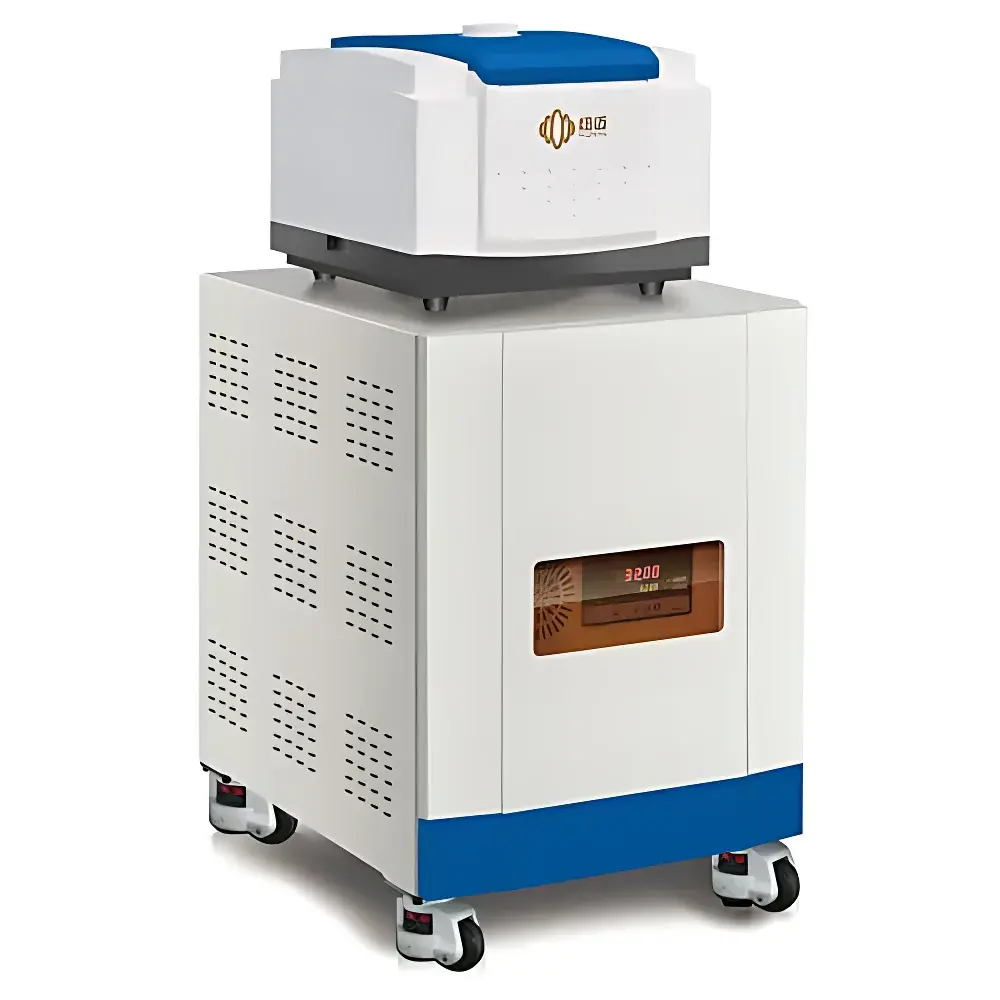
NIUMAG PQ001-f Benchtop Nuclear Magnetic Resonance (NMR) Oil Content Analyzer for Fibers
| Brand | NIUMAG |
|---|---|
| Origin | Shanghai, China |
| Manufacturer Type | Authorized Distributor |
| Country of Origin | China |
| Model | PQ001-f |
| Pricing | Available Upon Request |
| Magnet Type | Permanent Magnet |
| Static Magnetic Field Strength | 0.5 ± 0.08 T |
| Larmor Frequency | 21.3 MHz |
| Probe Coil Diameter | 25 mm |
| Effective Sample Volume | Ø25 mm × H25 mm |
| Detection Limit | 1 mg soybean oil |
| Max Sample Dimensions | Ø ≤ 25 mm, Height < 25 mm |
| Oil Content Measurement Range | 0.07–100 wt% |
| Linearity (R²) | > 0.999 |
| Repeatability (RSD) | < 6% |
| Compliant Standard | GB/T 6504–2008 |
Overview
The NIUMAG PQ001-f is a benchtop low-field nuclear magnetic resonance (NMR) analyzer engineered specifically for rapid, non-destructive quantification of oil content on synthetic and natural fibers in textile manufacturing and quality control laboratories. Based on the physical principle of proton spin relaxation—specifically the transverse relaxation time (T₂) decay of hydrogen nuclei in mobile oil phases—the PQ001-f exploits the differential relaxation behavior between oil-bound protons and those in solid fiber matrices. Unlike solvent extraction or gravimetric methods, this NMR-based approach eliminates chemical reagents, sample digestion, and operator-dependent handling, delivering results in under 90 seconds per measurement with no sample preparation beyond uniform packing into the cylindrical detection volume. The system operates at a fixed Larmor frequency of 21.3 MHz, corresponding to a static magnetic field strength of 0.5 ± 0.08 T generated by a temperature-stabilized permanent magnet assembly. Its compact footprint (≤ 450 × 350 × 300 mm) and air-cooled design enable seamless integration into QC labs, R&D workstations, and production-line near-line testing environments.
Key Features
- Non-invasive, non-destructive analysis requiring no solvents, drying, or calibration curves
- Dedicated hardware architecture optimized for fiber geometry: 25 mm diameter probe coil with homogeneous B₀ field over Ø25 mm × H25 mm active volume
- High signal-to-noise ratio (SNR) enabled by optimized RF pulse sequence timing and digital signal processing firmware
- Factory-calibrated against reference oil standards traceable to national metrology institutes; supports user-defined calibration using certified oil-spiked fiber blanks
- Robust mechanical design with vibration-damping base and thermal drift compensation algorithms ensuring long-term stability (±0.3% signal drift over 8-hour operation)
- Compliance-ready configuration options including audit trail logging, electronic signature support, and password-protected method locking
Sample Compatibility & Compliance
The PQ001-f accepts loose fibers, staple bundles, yarns, and non-woven swatches within the defined dimensional envelope (Ø ≤ 25 mm, height < 25 mm). Samples must be uniformly packed to minimize air gaps and ensure consistent filling factor—critical for quantitative accuracy. The instrument meets the technical requirements of GB/T 6504–2008 “Test Method for Oil Content of Chemical Fibers” and is routinely validated in textile mills accredited to ISO/IEC 17025. While not FDA- or EU-registered as a medical device, its data integrity framework aligns with principles outlined in FDA 21 CFR Part 11 for electronic records when configured with optional secure software modules. All measurements are traceable to SI units via primary NMR reference standards (e.g., doped water phantoms), supporting GLP-compliant documentation workflows.
Software & Data Management
The PQ001-f runs NIUMAG’s proprietary FiberOil v4.2 software, delivered with an English-language GUI optimized for routine operator use. The interface features three logically segregated panels: (1) measurement parameter configuration (pulse sequence selection, number of scans, receiver gain), (2) real-time FID acquisition visualization with baseline correction preview, and (3) post-processing result display showing oil content (% w/w), T₂ distribution histogram, and statistical summary (mean, SD, RSD). Raw FID data and processed spectra are exported in ASCII and CSV formats for external analysis. Software supports method templates, batch reporting, and configurable PDF certificate generation. Audit trail functionality logs all user actions—including parameter changes, calibration events, and result exports—with timestamps and operator IDs, satisfying internal QA and external accreditation requirements.
Applications
- Quality assurance of spun-dyed and melt-spun synthetic fibers (polyester, nylon, acrylic) during draw-texturing and false-twist processes
- Verification of lubricant application consistency in filament winding and weaving preparatory stages
- Research into oil migration kinetics under thermal aging or humidity cycling
- Development and validation of low-oil or silicone-free fiber treatments for eco-label compliance (e.g., OEKO-TEX® Standard 100)
- Root-cause analysis of weaving defects linked to insufficient or excessive oil coating
- Batch release testing in accordance with internal specifications aligned with AATCC TM116 and ISO 1833-11
FAQ
What sample preparation is required prior to measurement?
Minimal preparation: fibers must be homogeneously packed into the standard 25 mm diameter cylindrical sample tube without compression artifacts or voids. No drying, extraction, or weighing is necessary.
Can the PQ001-f differentiate between mineral oil and silicone-based lubricants?
No—standard T₂-based quantification reports total mobile hydrogen-bearing oil content without chemical speciation. For compositional differentiation, complementary techniques such as FTIR or GC-MS are recommended.
Is routine recalibration required?
Annual factory recalibration is recommended; however, daily system suitability checks using a supplied reference oil phantom ensure ongoing accuracy and precision.
Does the instrument require shielding or special facility infrastructure?
No magnetic shielding is needed due to the low-field permanent magnet design. Standard laboratory power (100–240 VAC, 50/60 Hz) and ambient temperature (15–30 °C) with <70% RH are sufficient.
How is data integrity ensured during multi-shift operations?
Role-based access control, electronic signatures for critical actions, and immutable audit trails meeting ALCOA+ principles are implemented via optional Secure Mode licensing.
Related Products







