
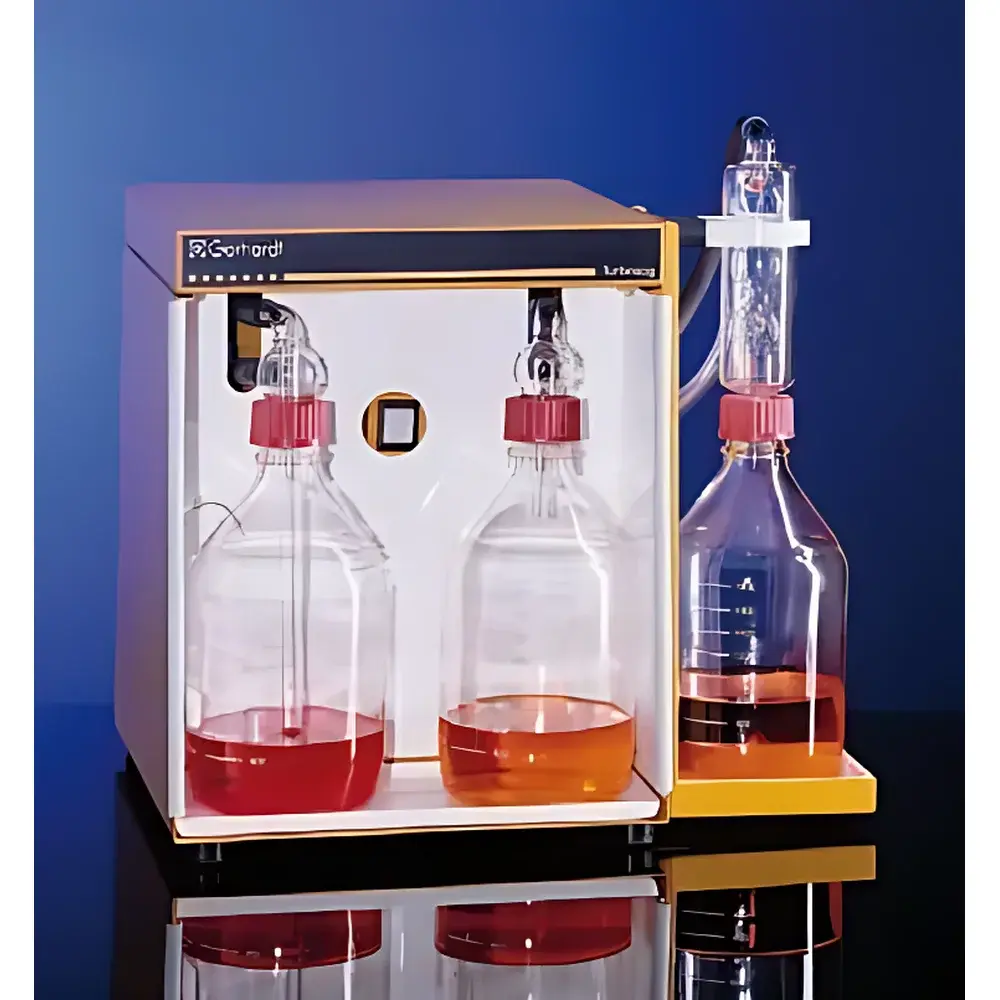
Turbosog TUR/K Exhaust Gas Scrubbing System by C. Gerhardt
| Brand | C. Gerhardt |
|---|---|
| Origin | Germany |
| Model | TUR/K |
| Voltage | 230 V AC |
| Frequency | 50–60 Hz |
| Power Consumption | 205 W |
| Weight | 19 kg |
| Dimensions (W × D × H) | 330 × 450 × 420 mm |
| Exhaust Gas Removal Efficiency | >90% |
| Maintenance Requirement | Minimal |
Overview
The Turbosog TUR/K Exhaust Gas Scrubbing System is a compact, benchtop laboratory scrubber engineered by C. Gerhardt (Germany) for safe and efficient removal of acidic, corrosive, or reactive gaseous byproducts generated during sample preparation—particularly in open-vessel wet digestion, Kjeldahl digestion, distillation, and acid reflux procedures. Operating on the principle of forced-air gas-liquid contact within a packed column, the system draws process off-gases through an aqueous alkaline scrubbing solution (e.g., NaOH or Na₂CO₃), where acid gases—including HCl, HNO₃, SO₂, HF, and NH₃—are neutralized via controlled chemical absorption. Its design prioritizes operator safety, regulatory compliance, and long-term operational stability in routine analytical laboratories performing AOAC, ISO 14851, EPA Method 300.0, and DIN EN ISO 11885-compliant workflows.
Key Features
- Robust stainless steel and chemically resistant polymer construction ensures durability against aggressive digestates and prolonged exposure to acidic vapors.
- Integrated centrifugal blower delivers consistent airflow without requiring external vacuum sources—eliminating dependency on central lab vacuum systems.
- Optimized scrubber column geometry and packing material promote high interfacial surface area and residence time, enabling >90% capture efficiency for common mineral acid fumes under standard operating conditions.
- Low-power consumption (205 W) and thermally stable operation allow unattended use during extended digestion cycles (up to 8 hours).
- Modular design facilitates rapid solution replacement and visual inspection of liquid level and packing integrity; no tools required for routine service access.
- Compact footprint (330 × 450 × 420 mm) enables seamless integration into fume hoods or dedicated digestion workstations without compromising workspace ergonomics.
Sample Compatibility & Compliance
The Turbosog TUR/K is compatible with a broad range of sample matrices processed via electric heating digestion—including soils, sediments, biological tissues, foodstuffs, polymers, and environmental sludges—when digested using HNO₃, HCl, H₂SO₄, HClO₄, or mixed-acid protocols. It meets essential safety and performance criteria outlined in DIN EN 14181 (ambient air quality—automated measuring systems), VDI 3871 (emission control in laboratories), and OSHA Laboratory Standard 29 CFR 1910.1450. While not a standalone analytical instrument, its integration supports GLP- and GMP-aligned sample prep environments by mitigating cross-contamination risks and ensuring traceable exhaust management. Documentation includes CE marking per Directive 2014/35/EU (Low Voltage Directive) and conformity to IEC 61000-6-3 (EMC emission limits).
Software & Data Management
The Turbosog TUR/K operates as a standalone hardware unit with no embedded microprocessor, firmware, or digital interface. All operational parameters—including airflow rate, scrubbing solution concentration, and replacement intervals—are defined and monitored manually per SOP. This analog architecture eliminates cybersecurity vulnerabilities, reduces validation burden in regulated settings, and aligns with FDA 21 CFR Part 11 requirements for non-electronic record systems. Users maintain logbooks documenting scrubber solution change dates, observed pressure drop across the column, and visual inspection outcomes—supporting audit readiness for ISO/IEC 17025 accreditation and internal QA/QC reviews.
Applications
- Neutralization of HCl and NOx vapors during microwave-assisted or hotplate-based open-vessel digestion of geological samples prior to ICP-OES or ICP-MS analysis.
- Controlled removal of NH3 during steam distillation steps in Kjeldahl nitrogen determination (ISO 5983, AOAC 984.13).
- Safe handling of HF-containing digestates in silicate matrix dissolution for subsequent fluoride-sensitive elemental assays.
- Supplemental gas abatement in tandem with automated block digesters (e.g., Gerhardt Vapodest series) to prevent hood saturation and extend filter life.
- Compliance support for laboratories undergoing EPA 1631 or ASTM D3222 method validation where documented fume control is mandatory.
FAQ
Does the Turbosog TUR/K require connection to a fume hood?
No—it functions independently as a closed-loop scrubber and does not rely on external ventilation infrastructure. However, it is recommended for installation inside a certified fume hood when processing highly toxic or volatile compounds beyond standard mineral acids.
What scrubbing solutions are recommended?
A 0.5–2.0 mol/L sodium hydroxide (NaOH) solution is standard for acid gas neutralization; sodium carbonate (Na₂CO₃) may be substituted for milder applications. Solution volume and concentration must be validated against expected gas load per digestion batch.
How often should the scrubbing solution be replaced?
Replacement frequency depends on digestion throughput and acid strength used. Under typical daily use (4–6 digestions), solution change is advised every 2–3 days or when pH falls below 10.0, as verified with calibrated pH strips or meter.
Is the unit suitable for HF digestion workflows?
Yes—provided the scrubbing solution contains calcium chloride or calcium hydroxide additives to precipitate fluorides, and all wetted parts (including pump seals and column packing) are confirmed compatible with hydrofluoric acid exposure per manufacturer specifications.
Can the Turbosog TUR/K be integrated with automated digestion platforms?
It is mechanically compatible with most Gerhardt and third-party digestion systems via flexible ducting (ID 32–40 mm). No electrical or data interface is required; synchronization is achieved via physical placement and timed operation protocols.



