
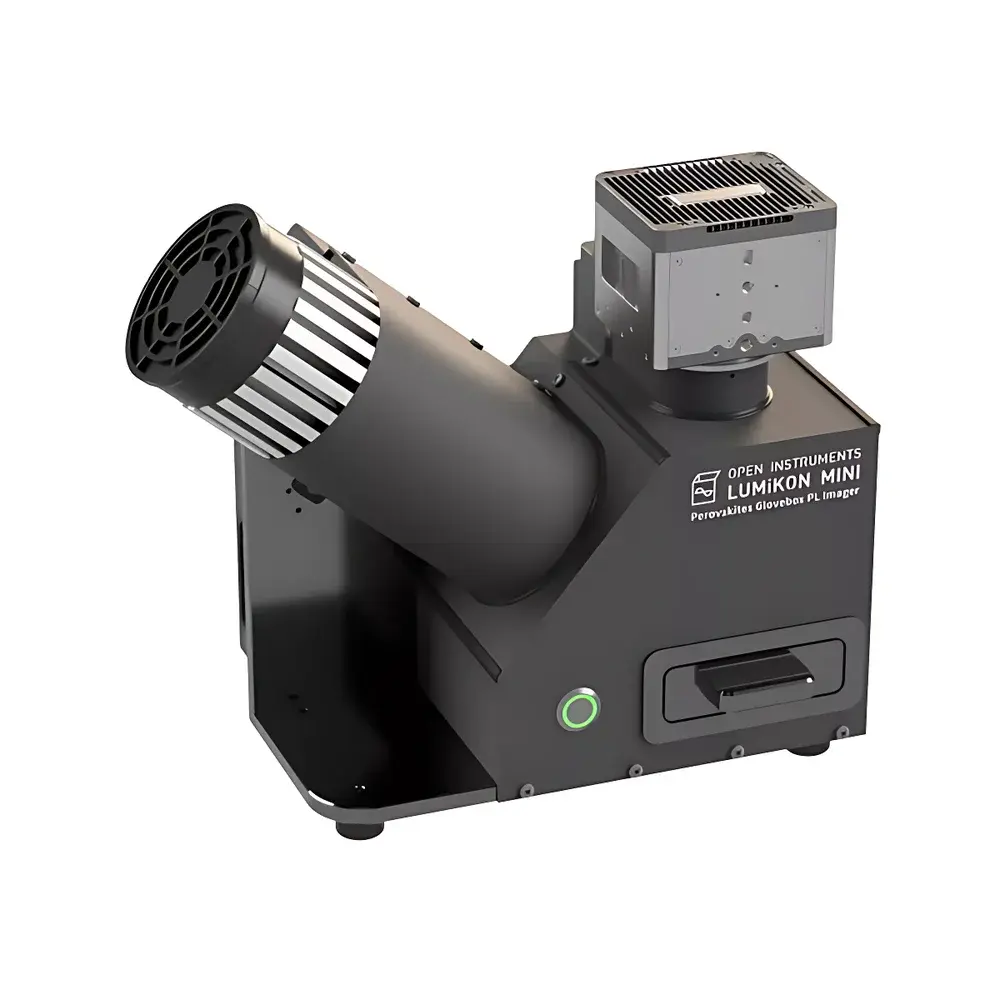
Open Instruments LUMiKON MINI Photoluminescence Imaging System for Perovskite and Tandem Solar Cells
| Brand | Open Instruments |
|---|---|
| Origin | Imported |
| Manufacturer Type | Authorized Distributor |
| Model | LUMiKON MINI |
| Trigger Mode | Steady-State |
| Dimensions (W×H×D) | 32.5 × 37 × 20.8 cm |
| Imaging Sensor | 26 MP monochrome scientific CMOS (upgradable to 61 MP) |
| Uniformity | >95% (±5% irradiance variation across FOV) |
| Illumination Range | 0.01–1.2 suns (AM1.5G-equivalent, calibrated broadband LED source) |
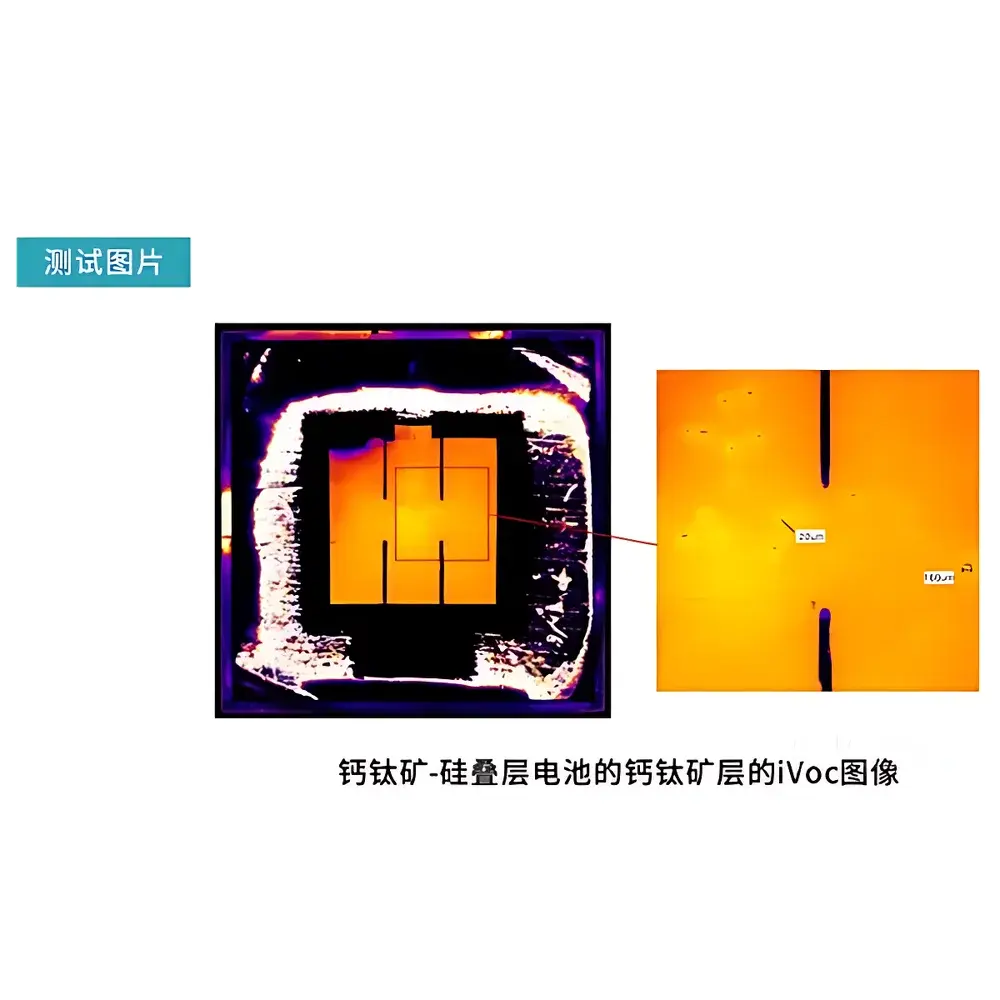
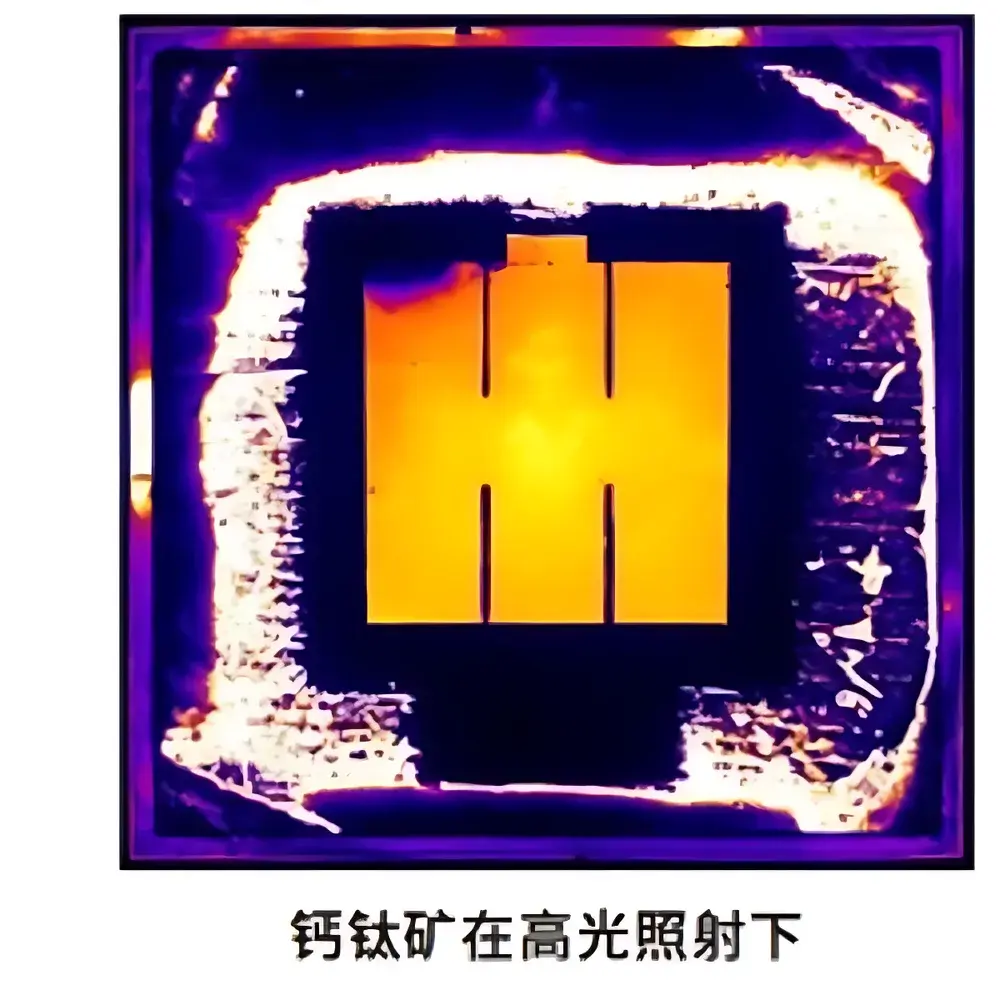
| Real-Time Outputs | Quantitative PL intensity, implied Voc (iVoc), implied Fill Factor (iFF), implied Maximum Power Point (iMPP) maps |
| Spectral Capability | Optional point-scanning mode for full PL spectra (bandgap & compositional mapping) |
| Environmental Integration | Glovebox-compatible (O₂ < 0.1 ppm, H₂O < 0.1 ppm), no sample transfer required |
Overview
The Open Instruments LUMiKON MINI is a compact, glovebox-integrated photoluminescence (PL) imaging system engineered specifically for quantitative, in-situ characterization of emerging photovoltaic materials—particularly perovskite single-junction and perovskite/silicon tandem solar cells. Operating on the fundamental principle of steady-state PL emission under calibrated optical excitation, the system captures spatially resolved luminescence signals directly correlated with local minority carrier lifetime, quasi-Fermi level splitting, and recombination activity. Unlike conventional benchtop PL setups requiring ambient-air transfer or vacuum handling, the LUMiKON MINI is designed for seamless integration into inert-atmosphere gloveboxes (O₂ < 0.1 ppm, H₂O < 0.1 ppm), eliminating photochemical degradation during measurement and enabling true process-parallel device evaluation. Its core architecture combines a high-dynamic-range, back-illuminated scientific CMOS sensor (26 MP standard, field-upgradeable to 61 MP) with an absolute radiometric calibration traceable to NIST-traceable standards, delivering pixel-level quantitative PL intensity values in photons·s⁻¹·cm⁻²·sr⁻¹. This enables direct derivation of spatially resolved implied open-circuit voltage (iVoc) maps via the thermodynamic relationship: iVoc = (kT/q)·ln(PL/PL₀ + 1), where PL₀ is the background-referenced dark count and kT/q is the thermal voltage.
Key Features
- Glovebox-native mechanical design (32.5 × 37 × 20.8 cm) with feedthrough-compatible electrical and optical interfaces for O₂/H₂O-sensitive operation
- Steady-state broadband LED excitation source (405–530 nm range), intensity continuously tunable from 0.01 to 1.2 suns (AM1.5G spectral weighting)
- Automated flat-field correction, vignetting compensation, and lens distortion correction applied in real time during acquisition
- On-the-fly computation of quantitative iVoc, iFF, and iMPP maps using embedded physics-based algorithms—no post-processing required
- Optical uniformity better than ±5% across full field-of-view, validated per ISO 9022-18 for illumination homogeneity
- Zero-sample-transfer workflow: eliminates exposure-induced degradation common in air-sensitive perovskites and low-dimensional absorbers
- Modular upgrade path to point-scanning spectroscopic mode for spatially resolved PL spectral acquisition (bandgap mapping, halide segregation analysis, phase distribution)
Sample Compatibility & Compliance
The LUMiKON MINI supports planar and textured substrates up to 15 × 15 cm, accommodating standard glass/ITO/ETL/perovskite/HTL/metal stacks, as well as monolithic and mechanically stacked perovskite/Si tandems. It complies with ISO/IEC 17025:2017 requirements for measurement uncertainty quantification in analytical instrumentation and meets ASTM E2848-22 criteria for spatially resolved photovoltaic performance mapping. All radiometric calibrations are performed using certified reference detectors traceable to NIST SRM 2271 and NPL PRM-101. The system’s data acquisition firmware adheres to GLP-compliant logging protocols—including timestamped metadata, operator ID, environmental sensor readouts (O₂, H₂O, T), and full audit trail of processing parameters—to support regulatory submissions under FDA 21 CFR Part 11 and ICH M10 guidelines.
Software & Data Management
Control and analysis are executed via LUMiKON Control Suite v3.x—a Python-based, cross-platform application supporting Windows, Linux, and macOS. The software implements deterministic image acquisition sequencing, automatic gain optimization per ROI, and export of TIFF-64 (floating-point) and HDF5 datasets compliant with FAIR data principles. Processed outputs include georeferenced iVoc heatmaps (mV), normalized PL quantum yield (QY) maps, and statistical summaries (mean, σ, min/max per sub-cell region). Raw and processed data are structured according to the PV-ML schema (Photovoltaic Metadata Language), enabling direct ingestion into institutional data lakes and machine learning pipelines for defect clustering, yield prediction, or process window optimization. Audit logs record all user actions, parameter changes, and calibration events with SHA-256 hashing for integrity verification.
Applications
- High-throughput screening of perovskite composition gradients (e.g., Br/I ratio, cation mixing) via bandgap-resolved PL mapping
- Spatial correlation of non-radiative recombination losses with grain boundaries, pinholes, or interfacial delamination in n-i-p and p-i-n architectures
- In-line monitoring of annealing, anti-solvent dripping, or vapor-assisted crystallization processes inside gloveboxes
- Quantitative comparison of passivation efficacy across ALD, SAM, and 2D capping layers
- Validation of tandem current-matching conditions by simultaneous PL imaging of perovskite top cell and Si bottom cell emission bands
- Correlative analysis with EL, LBIC, and TRPL datasets through shared coordinate registration and pixel-aligned overlay
FAQ
Can the LUMiKON MINI operate outside a glovebox?
Yes—though optimized for inert environments, it functions in ambient air with appropriate encapsulation; however, iVoc accuracy degrades for air-sensitive perovskites due to surface oxidation.
Is spectral resolution available in the base configuration?
No—the standard system provides broadband PL intensity and derived metrics; spectral mapping requires the optional point-scanning add-on module.
How is absolute PL intensity calibrated?
Using a NIST-traceable silicon photodiode (Hamamatsu S1337-66BR) mounted at the sample plane during factory calibration, with corrections for lens transmission, filter throughput, and sensor QE.
Does the system support batch acquisition across multiple samples?
Yes—via programmable stage control (optional motorized XY stage) and scriptable acquisition sequences in Python API.
What data formats are supported for export?
TIFF-64 (32-bit float), HDF5 (with metadata), CSV (summary statistics), and PNG (publication-ready overlays).





