
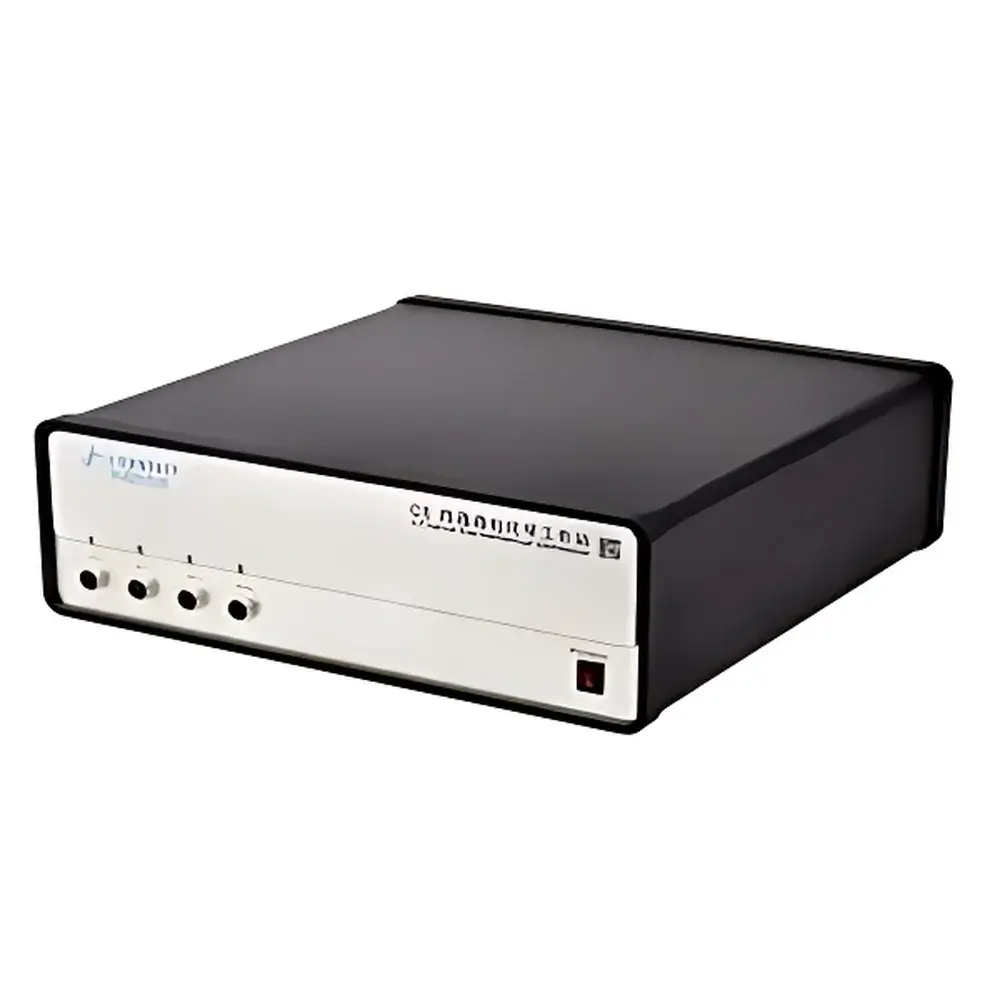
CorrTest CS300X Multi-Channel Electrochemical Workstation
| Brand | CorrTest |
|---|---|
| Origin | Hubei, China |
| Model | CS300X |
| Channel Count | 2–8 (configurable) |
| Current Range | ±500 mA (Ch. 1–3), ±200 mA (Ch. 4–8) |
| Current Accuracy | 0.1% of full-scale reading |
| Potential Accuracy | 0.1% of full-scale reading ±1 mV |
| Potentiostatic Range | ±10 V |
| EIS Frequency Range | 10 µHz to 1 MHz |
| Data Acquisition | 16-bit @ 1 MHz, 20-bit @ 1 kHz |
| Input Impedance (Reference) | 10¹² Ω |
| Output Compliance Voltage | ±21 V (expandable to ±200 V) |
| Communication Interface | USB 2.0 / Ethernet |
Overview
The CorrTest CS300X Multi-Channel Electrochemical Workstation is an engineered platform for high-fidelity, parallel electrochemical characterization across up to eight independent measurement channels. Built upon a modular potentiostat/galvanostat architecture, it implements true channel-isolation design—each channel operates with dedicated analog front-end circuitry, independent digital control, and synchronized timing logic. This ensures no crosstalk during concurrent experiments, enabling rigorous comparative studies under identical environmental conditions. The system supports core electrochemical techniques including potentiodynamic polarization, cyclic voltammetry (CV), chronoamperometry (CA), electrochemical impedance spectroscopy (EIS), and transient pulse methods—all executed simultaneously across selected channels. Its design adheres to fundamental principles of controlled-potential and controlled-current electrochemistry, where precision voltage/current sourcing, low-noise signal conditioning, and high-resolution data acquisition are essential for quantitative kinetic and thermodynamic analysis of electrode processes.
Key Features
- True parallel operation: Eight fully isolated channels, each capable of autonomous method execution without hardware or software interdependence.
- Flexible channel configuration: Standard configurations include CS3002 (2-channel), CS3004 (4-channel), CS3006 (6-channel), and CS3008 (8-channel); custom channel counts between 2 and 8 are available upon request.
- Selective EIS capability: Impedance functionality can be enabled on all channels or restricted to a single designated channel—reducing cost and complexity where broadband frequency response is required only for reference or calibration measurements.
- High dynamic range: Current measurement spans 2 nA to 200 mA (9 auto-ranging decades), with current sensitivity down to 1 pA and potential resolution of 3 µV (<10 Hz).
- Rapid response performance: Potential step rise time <1 µs (for loads <10 mA), supporting fast transient analysis such as double-layer charging kinetics and nucleation overpotential determination.
- Extended compliance and stability: ±21 V output compliance (optionally expandable to ±200 V), combined with 10¹² Ω reference input impedance, ensures accurate measurements in high-resistance systems (e.g., coated metals, solid-state electrolytes, or low-conductivity organic solvents).
Sample Compatibility & Compliance
The CS300X accommodates a broad spectrum of electrochemical cells—from standard three-electrode aqueous setups to non-aqueous battery half-cells, rotating disk electrodes (RDE), and dual-working-electrode configurations for zero-resistance ammetry (ZRA) or hydrogen permeation testing. It supports corrosion monitoring per ASTM G5, G102, G106, and ISO 17475; battery cycling per IEC 62660-1 and SAE J2464; and sensor characterization aligned with ISO 11352 and USP . All hardware and firmware comply with CE marking requirements for electromagnetic compatibility (EMC Directive 2014/30/EU) and low-voltage safety (LVD Directive 2014/35/EU). Software audit trails, electronic signatures, and method locking are implemented to support GLP and GMP environments compliant with FDA 21 CFR Part 11.
Software & Data Management
CS Studio—the native Windows-based application—provides unified control, real-time visualization, and post-experiment analysis. It features scriptable experiment sequencing via Python API integration, enabling automated multi-step protocols (e.g., OCP stabilization → LPR → EIS → CV sweep → CA decay). Raw data are stored in HDF5 format with embedded metadata (timestamp, instrument ID, method parameters, calibration history), ensuring FAIR (Findable, Accessible, Interoperable, Reusable) data principles. Export options include CSV, MATLAB (.mat), and Origin-compatible formats. Version-controlled method templates, user-level access permissions, and encrypted project archives facilitate collaborative lab workflows and regulatory documentation.
Applications
- Electrochemical energy materials: In situ/operando evaluation of Li-ion cathode degradation, solid-electrolyte interphase (SEI) formation kinetics, and redox shuttle behavior in flow batteries.
- Corrosion science: High-throughput screening of inhibitor efficiency using parallel LPR and EIS; localized corrosion assessment via electrochemical noise (EN) and galvanic coupling (ZRA) between dissimilar alloys.
- Electrosynthesis & electrodeposition: Quantitative Faradaic efficiency mapping during Cu/Ni/Zn plating; nucleation overpotential analysis in additive-free baths.
- Sensor development: Calibration-free detection limit estimation via DPV/NPV signal-to-noise optimization; stability profiling under continuous amperometric monitoring.
- Advanced functional interfaces: Mott-Schottky analysis of semiconductor photoelectrodes; capacitance-voltage profiling of conductive polymer films.
FAQ
Can the CS300X perform EIS on multiple channels simultaneously?
Yes—each channel equipped with EIS capability can acquire impedance spectra independently and concurrently, with frequency sweeps synchronized to within ±10 ns via internal clock distribution.
Is remote operation supported?
Yes—Ethernet interface enables secure LAN/WAN access via CS Studio’s client-server mode, including TLS-encrypted command transmission and role-based session management.
What electrode configurations does it support?
Standard three-electrode (WE/RE/CE), two-electrode (for symmetric devices), rotating ring-disk electrode (RRDE), and dual-working-electrode (ZRA/HDT) modes are natively supported.
Does it meet regulatory requirements for pharmaceutical electroanalysis?
CS Studio includes 21 CFR Part 11-compliant features: electronic signatures, audit trail logging, method validation reports, and password-protected configuration locks.
How is calibration traceability maintained?
Factory calibration uses NIST-traceable standards; users may perform on-site verification with external calibrators (e.g., AMETEK SI-100 series), and all calibration events are timestamped and archived within the HDF5 dataset.
Related Products




