
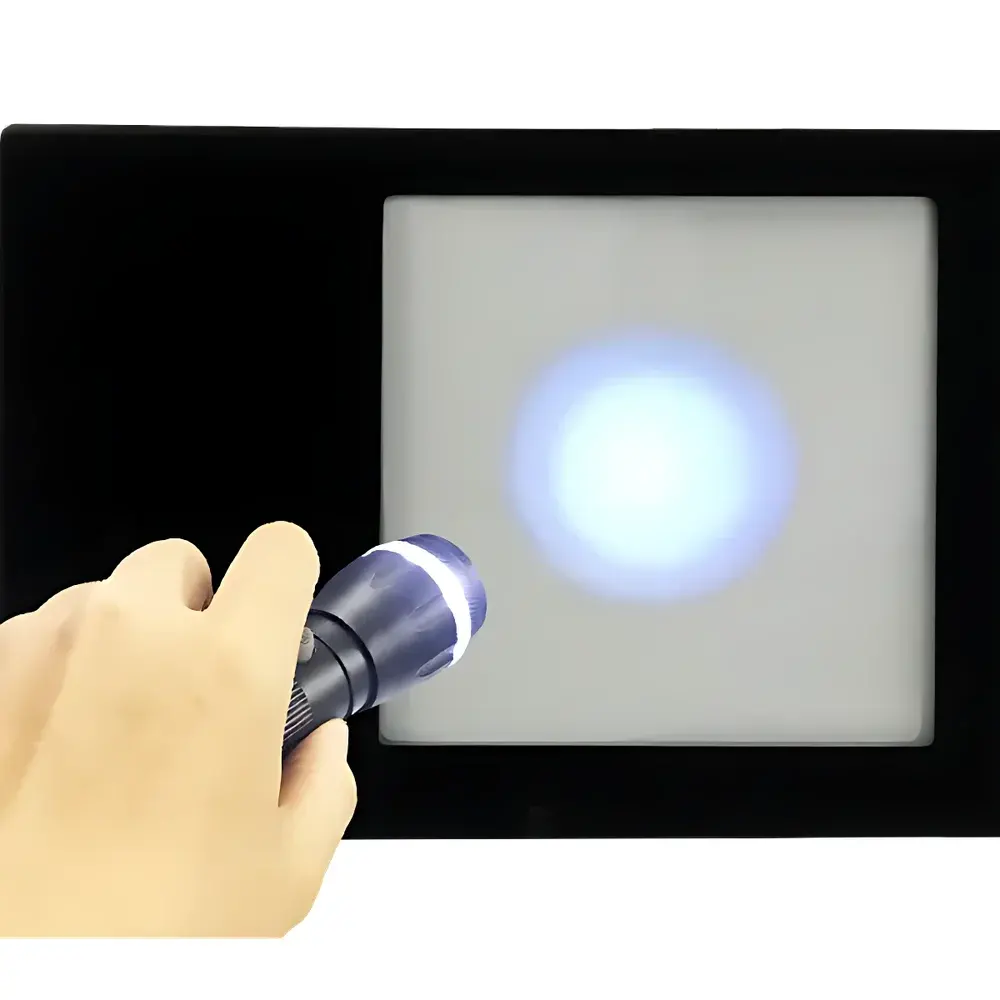
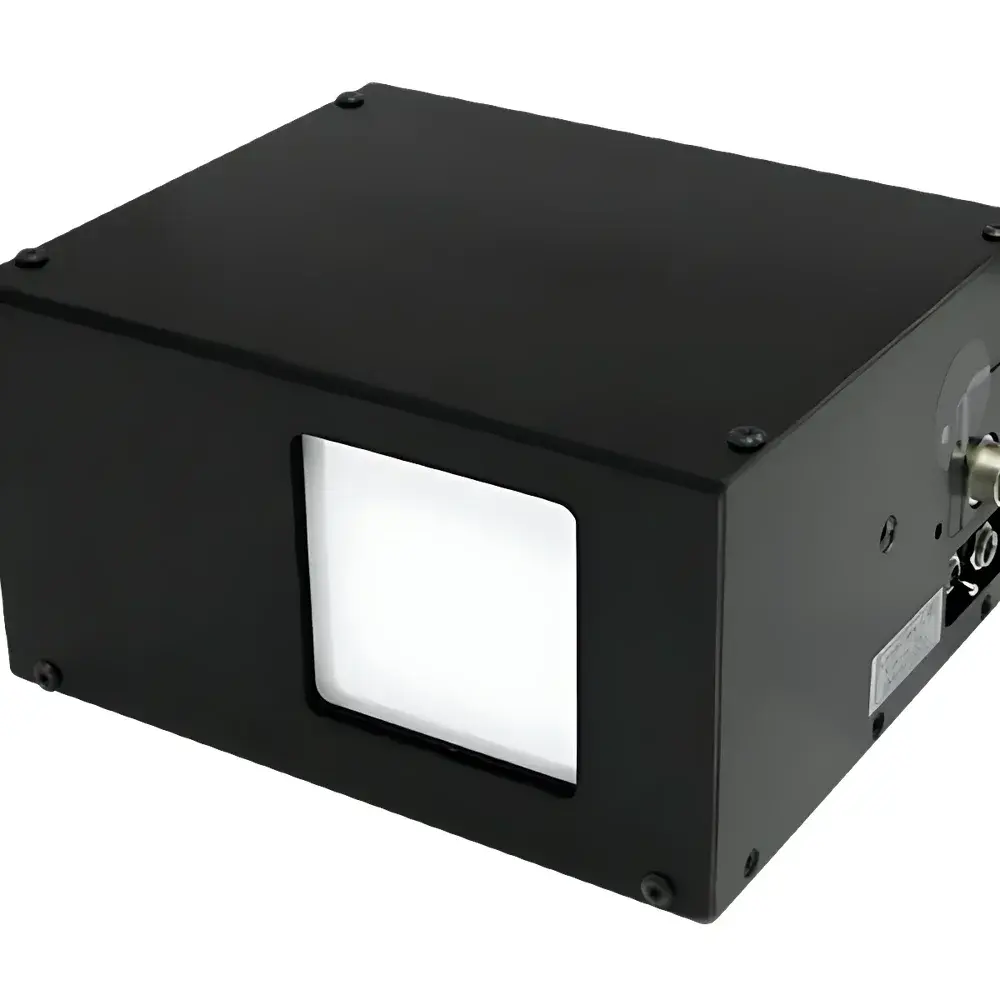
Kokyo Larger-area Beam Profiler – High-Resolution Laser Beam Analysis System
| Brand | Kokyo |
|---|---|
| Origin | Imported (Asia) |
| Model | Larger-area Beam Profiler |
| Wavelength Range | 190 nm – 16 µm |
| Beam Diameter Measurement Range | 2 µm – 800 mm |
| Irradiance Range | 0.001 W/m² – 100 kW/m² |
| Detector Type | Semiconductor-based imaging sensor array |
| Customization | Hardware and software configurable |
| Compliance | Designed for ISO 11146-1/2, ISO 13694, and ANSI Z136.1 alignment |
Overview
The Kokyo Larger-area Beam Profiler is a precision optical measurement instrument engineered for quantitative characterization of laser beam spatial intensity distribution, geometric parameters, and propagation dynamics. It operates on the principle of high-resolution, calibrated imaging detection—utilizing semiconductor-based sensor arrays optimized for broad spectral response (UV to mid-IR) and wide dynamic irradiance range. Unlike single-point or scanning slit methods, this system captures full 2D beam profiles in a single exposure, enabling accurate computation of fundamental beam metrics including D4σ, knife-edge, and 1/e² diameters; centroid position; ellipticity; beam asymmetry; and higher-order moments. Its design addresses critical challenges in modern photonics applications where beam quality directly governs process fidelity—such as laser material processing, free-space optical communications, lidar transmitter validation, and ultrafast amplifier diagnostics. The instrument is particularly suited for scenarios involving large-diameter, low-divergence, or high-power beams where conventional profilers suffer from saturation, clipping, or insufficient field-of-view.
Key Features
- Extended measurement range: Supports beam diameters from 2 µm (micro-focusing verification) up to 800 mm (collimated beam uniformity assessment), accommodating both fiber-coupled micro-beams and industrial-scale laser delivery systems.
- Broad spectral coverage: Calibrated sensitivity across 190 nm (deep UV excimer) to 16 µm (CO₂ and quantum cascade lasers), with optional interchangeable filter sets and sensor coatings for optimal quantum efficiency per wavelength band.
- High dynamic irradiance tolerance: Capable of direct measurement from 0.001 W/m² (low-power alignment beams) to 100 kW/m² (pulsed or CW high-energy industrial lasers), incorporating automatic neutral density attenuation and real-time gain adjustment.
- Modular multi-camera architecture: Enables synchronized spatial stitching for ultra-large beam analysis or multi-angle simultaneous profiling—ideal for M² measurement setups and lidar transmitter far-field mapping.
- Ruggedized mechanical design: Aluminum alloy housing with thermal stabilization features ensures dimensional stability under ambient temperature fluctuations (±0.5 °C drift compensation), minimizing measurement drift during extended acquisition sessions.
Sample Compatibility & Compliance
The profiler accommodates continuous-wave (CW), pulsed (nanosecond to femtosecond), and quasi-CW laser sources—including diode, solid-state, fiber, CO₂, and excimer systems. It supports both free-space and fiber-delivered beams via optional beam expansion/reduction optics and fiber coupling adapters. All optical components meet RoHS and REACH directives. Software output complies with ISO 11146-1 (determination of beam widths, divergence, and M²) and ISO 13694 (laser beam power density measurement). Audit trails, user access control, and electronic signature support align with GLP/GMP documentation requirements and FDA 21 CFR Part 11 readiness when deployed in regulated manufacturing or R&D environments.
Software & Data Management
The included BeamStudio™ software provides real-time visualization, automated parameter extraction, and standardized reporting templates. It supports time-resolved beam monitoring (frame rates up to 120 Hz for CMOS variants), image sequence storage with metadata tagging (wavelength, exposure, ND filter status), and export to CSV, HDF5, or TIFF formats for third-party analysis (e.g., MATLAB, Python SciPy). Multi-camera synchronization is managed through hardware-triggered acquisition and geometric calibration routines. Software updates are delivered via secure HTTPS portal; version history and change logs are maintained for traceability. Optional API integration (C/C++, .NET, Python SDK) enables embedded control within custom automation workflows or PLC-driven test benches.
Applications
- Laser resonator optimization and cavity alignment verification
- M² factor determination per ISO 11146 for QC/QA of OEM laser modules
- Far-field pattern analysis of automotive and aerospace lidar transmitters
- Beam homogeneity assessment in UV lithography illumination systems
- Thermal lensing and mode instability monitoring in high-power fiber amplifiers
- LED and VCSEL array near-field/far-field characterization for AR/VR displays
- Calibration reference for ISO-compliant laser safety measurements (ANSI Z136.1)
FAQ
Does the system require external beam attenuation for high-power lasers?
Yes—integrated motorized ND filter wheels are available as an option; manual ND filters compliant with ISO 11551 are recommended for peak powers exceeding 10 kW/cm².
Can it measure ultrashort pulses (e.g., <100 fs)?
It captures integrated spatial profile per pulse; temporal pulse shape requires complementary autocorrelation or FROG instrumentation.
Is calibration traceable to NIST or other national standards?
Factory calibration includes traceable spatial scale verification using certified Ronchi rulings and irradiance calibration against NIST-traceable thermopile sensors.
What operating systems are supported?
Windows 10/11 (64-bit), with Linux drivers available upon request for embedded deployment.
How is beam pointing stability quantified?
Sub-pixel centroid tracking over user-defined time windows (1 ms to hours), with statistical reporting of RMS jitter, drift rate, and Allan deviation.




