
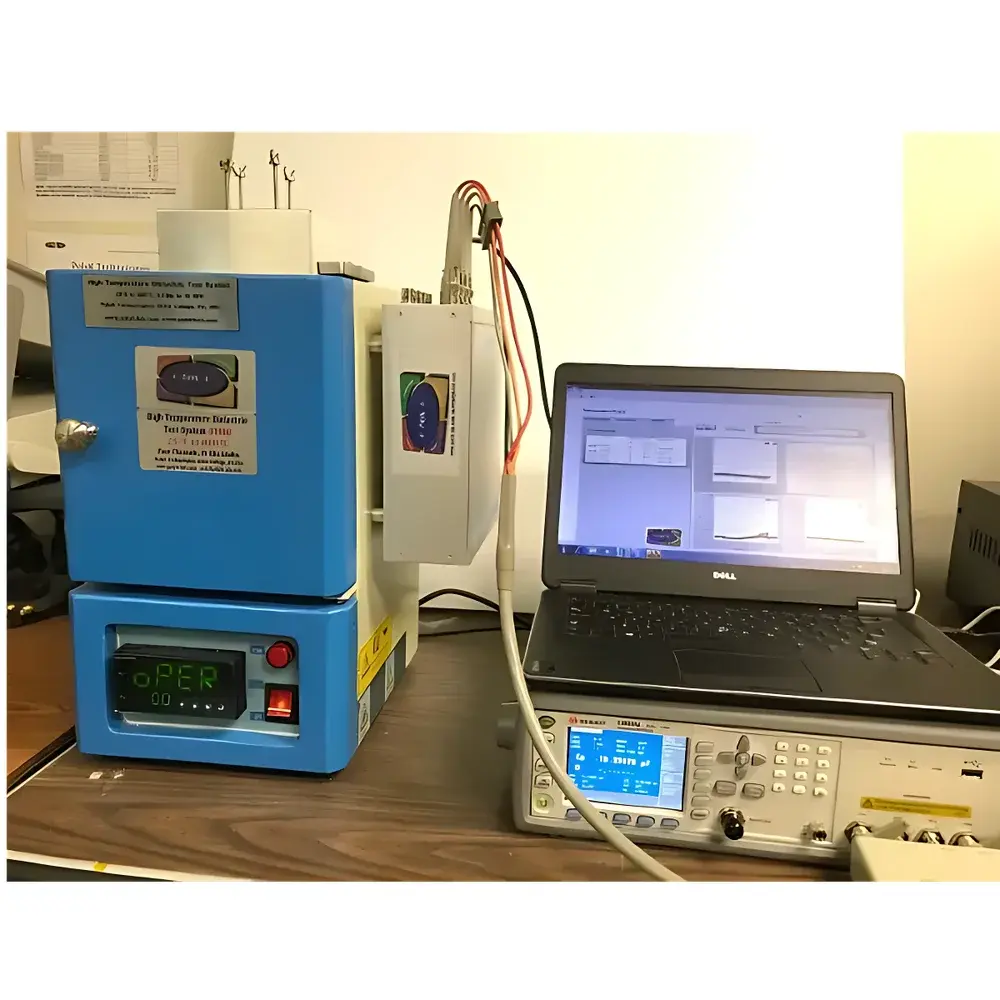
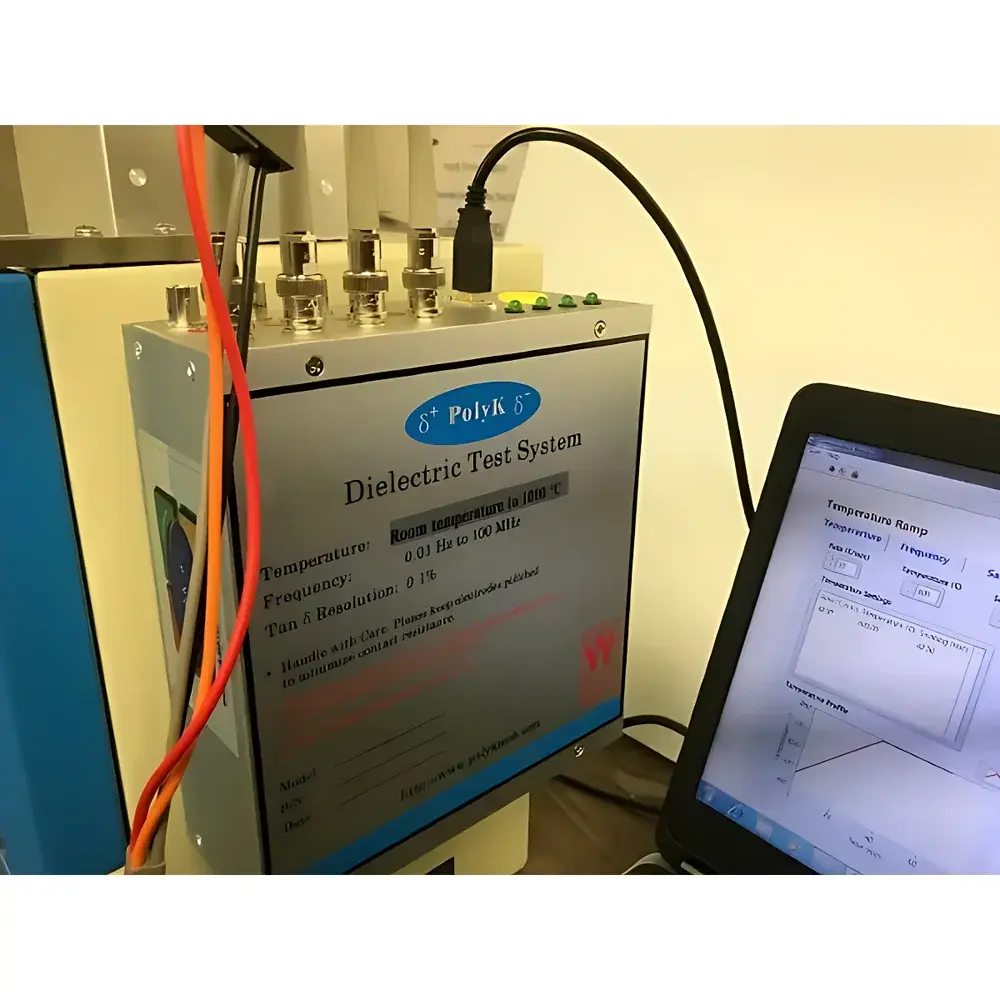
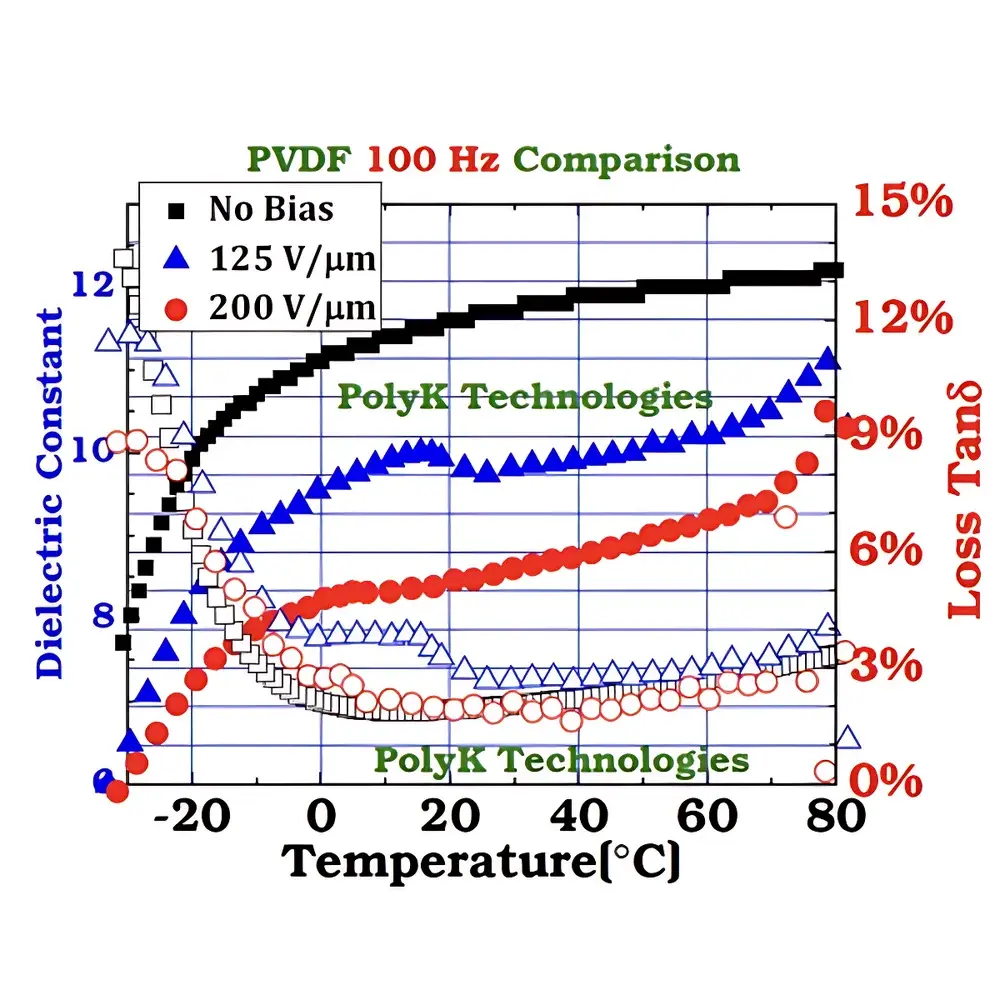
PolyK PK-HT800 High-Temperature Dielectric Characterization System
| Brand | PolyK Technologies |
|---|---|
| Origin | USA |
| Model | PK-HT800 |
| Temperature Range | RT to 800 °C (up to 1000 °C optional) |
| Frequency Range | 20 Hz to 1 MHz (4-terminal shielded) |
| Dielectric Loss Tangent Sensitivity | < 0.1% |
| Sample Capacity | Up to 4 samples per thermal cycle |
| DC Bias Voltage | Up to 4000 V (optional) |
| Includes | High-temperature furnace, ceramic-insulated 4TP test fixture with spring-loaded Pt probes, Agilent/Keysight LCR meter interface (4284A, E4980AL, 4294A compatible), dedicated control software, and thermally rated cabling |
Overview
The PolyK PK-HT800 High-Temperature Dielectric Characterization System is an engineered platform for precision measurement of complex permittivity (ε′, ε″), loss tangent (tan δ), capacitance (C), and impedance (Z) of dielectric, ferroelectric, and piezoelectric materials under controlled thermal and electrical conditions. It operates on the principle of AC impedance spectroscopy coupled with programmable thermal ramping, enabling quantitative analysis of temperature- and frequency-dependent dielectric response—critical for material development in solid-state electrolytes, high-k ceramics, polymer composites, and thin-film capacitor dielectrics. The system integrates a calibrated high-temperature furnace, a low-noise 4-terminal-pair (4TP) shielded sample holder with spring-loaded platinum electrodes, and industry-standard LCR instrumentation (e.g., Keysight E4980AL or legacy Agilent 4284A), all synchronized via deterministic real-time control software.
Key Features
- Thermal operation from ambient to 800 °C (with extended configuration supporting up to 1000 °C for short-duration characterization)
- Spring-loaded, pressure-adjustable platinum probe electrodes—designed to maintain consistent contact force on soft polymer films or brittle ceramic wafers without mechanical damage
- Ceramic-insulated, fully shielded 4TP test fixture with integrated grounding plane and low-thermal-drift geometry, minimizing stray capacitance and electromagnetic interference above 200 °C
- Automated multi-sample sequencing: up to four pre-mounted specimens can be measured sequentially within a single temperature ramp, reducing thermal cycling overhead and improving inter-sample comparability
- DC bias capability up to 4000 V (custom-configurable), enabling leakage current, breakdown field, and polarization hysteresis (P–E loop) measurements under elevated temperature
- Full compatibility with third-party LCR meters including Keysight E4980AL, E4980A, 4294A, and 4284A—ensuring traceable calibration paths aligned with NIST-maintained impedance standards
Sample Compatibility & Compliance
The PK-HT800 accommodates disk-shaped, pelletized, or thin-film specimens (diameter: 6–25 mm; thickness: 0.1–3 mm), including sintered oxides (e.g., BaTiO₃, Al₂O₃), polymer electrolytes (PEO-LiTFSI), glass-ceramics, and multilayer ceramic capacitors (MLCCs). Electrode configuration supports both parallel-plate and interdigitated geometries via interchangeable fixtures. All hardware components meet UL 61010-1 and IEC 61000-4 electromagnetic compatibility requirements. Thermal control adheres to ASTM E1142 (Standard Practice for Calibration of Temperature Measurement Systems for Materials Testing) and supports GLP-compliant audit trails when operated with validated software versions. Data acquisition logs include timestamped temperature, frequency sweep index, instrument ID, operator tag, and environmental chamber status—facilitating 21 CFR Part 11 readiness upon customer-defined electronic signature implementation.
Software & Data Management
The bundled Windows-based control suite provides graphical setup of multi-step thermal profiles (ramp/soak/cool), frequency sweeps (logarithmic or linear), and bias voltage sequences. Real-time plotting displays ε′(f,T), tan δ(f,T), and Z*(f,T) with overlay support for comparative datasets. Raw data exports to CSV, MATLAB (.mat), and HDF5 formats; metadata embedding follows ISA-Tab conventions for reproducible materials informatics workflows. Software architecture supports remote monitoring via secure TCP/IP connection and integrates with laboratory information management systems (LIMS) through configurable REST API endpoints. Firmware updates and calibration certificate tracking are managed via embedded device registry compliant with ISO/IEC 17025 documentation practices.
Applications
- Development and qualification of high-temperature capacitor dielectrics for aerospace power electronics
- Structure–property correlation of relaxor ferroelectrics across Curie transitions
- Ion-conduction mechanism analysis in solid polymer electrolytes for solid-state batteries
- Thermal aging studies of encapsulation materials in photovoltaic modules
- Quality control of MLCC base metal electrode (BME) stacks during manufacturing process validation
- Dielectric relaxation mapping of glass transition dynamics in amorphous polymers
FAQ
What LCR meters are natively supported by the PK-HT800 system?
The system is validated with Keysight E4980AL, E4980A, 4294A, and Agilent 4284A LCR meters. Custom drivers are available for other IEEE-488 or USB-TMC compliant instruments upon request.
Is vacuum or controlled-atmosphere operation possible?
Yes—the furnace chamber accepts optional quartz tube inserts with flanged gas inlets/outlets, enabling inert (N₂, Ar), reducing (H₂/N₂), or oxidizing (O₂) atmospheres up to 1 bar absolute pressure.
How is thermal uniformity verified across the sample zone?
Each PK-HT800 unit undergoes factory thermal mapping using calibrated Pt100 sensors at nine spatial points; uniformity is certified to ±2 °C over a 10 mm diameter central zone at 800 °C.
Can the system perform simultaneous impedance and modulus spectroscopy?
Yes—raw complex impedance (Z*, Y*) data are acquired directly; software computes M* = 1/(jωC₀Z*), ε*, σ*, and other derived functions post-measurement without loss of resolution.
What level of technical support and calibration services does PolyK provide?
PolyK offers annual on-site verification, NIST-traceable temperature and impedance calibration, and application-specific method development support under service contracts aligned with ISO/IEC 17025 technical competence requirements.



