
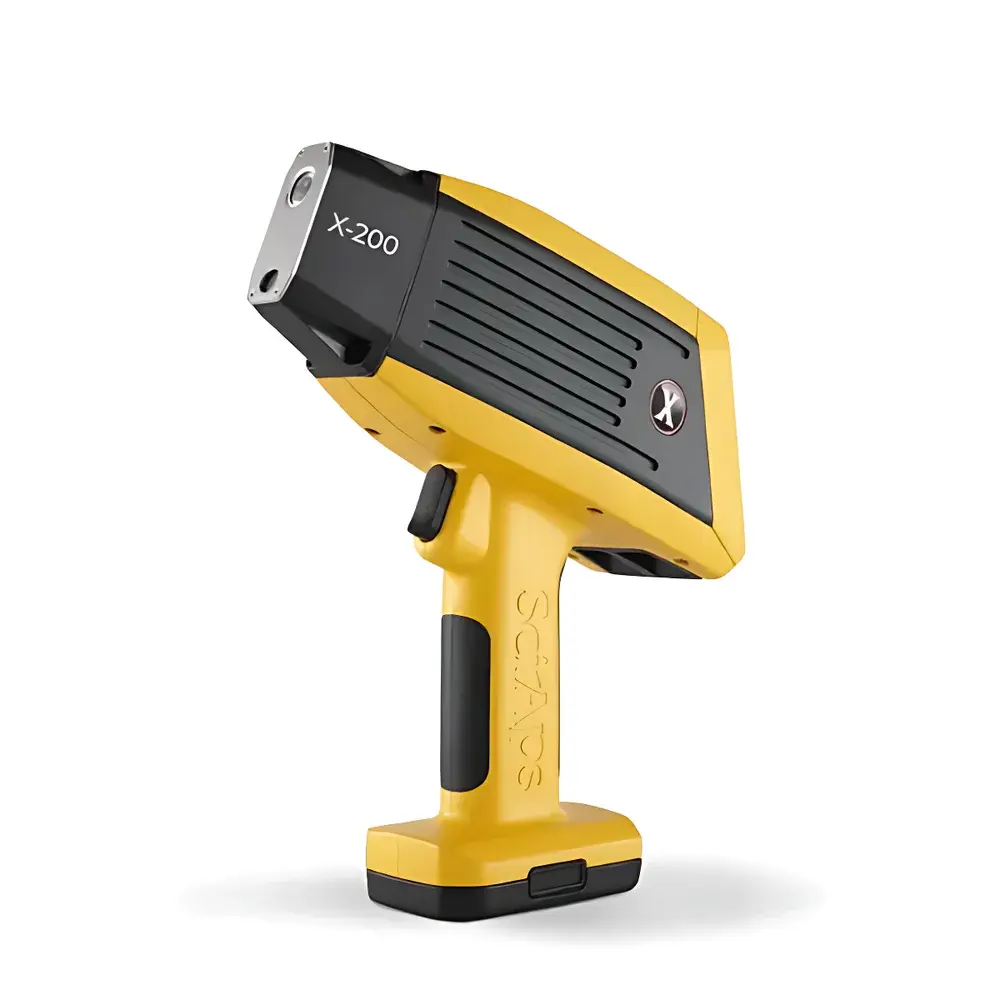
SciAps X-200 Portable Energy Dispersive X-Ray Fluorescence (ED-XRF) Spectrometer
| Brand | SciAps |
|---|---|
| Origin | USA |
| Model | X-200 |
| Application | Handheld/Portable |
| Element Range | Pb, Hg, Cd, Br, Cr |
| Detector | 20 mm² Silicon Drift Detector (SDD), 135 eV FWHM resolution at 5.95 keV Mn Kα line |
| Excitation Source | Rh anode (6–40 kV, 200 µA) for alloy analysis |
| Weight | 1.5 kg (3.3 lbs) with battery |
| Display | 5-inch color capacitive touchscreen |
| Operating Temperature | −4 °C to +54 °C (25 °F to 130 °F) at 10% duty cycle |
| Certifications | CE, RoHS, US FDA Registered, Canada RED Act compliant |
Overview
The SciAps X-200 is a field-deployable, handheld energy dispersive X-ray fluorescence (ED-XRF) spectrometer engineered for rapid, non-destructive elemental analysis across industrial, regulatory, and geological domains. Based on fundamental XRF physics—where primary X-rays from a micro-focus tube excite characteristic secondary (fluorescent) X-rays from sample atoms—the instrument quantifies elemental composition by measuring the energy and intensity of emitted photons. Its high-resolution silicon drift detector (SDD), with 135 eV full width at half maximum (FWHM) at the Mn Kα line (5.95 keV), enables precise peak separation for overlapping transitions in complex matrices. The dual-anode X-ray source (Rh for metals, Au for soils/environmental samples) allows optimized excitation across low- and mid-Z elements, supporting compliance-driven screening (e.g., RoHS) and exploratory geochemical profiling with equal fidelity.
Key Features
- High-performance SDD detector: 20 mm² active area, 135 eV FWHM resolution at 5.95 keV, enabling robust detection of trace-level regulated elements (Pb, Hg, Cd, Br, Cr) down to low ppm ranges in solid matrices.
- Dual-target excitation system: Rh anode (6–40 kV, 200 µA) calibrated for alloy identification (stainless steels, Al-series 2000/7000/MLC, Cu-based red metals); Au anode (6–50 kV, 200 µA) optimized for soil, sediment, and ore analysis.
- Integrated 6-position filter wheel: Dynamically selects optimal beam filtration to enhance signal-to-background ratio for specific element groups (e.g., light elements < Na, transition metals, or halogens).
- Real-time spectral processing: FPGA-based digital pulse processor with 14 MSPS sampling rate, 80-bit ADC, and 8K-channel MCA; supports adaptive peak deconvolution and background subtraction during acquisition.
- Ruggedized field architecture: IP54-rated enclosure, stainless-steel shutter for automated energy-scale validation and calibration checks, and thermal management validated for continuous operation at 10% duty cycle across −4 °C to +54 °C.
- Onboard computing platform: ARM Cortex-A9 dual-core 1.2 GHz processor, 1 GB DDR2 RAM, 1 GB NAND flash, and 8 GB removable microSD storage for secure, offline data capture and report generation.
Sample Compatibility & Compliance
The X-200 accommodates heterogeneous solid samples—including metal alloys, mining core fragments, contaminated soils, electronic components, and polymer composites—without requiring pelletization or vacuum environments. Its measurement protocol adheres to ASTM E1621 (Standard Guide for XRF Analysis of Metals), ISO 21043 (XRF for RoHS screening), and EPA Method 6200 (field portable XRF for soil lead). For regulated environments, firmware supports audit-ready logging (user ID, timestamp, GPS coordinates, spectrum metadata) and optional password-protected administrator mode aligned with GLP/GMP documentation requirements. CE marking, US FDA registration, and Canadian Radio Equipment Declaration (RED) confirm conformance with electromagnetic compatibility, safety, and radiological performance standards.
Software & Data Management
Data acquisition and reporting are managed via SciAps’ proprietary Android-based OS, featuring intuitive touchscreen navigation and context-aware measurement workflows. Real-time spectra visualization includes overlay comparison, peak identification, and limit-checking against user-defined thresholds (e.g., RoHS 1000 ppm for Pb/Cd/Hg, 900 ppm for Cr⁶⁺ surrogates). Export options include CSV, PDF reports (with embedded spectra and calibration logs), and direct synchronization to SciAps Profile Builder PC software for advanced multivariate calibration development (fundamental parameters, Compton normalization, empirical models). Bluetooth 4.2, Wi-Fi 802.11 b/g/n, and USB 2.0 interfaces enable seamless integration into laboratory information management systems (LIMS) and enterprise QA/QC databases.
Applications
- Regulatory Compliance Screening: Rapid pass/fail assessment of RoHS, WEEE, and halogen-free (IEC 61249-2-21) materials in electronics manufacturing and recycling streams.
- Metal Alloy Identification: Discrimination of stainless grades (304 vs. 316), aluminum series (2xxx, 7xxx), and copper alloys based on multi-element fingerprinting with <2 s measurement time.
- Geochemical Exploration: In-situ soil and rock analysis for pathfinder elements (e.g., As, Cu, Zn, Ni) in mineral prospecting, with optional Compton-normalized calibrations for variable moisture and grain-size effects.
- Environmental Site Assessment: Field quantification of heavy metals (Pb, Cr, Cd) in contaminated soils per EPA Tier 1 screening protocols, with built-in uncertainty estimation and matrix-matched reference checks.
- Scrap Metal Sorting: Real-time segregation of ferrous/non-ferrous fractions and identification of high-value alloys (Inconel, Monel, titanium grades) in recycling facilities.
FAQ
Does the X-200 require external calibration standards for routine use?
No—internal shutter-based energy scale verification and factory-installed fundamental parameter (FP) calibrations enable daily operation without physical standards. Optional empirical calibrations (e.g., for site-specific soils) can be deployed via Profile Builder.
Is the instrument suitable for analyzing light elements such as Mg, Al, or Si?
Yes, when using the Au anode and optimized filtration; detection limits for Mg and Al are achievable in low-absorption matrices (e.g., thin films or fused beads), though performance depends on surface condition and instrument geometry.
How is data security maintained during field deployment?
User-level password protection, encrypted SD card storage, and configurable audit trails (including operator ID, GPS stamp, and spectrum hash) support ISO/IEC 17025 and FDA 21 CFR Part 11 readiness.
Can the X-200 operate while charging?
Yes—hot-swappable lithium-ion battery design permits uninterrupted operation during AC adapter connection, with up to 60 seconds of safe hot-plug window.
What maintenance is required for long-term reliability?
Annual detector vacuum integrity check and source output verification are recommended; no consumables or user-serviceable optics are required under normal field use conditions.



