
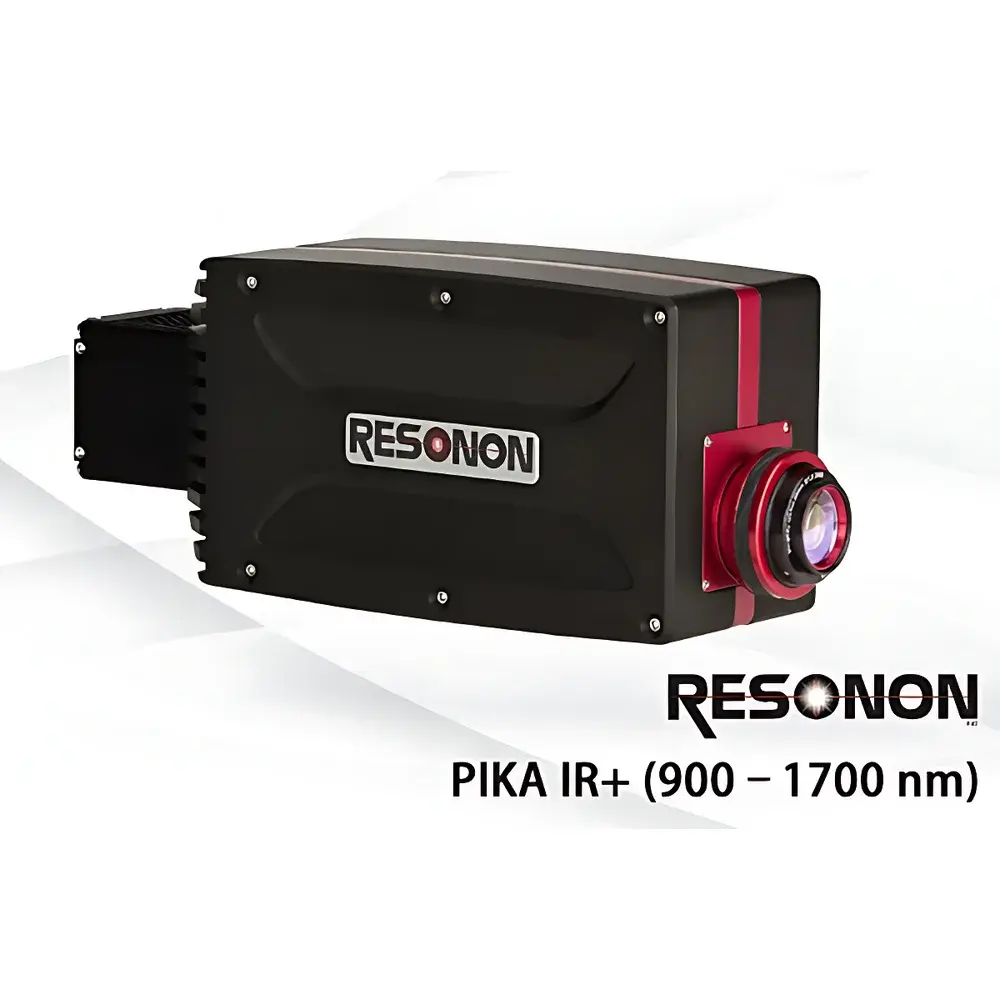
Resonon Pika IR+ Hyperspectral Imaging System
| Brand | Resonon |
|---|---|
| Origin | USA |
| Model | Pika IR+ |
| Instrument Type | Online Hyperspectral Imager |
| Principle | Push-broom Imaging Spectroscopy |
| Spectral Range | 900–1700 nm |
| Spectral Resolution | 2.5 nm |
| Spectral Bands | 328 |
| Spatial Pixels | 640 |
| Max Frame Rate | 249 fps |
| Data Bit Depth | 14-bit |
| Weight | 2.7 kg |
| Dimensions (L×W×H) | 11.0 × 29.6 × 8.9 cm |
| Interface | GigE Vision |
| Operating Temperature | 5–40 °C |
| Aperture | f/1.8 |
| Pixel Size | 15 µm |
| RMS Spot Radius (avg.) | 10 µm |
| Smile (peak-to-peak) | 10 µm |
| Keystone (peak-to-peak) | 10 µm |
| Radiometric Calibration | Included |
| Pre-installed Software | SpectrononPro, Resonon Acquisition & Analysis Suite |
Overview
The Resonon Pika IR+ is a compact, lightweight, and high-performance push-broom hyperspectral imaging system engineered for precision near-infrared (NIR) spectral analysis in laboratory, field-deployable, industrial process monitoring, and airborne remote sensing applications. Operating on the principle of spatial-spectral scanning, the Pika IR+ captures full 2D spatial images with contiguous spectral information across 328 narrowband channels from 900 to 1700 nm—encompassing key absorption features of water, cellulose, lignin, hydrocarbons, and numerous chemical functional groups. Its optical design minimizes geometric distortions—including barrel, pincushion, smile, and keystone—ensuring pixel-level spatial-spectral fidelity critical for quantitative chemometric modeling and pixel-wise classification. The system integrates a high-transmission f/1.8 lens, a scientific-grade InGaAs sensor with 14-bit digitization, and optimized thermal management for stable radiometric performance across ambient temperatures from 5 to 40 °C.
Key Features
- Push-broom architecture enabling real-time, line-scan-based hyperspectral data acquisition at up to 249 frames per second
- High spectral resolution of 2.5 nm (FWHM) across 328 evenly sampled bands within the 900–1700 nm range
- Low optical distortion: peak-to-peak smile and keystone both ≤10 µm; average RMS spot radius ≤10 µm
- High signal fidelity: low stray light design yields superior signal-to-noise ratio (SNR), essential for detecting subtle spectral signatures
- Compact form factor (11.0 × 29.6 × 8.9 cm) and lightweight construction (2.7 kg) suitable for UAV integration, portable field rigs, and benchtop setups
- Factory radiometric calibration provided, supporting absolute reflectance and radiance quantification
- GigE Vision-compliant interface ensures plug-and-play compatibility with standard industrial frame grabbers and embedded computing platforms
Sample Compatibility & Compliance
The Pika IR+ is designed for non-contact, non-destructive analysis of solid, granular, and semi-solid samples under ambient or controlled illumination conditions. It supports integration with standardized lighting systems (e.g., halogen, quartz-tungsten-halogen, or LED arrays) compliant with ASTM E1777 and ISO 13406-2 for uniform irradiance distribution. While the instrument itself does not carry CE, FCC, or RoHS certification labels, its GigE interface and power supply meet IEC 61000-6-3 (EMI) and IEC 61000-6-2 (immunity) requirements for industrial environments. Data output formats (ENVI .hdr/.bil, TIFF, HDF5) are compatible with FDA 21 CFR Part 11–compliant workflows when deployed with validated software configurations and audit-trail-enabled acquisition protocols.
Software & Data Management
The Pika IR+ ships with a dedicated control laptop pre-installed with two core software packages: SpectrononPro and Resonon’s native Acquisition & Analysis Suite. SpectrononPro provides advanced chemometric tools—including PCA, PLS regression, SVM classification, spectral library matching, and false-color mapping—with support for batch processing and scripting via Python API. The Resonon Acquisition Suite enables real-time preview, exposure control, region-of-interest (ROI) selection, dark/reference correction, and metadata embedding (GPS, IMU, timestamp). All software modules generate traceable, timestamped logs and support export to CSV, MATLAB (.mat), and industry-standard ENVI formats. For GxP-regulated environments, users may configure secure user authentication, electronic signatures, and change-controlled versioning through third-party LIMS or ELN integrations.
Applications
- Agricultural phenotyping: quantification of crop water status, nitrogen content, and stress biomarkers via NIR spectral indices (e.g., NDVI, PRI, NDSI)
- Pharmaceutical manufacturing: real-time blend uniformity assessment, tablet coating thickness verification, and raw material identification per USP and ICH Q5C
- Recycling & waste sorting: polymer identification (PET, HDPE, PP) and contaminant detection based on C–H and O–H overtone absorptions
- Food quality inspection: moisture mapping, fat content estimation, and adulteration screening in grains, dairy, and meat products
- Geological surveying: mineral identification (e.g., clays, carbonates, sulfates) using diagnostic absorption features near 1400 nm and 1900 nm
- Defense & security: concealed substance detection and camouflage assessment under natural illumination
FAQ
What spectral calibration standards are supported?
The Pika IR+ includes factory-applied wavelength and radiometric calibration using NIST-traceable sources. Users may perform field recalibration using certified reflectance panels (e.g., Labsphere Spectralon) and tungsten-halogen reference lamps.
Is the system compatible with third-party data processing platforms like MATLAB or Python?
Yes—raw and processed data are exported in open formats (ENVI, TIFF, HDF5), and Resonon provides documented APIs for MATLAB and Python (via PyResonon) to enable custom algorithm development and pipeline automation.
Can the Pika IR+ operate in moving-platform configurations such as drones or conveyor belts?
Absolutely—the 249 fps line rate, robust mechanical housing, and GigE synchronization triggers make it suitable for motion-compensated scanning on UAVs, robotic arms, and inline production lines.
Does the system support real-time onboard processing?
While the Pika IR+ itself performs only data acquisition, its GigE interface allows streaming to edge-computing devices (e.g., NVIDIA Jetson AGX Orin) for real-time spectral unmixing or anomaly detection when paired with optimized inference models.
What maintenance is required for long-term radiometric stability?
No routine optical alignment is needed. Users should periodically verify calibration using reference standards every 6–12 months depending on usage intensity and environmental exposure, per ISO/IEC 17025 guidelines for measurement uncertainty management.





