
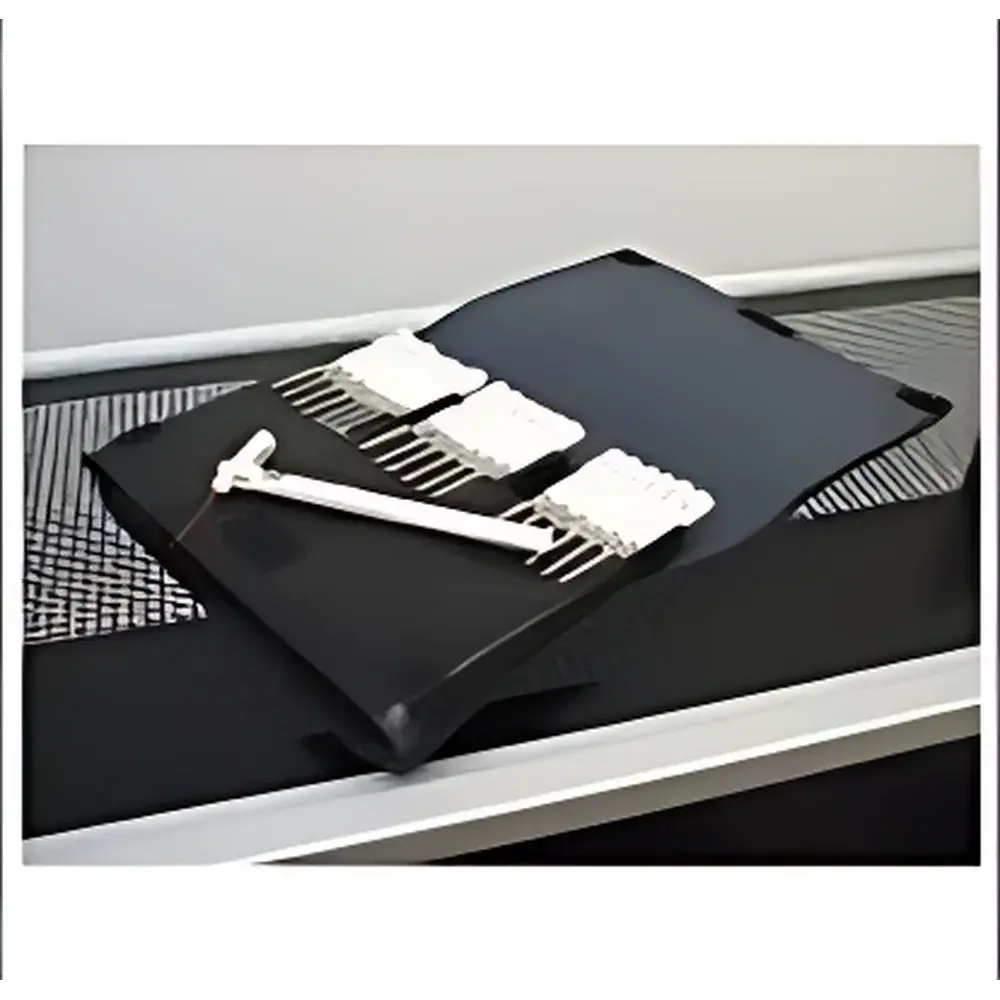
Ugo Basile von Frey Filament Set 37450/277 for Rodent Mechanical Allodynia and Hyperalgesia Assessment
| Brand | Ugo Basile |
|---|---|
| Country of Origin | Italy |
| Model | 37450/277 |
| Force Range | 0.008 g – 300 g (0.08 mN – 2.94 N) |
| Filament Count | 20 |
| Compliance | ASTM F2475-21, ISO 13485 (manufacturer), GLP-ready application protocol |
Overview
The Ugo Basile von Frey Filament Set 37450/277 is a calibrated, standardized mechanical sensory testing system engineered for quantitative assessment of tactile allodynia and mechanical hyperalgesia in rodent models. Based on the Semmes-Weinstein monofilament principle, this set applies precisely defined bending forces to the plantar surface of the hind paw via controlled vertical indentation. Each nylon filament exhibits predictable buckling behavior at a specific force threshold—governed by its diameter, length of protrusion, and material modulus—enabling reproducible, non-invasive quantification of mechanosensory thresholds. The system operates under the “up-down” method (Dixon, 1965) or fixed-interval protocols, delivering objective behavioral endpoints essential for preclinical pain research, neuropharmacology studies, and translational validation of analgesic compounds.
Key Features
- 20 individually calibrated filaments covering a continuous force range from 0.008 g (0.08 mN) to 300 g (2.94 N), spanning five orders of magnitude in stimulus intensity
- High-precision nylon monofilaments manufactured to ISO 9001-certified tolerances; each filament marked with corresponding force value and calibrated traceability documentation
- Consistent buckling mechanics ensured by standardized 10 mm protrusion length and perpendicular application angle—minimizing inter-operator variability
- Integrated ergonomic handle design with tactile feedback groove for stable, repeatable manual actuation
- Compatible with Ugo Basile’s optional Perforated Observation Platform (Cat. No. 37451), featuring laser-cut 5 × 5 mm² square apertures spaced at 1 mm intervals for unobstructed plantar visualization
- Platform surface treated with corrosion-resistant epoxy-polyester coating, facilitating rapid decontamination between subjects and compliance with IACUC sanitation guidelines
Sample Compatibility & Compliance
The 37450/277 set is validated for use in C57BL/6, CD-1, Sprague-Dawley, and Wistar rats and mice (both sexes, post-weaning to adult age). Filament selection and application follow established IASP and NIH Office of Laboratory Animal Welfare (OLAW)-recommended protocols for minimizing stress and ensuring ethical endpoint detection. Data acquisition aligns with GLP principles: filament sequence, application duration (≤3 s per stimulus), latency to withdrawal, and number of positive responses are documented per subject in auditable log formats. While the filaments themselves are not medical devices, their use in regulatory toxicology studies adheres to ASTM F2475-21 (Standard Practice for Evaluating Mechanical Sensitivity in Rodents) and supports FDA-preclinical study reporting requirements under 21 CFR Part 58.
Software & Data Management
Though the 37450/277 is a manual, hardware-only system, it integrates seamlessly into digital workflows via Ugo Basile’s optional Touch Test Software (v3.2+), which supports automated up-down algorithm execution, real-time threshold calculation (50% effective dose, ED50), and export of raw response matrices in CSV and Excel-compatible formats. All session metadata—including date, operator ID, animal ID, filament sequence, and environmental conditions (ambient temperature, humidity)—are timestamped and stored with audit-trail functionality compliant with 21 CFR Part 11 when deployed on validated computing infrastructure. Raw data files retain full traceability to individual filaments via embedded calibration batch codes.
Applications
- Preclinical evaluation of neuropathic pain models (e.g., SNI, CCI, STZ-induced diabetic neuropathy)
- Pharmacodynamic profiling of opioid, NSAID, gabapentinoid, and novel ion channel modulator candidates
- Longitudinal monitoring of sensory recovery following spinal cord injury or peripheral nerve repair
- Genetic screening for mechanosensory phenotype expression in knockout/knockin strains
- Validation of dorsal root ganglion (DRG) neuron sensitization ex vivo correlates
- Training platform for standardization across multi-site collaborative studies (e.g., IMI PainCare consortium protocols)
FAQ
How is filament force calibrated and verified?
Each filament is factory-calibrated using a high-resolution force transducer (±0.5% full-scale accuracy) and certified against NIST-traceable standards. A calibration certificate listing individual filament force values, uncertainty budgets, and expiration date is supplied with every set.
Can these filaments be sterilized and reused?
Yes—filaments may be wiped with 70% ethanol or isopropanol between animals; autoclaving is not recommended due to thermal deformation risk. Reuse is limited to ≤10 applications per filament under controlled handling to maintain buckling consistency.
Is the perforated platform required for valid measurements?
While not mandatory, the 5 × 5 mm² laser-perforated platform significantly improves measurement reliability by standardizing paw positioning, reducing movement artifacts, and enabling consistent filament contact geometry—particularly critical for longitudinal or multi-operator studies.
What statistical methods are recommended for threshold analysis?
The Dixon up-down method with interpolated ED50 calculation remains the gold standard. Alternative approaches include logistic regression modeling of response probability versus log-force and nonparametric Kruskal-Wallis testing for group-wise comparisons, as implemented in GraphPad Prism and R packages ‘drc’ and ‘psyt’.





