
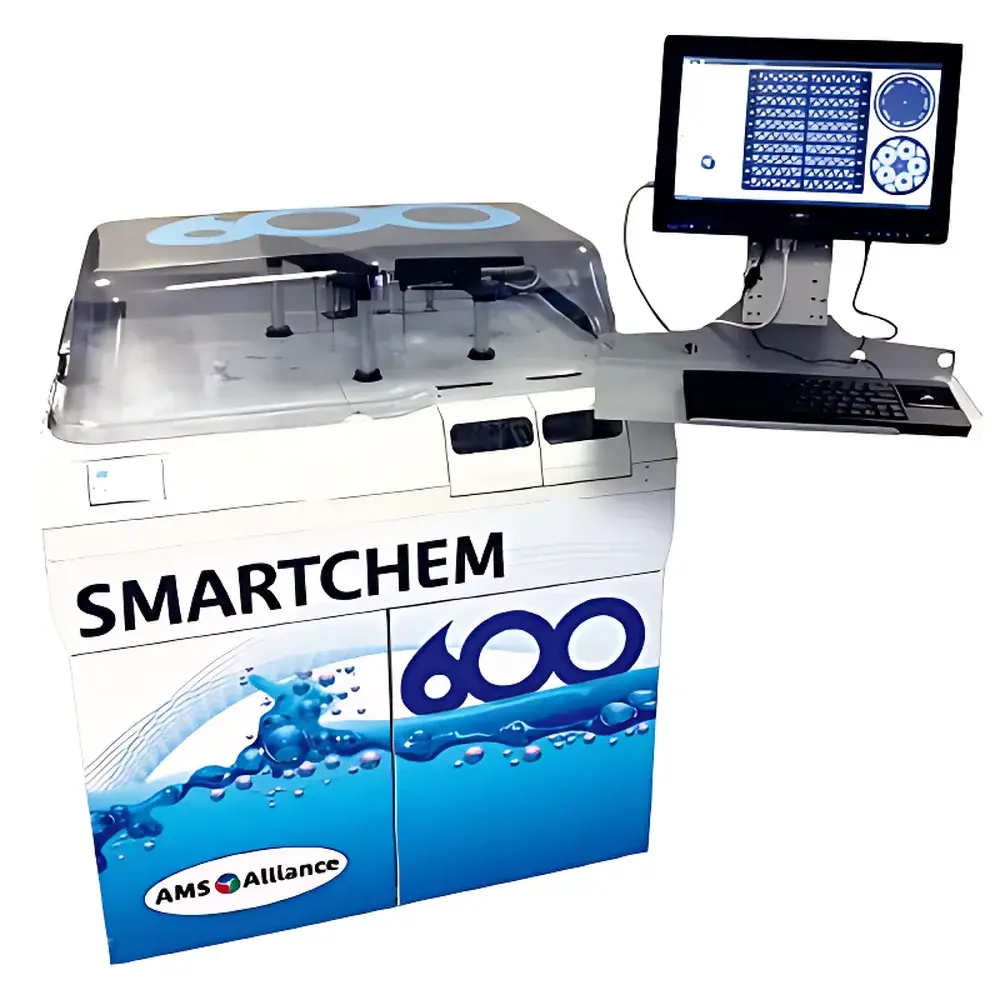
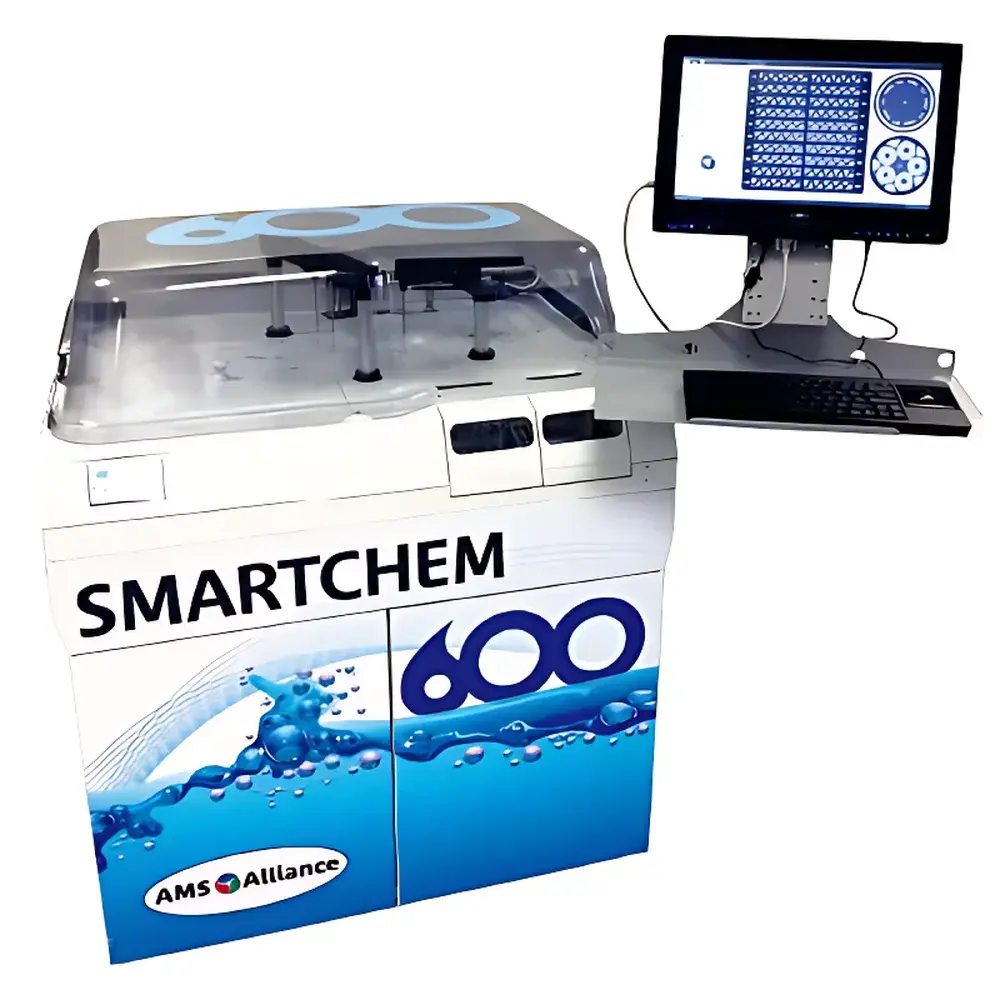
AMS Alliance Smartchem600 Discrete Automated Chemistry Analyzer
| Brand | AMS Alliance |
|---|---|
| Origin | France |
| Model | Smartchem600 |
| Product Type | Discrete Analyzer |
| Wavelength Range | 12 fixed wavelengths from 340 to 880 nm |
| Sample Capacity | 200 positions |
| Reagent Positions | 100 |
| Cuvette Path Length | 6 mm or 10 mm |
| Light Source | High-stability LED |
Overview
The AMS Alliance Smartchem600 is a high-throughput discrete automated chemistry analyzer engineered for precision, reproducibility, and operational robustness in clinical, environmental, food safety, and regulatory-compliant laboratories. Unlike continuous flow or segmented flow systems, the Smartchem600 employs true discrete analysis—where each sample and reagent are dispensed into individual cuvettes, enabling independent reaction control, flexible assay sequencing, and elimination of carryover between heterogeneous analyte determinations. Its optical detection system utilizes a solid-state LED light source coupled with a 12-position interference filter wheel and a photodiode array detector, delivering stable photometric performance across the 340–880 nm spectral range. The instrument operates under strictly controlled thermal conditions (37.0 ± 0.1 °C), ensuring kinetic and endpoint assay consistency per ISO 15197 and CLSI EP10 guidelines. Designed as a floor-standing platform, it minimizes benchtop footprint while maintaining full accessibility for maintenance and consumables loading.
Key Features
- Triple robotic arm architecture: Independent sample arm, reagent arm, and cuvette handling arm—each equipped with capacitive liquid level sensing, vibration monitoring, and clog detection for real-time error prevention.
- Dual stirring modules integrated into the reaction disc ensure homogeneous mixing without cross-contamination; reagent and sample aspiration paths are physically segregated.
- 200-sample capacity with 20 modular universal sample racks—supports simultaneous batch processing and ad-hoc emergency sample insertion at any time during run execution.
- 100-position refrigerated reagent carousel (4–10 °C) extends reagent stability and enables long unattended operation; reagent remaining volume is auto-calculated based on microliter-level dispensing accuracy.
- Integrated cuvette washing station with multi-step cleaning protocol—including inner/outer needle immersion, dedicated wash reservoirs per arm, reagent rinse cycles, and programmable priority-based cleaning rules to prevent inter-assay interference.
- Reusable quartz or high-transmission polymer cuvettes with automatic optical integrity verification; failed cuvettes are bypassed without interrupting analysis.
- Touchscreen-driven intelligent software with guided workflow, remote web-based monitoring, and full audit trail compliance for GLP/GMP environments.
Sample Compatibility & Compliance
The Smartchem600 accommodates standard 12–16 mm diameter sample tubes (including capped tubes for volatile or light-sensitive analytes) and supports direct analysis of serum, plasma, urine, wastewater, soil extracts, and food homogenates. It complies with key international method standards including EPA Method 353.2 (nitrate/nitrite with cadmium reduction column), ISO 6878 (phosphate), ISO 11929 (detection limit evaluation), and ASTM D5179 (chemical oxygen demand). Optional ISE modules enable simultaneous pH, conductivity, and redox potential measurement in accordance with ISO 10523 and ISO 7888. All hardware and firmware configurations support 21 CFR Part 11 requirements when paired with validated software deployment and electronic signature workflows.
Software & Data Management
The Smartchem Control Suite provides role-based user authentication, configurable access levels, and immutable system logs recording all operator actions, method changes, calibration events, and maintenance interventions. It features embedded QC management—including blank correction (reagent, cuvette, and true sample blanks), spike recovery calculation, duplicate analysis tracking, and Levey-Jennings charting. Data export is supported in CSV, PDF, and LIMS-compatible ASTM E1384 formats. Software modules include automatic standard curve generation with serial dilution, dynamic sample rerun logic (pre- or post-dilution), real-time status visualization of rack/reagent/cuvette states, and predictive run completion timing. Backup routines execute automatically prior to shutdown and may be scheduled for off-peak hours.
Applications
The Smartchem600 delivers validated performance across diverse application domains: clinical chemistry (glucose, creatinine, uric acid, total protein); environmental monitoring (nitrate, nitrite, phosphate, silicate, cyanide, phenol); food and beverage quality control (sulfite, SO₂, chloride, free acidity); and industrial process water analysis (hardness, alkalinity, residual chlorine). Its discrete architecture makes it particularly suited for multi-analyte panels requiring varied incubation times, different wavelength selection per test, or incompatible reagent chemistries—eliminating the need for method-specific hardware reconfiguration.
FAQ
What distinguishes discrete analysis from flow injection or segmented flow techniques?
Discrete analysis isolates each reaction in a dedicated cuvette, enabling precise temporal control over reagent addition, mixing, incubation, and detection—critical for kinetic assays and multiplexed testing where reaction kinetics vary significantly between analytes.
Can the Smartchem600 perform EPA Method 353.2 without external hardware?
Yes—the optional certified cadmium reduction column module is fully integrated, including column activation and regeneration protocols compliant with EPA specifications.
Is the photometric system compliant with CLSI EP15-A3 linearity verification requirements?
Yes—the 0–3.5 Abs linear dynamic range, calibrated using NIST-traceable neutral density filters, supports full validation per CLSI EP15-A3 and ISO 11929 Annex B.
How does the system handle low-volume or precious samples?
Microliter-range dispensing (minimum 2 µL) combined with programmable pre-dilution allows accurate quantification of limited-volume specimens without manual intervention.
What cybersecurity measures are implemented for remote access?
All network communications use TLS 1.2+ encryption; remote sessions require two-factor authentication and are logged with IP address, timestamp, and action scope for audit readiness.





