
Campbell Scientific SoilVUE10 Soil Profile Sensor
| Brand | Campbell Scientific |
|---|---|
| Origin | USA |
| Model | SoilVUE10 |
| Measurement Principle | Time-Domain Reflectometry (TDR) |
| Output Protocol | SDI-12 v1.4 |
| Depth Options | 0.5 m (6 depth layers) or 1.0 m (9 depth layers) |
| Diameter | 5.2 cm (body), 5.8 cm (with threads) |
| Length | 0.55 m (0.5 m version) / 1.05 m (1.0 m version) |
| Weight | 1.9 kg / 3.6 kg |
| Operating Temperature | −30 °C to +40 °C |
| Volumetric Water Content Accuracy | ±1.5% (for most mineral soils) |
| Electrical Conductivity Range | 0–10 dS/m |
| Relative Permittivity Range | 1–80 |
| Relative Permittivity Accuracy | ±1 unit |
| Temperature Accuracy | ±0.15 °C |
| Power | ~64 mA dynamic / ~2.5 mA quiescent @ 12 VDC |
| IP Rating | IP67 (M12 connector) |
| Compliance | SDI-12 v1.4, RoHS, CE |
Overview
The Campbell Scientific SoilVUE10 is a high-integrity, multi-depth soil profile sensor engineered for continuous in situ monitoring of volumetric water content (θv), bulk electrical conductivity (ECb), and temperature across discrete soil horizons. It employs Campbell’s proprietary TrueWave™ time-domain reflectometry (TDR) technology—based on precise measurement of the propagation delay of a nanosecond-rise-step voltage pulse along integrated helical waveguides—to determine the relative permittivity (dielectric constant) of the surrounding soil matrix. This dielectric response is then translated into θv using empirically validated mixing models (e.g., Topp equation for mineral soils) and corrected for salinity-induced polarization effects via concurrent ECb and temperature measurements. Unlike conventional single-point TDR probes or capacitance-based profilers, the SoilVUE10 integrates six (0.5 m version) or nine (1.0 m version) independent three-rod TDR electrodes into a single threaded cylindrical structure—enabling simultaneous, co-located, depth-resolved characterization without vertical sensor stacking or trenching. Its design prioritizes minimal soil disturbance, mechanical robustness, and long-term field stability under variable climatic and pedological conditions.
Key Features
- TrueWave™ TDR architecture delivering sub-nanosecond signal rise time and high-fidelity waveform capture for accurate dielectric determination across heterogeneous soil textures.
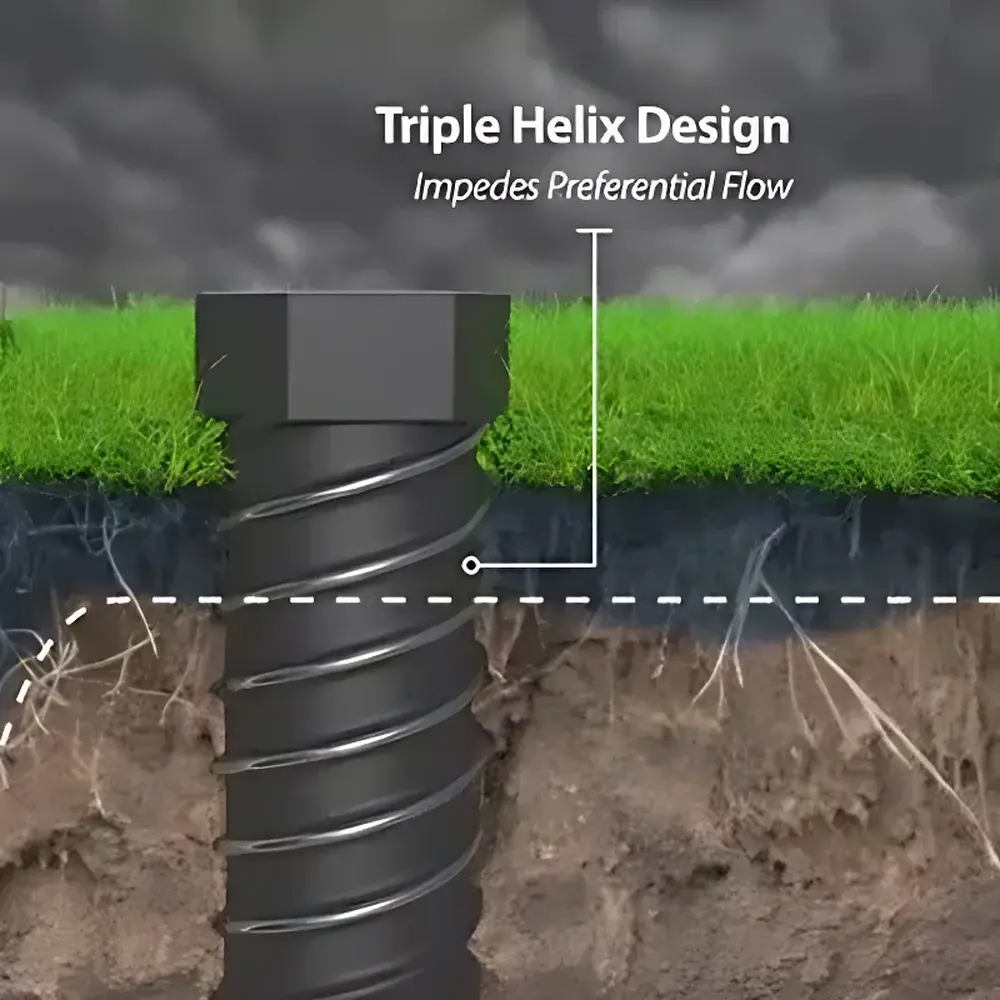
- Integrated threaded body (5.8 cm max diameter) enabling rapid installation into pre-augered 5 cm boreholes—no excavation, no grouting, no compaction artifacts.
- Co-located, depth-specific measurement of θv, ECb, and temperature at fixed intervals (e.g., 5–100 cm for 1.0 m model), eliminating inter-sensor calibration drift and spatial misalignment.
- SDI-12 v1.4 digital output ensures interoperability with Campbell CR-series data loggers (e.g., CR1000X, CR6) and third-party SDI-12–compliant systems, supporting low-power scheduled polling and diagnostic command sets.
- IP67-rated M12 connector allows field-replaceable cable sections; modular design supports maintenance without sensor removal from installed borehole.
- Low quiescent current draw (~2.5 mA @ 12 VDC) extends battery life in remote, solar-powered monitoring networks operating over multi-year deployments.
Sample Compatibility & Compliance
The SoilVUE10 is validated for use in mineral soils with organic carbon content <12% and clay fraction <45%. In high-organic or high-clay soils—where dielectric relaxation delays and bound-water effects degrade standard TDR inversion accuracy—site-specific calibration against gravimetric sampling or neutron probe validation is recommended. All measurements conform to ASTM D5778 (Standard Test Method for Subsurface Exploration Using the Seismic Cone and/or Piezocone Penetrometer) for geotechnical correlation and ISO 11274 (Soil quality — Determination of water retention characteristic curves) for hydrological modeling inputs. The sensor meets CE marking requirements for electromagnetic compatibility (EN 61326-1) and environmental protection (RoHS Directive 2011/65/EU). Its SDI-12 interface complies with ANSI/TIA-568-C.2 specifications for serial digital sensor communication.
Software & Data Management
Data acquisition is natively supported by Campbell Scientific’s LoggerNet, PC400, and RTDAQ software suites, which provide automated SDI-12 polling, real-time waveform visualization, and metadata tagging per measurement depth. Raw TDR waveforms can be exported for advanced post-processing (e.g., reflection coefficient analysis, travel-time deconvolution) in MATLAB or Python environments. When deployed in regulated environments (e.g., USDA ARS watersheds, EPA Long-Term Agroecosystem Research sites), the system supports audit-trail logging, user-access controls, and data integrity verification—aligning with principles of ALCOA+ (Attributable, Legible, Contemporaneous, Original, Accurate, Complete, Consistent, Enduring, Available) for GLP-compliant environmental monitoring.
Applications
- Long-term soil moisture network monitoring for drought early warning systems and climate resilience modeling.
- Root-zone water uptake studies in agronomic trials, including deficit irrigation scheduling and crop water productivity assessment.
- Hydrological modeling input for SWAT, HYDRUS, and ParFlow simulations requiring vertically resolved θv and ECb profiles.
- Contaminant transport tracking via temporal ECb anomalies linked to leaching events or saline intrusion.
- Calibration and validation of satellite-based soil moisture products (e.g., SMAP, Sentinel-1) at representative footprint scales.
- Permafrost active layer monitoring where freeze-thaw state transitions induce sharp dielectric shifts detectable at sub-cm resolution.
FAQ
What depth resolutions are available, and how are measurement depths defined?
The 0.5 m model measures at 5, 10, 20, 30, 40, and 50 cm; the 1.0 m model adds 60, 75, and 100 cm—each corresponding to the physical location of an embedded TDR electrode pair along the sensor axis.
Is factory calibration sufficient for all soil types?
Factory calibration covers typical mineral soils (sand to silt loam). For organic-rich (>12% SOC) or fine-textured (>45% clay) soils, empirical calibration using local gravimetric samples is advised to correct for dielectric dispersion effects.
Can the SoilVUE10 be used in frozen soil?
Yes—its wide operating range (−30 °C to +40 °C) and TDR-based principle allow detection of ice formation via abrupt permittivity reduction; however, ECb interpretation requires temperature-compensated algorithms below 0 °C.
How is sensor-to-soil contact ensured during installation?
The external thread geometry promotes soil compaction during screw-in insertion, minimizing air gaps; no backfilling or sealing compounds are required due to the sensor’s self-anchoring mechanical interface.
Does the sensor support firmware updates in the field?
No—firmware is固化 (hard-coded) at manufacture; measurement algorithms and SDI-12 command sets are immutable to ensure traceability and regulatory compliance in long-term deployments.
Related Products







