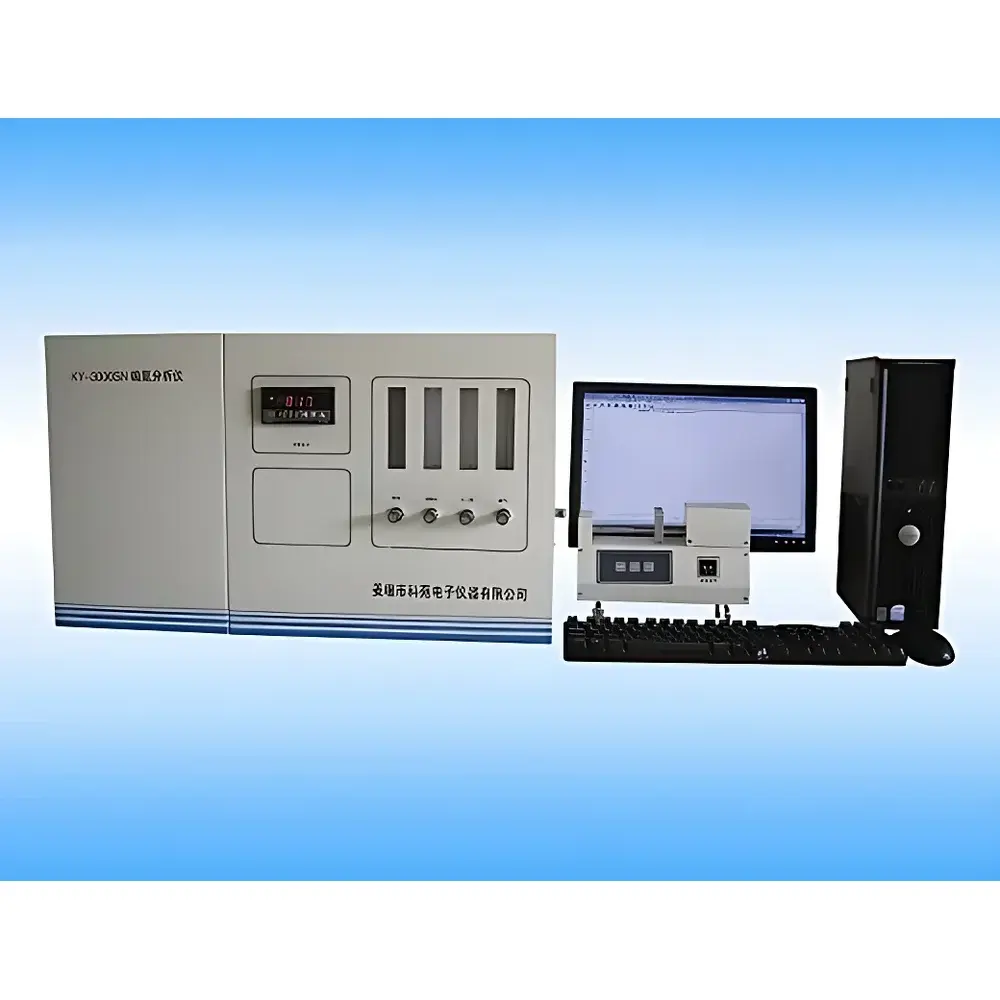
Jiangsu Keyuan KY-3000SN Total Sulfur and Total Nitrogen Analyzer
| Origin | Jiangsu, China |
|---|---|
| Manufacturer Type | Authorized Distributor |
| Origin Category | Domestic (PRC) |
| Model | KY-3000SN |
| Price Range | USD 14,000–42,500 (FOB China) |
| Analyte Coverage | Total Sulfur (S) and Total Nitrogen (N) |
| Detection Principle | UV Fluorescence (S), Chemiluminescence (N) |
| Compliance Standards | SH/T 0689, ASTM D5453, GB/T 34100-2017, SH/T 0657, ASTM D4629 |
| Sample Forms | Liquid, Solid, Gas (with optional dedicated injectors) |
| S Detection Range | 0.2 mg/L to 100% w/w |
| N Detection Range | 0.1 mg/L to 100% w/w |
| S LOD | 0.2 mg/L |
| N LOD | 0.1 mg/L |
| Combustion Furnace Temp | Ambient to 1300 °C |
| Temp Control Accuracy | ±1 °C |
| Data Acquisition | 24-bit ADC, USB Interface, Minimum Detectable Signal < 1 µV |
| PMT High Voltage | Adjustable |
| Calibration Modes | Single-point or multi-point |
| Repeatability | CV ≤ 10% (1–100 mg/L), CV ≤ 5% (100–10000 mg/L) |
| Carrier/Reactant Gases | Argon ≥99.98%, Oxygen ≥99.98% |
| Power Supply | AC 220 V ±10%, 50 Hz ±0.5 Hz |
| Rated Power | 1500 W |
Overview
The Jiangsu Keyuan KY-3000SN Total Sulfur and Total Nitrogen Analyzer is a dual-detection elemental combustion analyzer engineered for precise, simultaneous quantification of total sulfur (S) and total nitrogen (N) in petroleum-based matrices. It operates on two complementary, industry-standard detection principles: ultraviolet fluorescence (UVF) for sulfur and chemiluminescence (CLD) for nitrogen—both following high-temperature oxidative combustion (up to 1300 °C) in a controlled argon/oxygen atmosphere. This architecture ensures complete conversion of organosulfur and organonitrogen compounds into SO₂ and NO, respectively, enabling trace-level detection with high specificity and minimal interferences from hydrocarbon matrix effects. Designed for laboratories requiring regulatory-grade data integrity, the KY-3000SN meets the technical requirements of SH/T 0689, ASTM D5453, GB/T 34100-2017 (sulfur), and SH/T 0657, ASTM D4629 (nitrogen)—making it suitable for quality control in refineries, third-party testing labs, and R&D centers engaged in fuel specification compliance (e.g., Euro 5/6, Tier 3, IMO 2020), catalyst development, and petrochemical feedstock characterization.
Key Features
- Integrated dual-channel detection system: UV fluorescence detector for sulfur (214 nm emission) and chemiluminescent NOₓ detector for nitrogen—each optimized for signal-to-noise ratio and dynamic range.
- High-precision temperature-controlled combustion furnace (ambient to 1300 °C, ±1 °C stability) with programmable ramp profiles to ensure complete sample oxidation across diverse matrices including heavy fuel oils, cracked naphthas, and polymer-derived feedstocks.
- 24-bit analog-to-digital conversion with USB 2.0 interface, supporting real-time data acquisition at sub-microvolt resolution (<1 µV minimum detectable signal) and full audit trail logging.
- Adjustable photomultiplier tube (PMT) high-voltage supply enables optimization for low-concentration calibration or high-sensitivity trace analysis without hardware modification.
- Flexible calibration architecture: supports single-point linear validation or multi-point non-linear curve fitting (quadratic or cubic), compliant with ASTM D5453 Annex A1 and USP linearity guidance.
- Modular sample introduction: accommodates liquid autosamplers (1–100 µL), solid combustion boats (for polymers, catalysts, or residues), and gas-tight loop injectors (for LPG, natural gas condensates) via field-replaceable interfaces.
Sample Compatibility & Compliance
The KY-3000SN is validated for use with a broad spectrum of petroleum-related samples: gasoline, diesel, jet fuel, marine distillates, crude oil fractions, lubricants, bitumen extracts, synthetic fuels (e.g., Fischer–Tropsch liquids), and nitrogen-containing additives such as alkylamines or nitroaromatics. Solid compatibility extends to spent catalysts, carbon black, and polyolefin pellets when used with quartz boat combustion modules. All measurement protocols align with internationally recognized test methods—including ASTM D5453 (UVF sulfur), ASTM D4629 (CLD nitrogen), and their Chinese national equivalents (SH/T 0689, SH/T 0657). The instrument’s firmware and data handling architecture support 21 CFR Part 11-compliant electronic signatures and audit trails when deployed with validated laboratory information management systems (LIMS). Routine operation satisfies GLP and ISO/IEC 17025 documentation requirements for accredited testing laboratories.
Software & Data Management
The KY-3000SN is operated via Windows-based analytical software featuring intuitive workflow navigation, method editor with stepwise combustion parameter definition (oxidation time, furnace zone profiling, gas flow sequencing), and integrated calibration manager. All raw chromatograms, peak integration parameters, calibration curves, and QC reports are stored in a relational database with timestamped metadata (operator ID, instrument ID, environmental conditions). Export formats include CSV, PDF (print-ready reports), and XML for LIMS integration. Data security includes role-based access control (admin/user/auditor), automatic backup scheduling, and encrypted local storage. Software validation documentation (IQ/OQ/PQ templates) is available upon request for regulated environments.
Applications
- Refinery process monitoring: real-time sulfur/nitrogen tracking in hydrotreater feed and product streams to optimize catalyst life and meet pipeline specifications.
- Fuel certification: verification of ultra-low-sulfur diesel (ULSD), aviation turbine fuel (Jet A-1), and marine gas oil (MGO) against ISO 8217 and EN 590 limits.
- Research on heteroatom removal: kinetic studies of desulfurization/denitrogenation efficiency in novel catalyst screening programs.
- Quality assurance of petrochemical intermediates: analysis of BTX streams, alkylate blends, and solvent naphthas where nitrogen impurities poison downstream catalysts.
- Regulatory submission support: generation of auditable data packages for EPA, CEPA, or CNPC reporting under mandatory sulfur content regulations.
FAQ
What combustion gases are required, and what purity levels are mandatory?
Argon (≥99.98% purity) serves as the carrier and purge gas; oxygen (≥99.98%) is used as the combustion reactant. Lower purities introduce baseline noise and compromise detection limits due to quenching or incomplete oxidation.
Can the instrument analyze solid samples without modification?
Yes—solid samples require the optional quartz boat combustion module and manual or automated boat loader. Ash-forming matrices (e.g., coke, catalysts) must be pre-ashed or diluted to avoid furnace contamination.
Is multi-point calibration necessary for regulatory compliance?
While single-point calibration is permitted for routine QC within established control limits (per ASTM D5453 Section 10.3), multi-point calibration across the full working range is required for method validation, accreditation audits (ISO/IEC 17025), and initial instrument qualification.
How does the system handle high-salinity or chloride-rich samples?
Chloride interference is mitigated by the high-temperature combustion environment (>1000 °C) and post-combustion scrubbing; however, samples exceeding 1000 ppm Cl should undergo dilution or matrix-matched calibration to prevent PMT saturation and electrode corrosion.
Does the software support automated report generation for ISO 17025 audits?
Yes—the software exports fully traceable PDF reports containing raw signal traces, integration markers, calibration history, uncertainty estimates (k=2), and operator authentication logs—all structured to satisfy ISO/IEC 17025 clause 7.8.2 requirements for result reporting.