
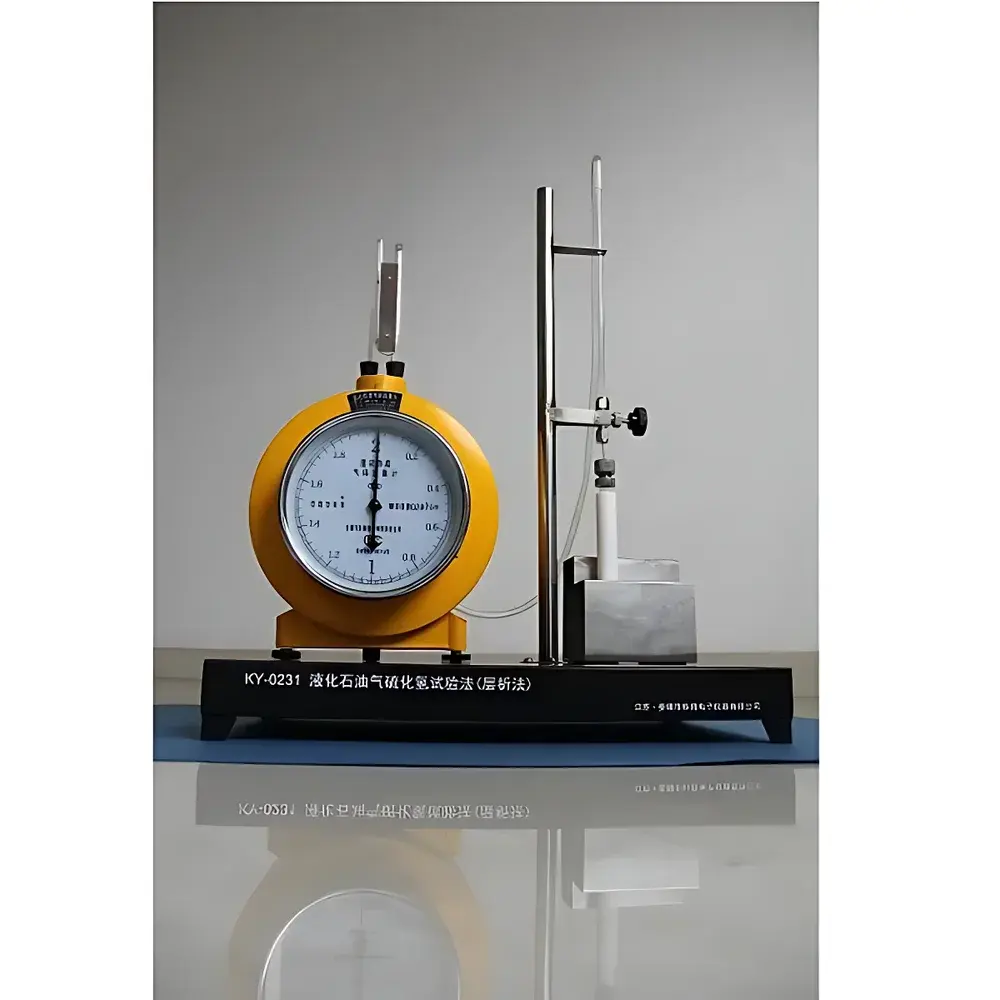
Jiangsu Keyuan KY-0231 Hydrogen Sulfide Analyzer for Liquefied Petroleum Gas (Colorimetric Chromatographic Method)
| Origin | Jiangsu, China |
|---|---|
| Manufacturer Type | Authorized Distributor |
| Origin Category | Domestic (PRC) |
| Model | KY-0231 |
| Pricing | Available Upon Request |
| Applicable Standard | SH/T 0231 |
| Wet Gas Meter Capacity | 2 L |
| Stainless Steel Hollow Needle | φ1 mm × 0.2 mm ID |
| H₂S Detection Range | 5–500 mg/m³ |
Overview
The Jiangsu Keyuan KY-0231 Hydrogen Sulfide Analyzer for Liquefied Petroleum Gas is a dedicated, benchtop analytical instrument engineered for quantitative determination of hydrogen sulfide (H₂S) concentration in LPG streams using the standardized colorimetric chromatographic method. This technique relies on selective chemical reaction kinetics and fixed-bed sorption principles: gaseous LPG samples are drawn at controlled flow rates through a vertical glass reaction tube packed with lead acetate–impregnated coarse-pore silica gel. Upon contact, H₂S reacts stoichiometrically with lead acetate to form insoluble black lead sulfide (PbS), producing a sharply defined chromatic front within the sorbent bed. The length (or volume) of the stained zone is directly proportional to the total mass of H₂S introduced, enabling calculation of volumetric concentration (mg/m³) when combined with precise sample volume measurement via integrated wet gas metering. The method conforms explicitly to SH/T 0231—China’s petroleum industry standard for H₂S determination in liquefied hydrocarbon gases—and aligns with foundational principles outlined in ASTM D4084 and ISO 8573-7 for trace sulfur compound detection in compressed gases.
Key Features
- Glass reaction column design ensures optical clarity for real-time visual assessment of stain front progression and facilitates post-analysis verification of bed integrity and reagent uniformity.
- Integrated 2-liter wet-type gas meter provides gravimetrically traceable volumetric flow measurement under ambient conditions, calibrated per JJG 258–2018 (Chinese national metrological verification regulation for wet gas meters).
- Stainless steel hollow sampling needle (φ1 mm OD / 0.2 mm ID) and precision-machined stainless steel needle valve enable fine control over sample introduction rate and pressure stabilization during dynamic flow conditions.
- Corrosion-resistant sample probe constructed from fluoropolymer-lined or Hastelloy C-276 components prevents H₂S-induced degradation and ensures long-term repeatability across high-sulfur LPG batches.
- Robust enclosure fabricated from electropolished 304 stainless steel, subjected to high-temperature powder coating (≥200 °C curing), delivering thermal stability up to 60 °C and resistance to acidic condensates common in LPG handling environments.
Sample Compatibility & Compliance
The KY-0231 is validated for use with commercial-grade liquefied petroleum gas (propane/butane blends), refinery off-gas, and stabilized field gas streams meeting GB 11174–2011 specifications. It excludes applicability for hydrogen-rich streams (>5 vol% H₂), chlorinated hydrocarbons, or amine-treated feedstocks where competing sulfur species (e.g., mercaptans, disulfides) may interfere with PbS formation selectivity. Instrument operation satisfies mandatory requirements of SH/T 0231, including pre-conditioning protocols, blank correction procedures, and maximum allowable flow velocity (≤15 mL/min) to maintain kinetic control of the surface reaction. No software-based data acquisition is embedded; thus, compliance with FDA 21 CFR Part 11 or EU Annex 11 is not applicable—manual recording workflows follow GLP-aligned documentation practices as defined in CNAS-CL01:2018.
Software & Data Management
The KY-0231 operates as a fully manual, analog measurement system with no onboard microprocessor, display interface, or digital output. All calculations—including stain length-to-volume conversion, temperature/pressure correction of sample volume, and final H₂S concentration derivation—are performed externally using laboratory worksheets compliant with SH/T 0231 Annex B. Users are advised to document raw observations (stain length in mm, wet meter readings before/after analysis, ambient T/P) in bound logbooks with dual-signature verification. For laboratories implementing electronic lab notebooks (ELN), instrument-specific templates can be configured to enforce mandatory fields and arithmetic validation rules aligned with ISO/IEC 17025:2017 clause 7.5.2.
Applications
- Quality control testing of LPG cargoes prior to marine shipment, ensuring compliance with ISO 8573-7 Class 3 purity thresholds (≤15 mg/m³ H₂S).
- In-process monitoring at LPG fractionation units to verify desulfurization efficiency of amine scrubbers or solid-bed adsorbers.
- Regulatory reporting for environmental permits requiring quarterly H₂S emission profiling from terminal storage facilities.
- Method verification and reference analysis during calibration of online H₂S analyzers (e.g., UV photometers, electrochemical sensors) deployed in continuous monitoring systems.
- Research investigations into silica gel impregnation efficacy, aging behavior of Pb-acetate reagents, and breakthrough curve modeling under variable humidity conditions.
FAQ
What is the minimum detectable H₂S concentration using this method?
The practical lower limit is 5 mg/m³, determined by the smallest reliably measurable stain length (≥2 mm) on the calibrated silica gel column under optimal lighting and observer acuity conditions.
Can the same silica gel column be reused?
No. Each column is single-use per SH/T 0231 Section 5.3.1 to prevent carryover, incomplete regeneration, and irreversible PbS agglomeration that compromises linearity.
Is temperature correction required for the wet gas meter reading?
Yes. Volume readings must be corrected to standard conditions (25 °C, 101.325 kPa) using the ideal gas law formulation specified in SH/T 0231 Clause 6.4.2.
Does the instrument require electrical power?
No. The KY-0231 is entirely pneumatic and gravity-assisted; only external vacuum source (e.g., water aspirator or diaphragm pump) is needed for sample aspiration.
How often should the stainless steel needle valve be serviced?
Inspection and cleaning with anhydrous ethanol are recommended after every 20 analyses or upon observed flow hysteresis; no lubrication is permitted due to contamination risk.







