
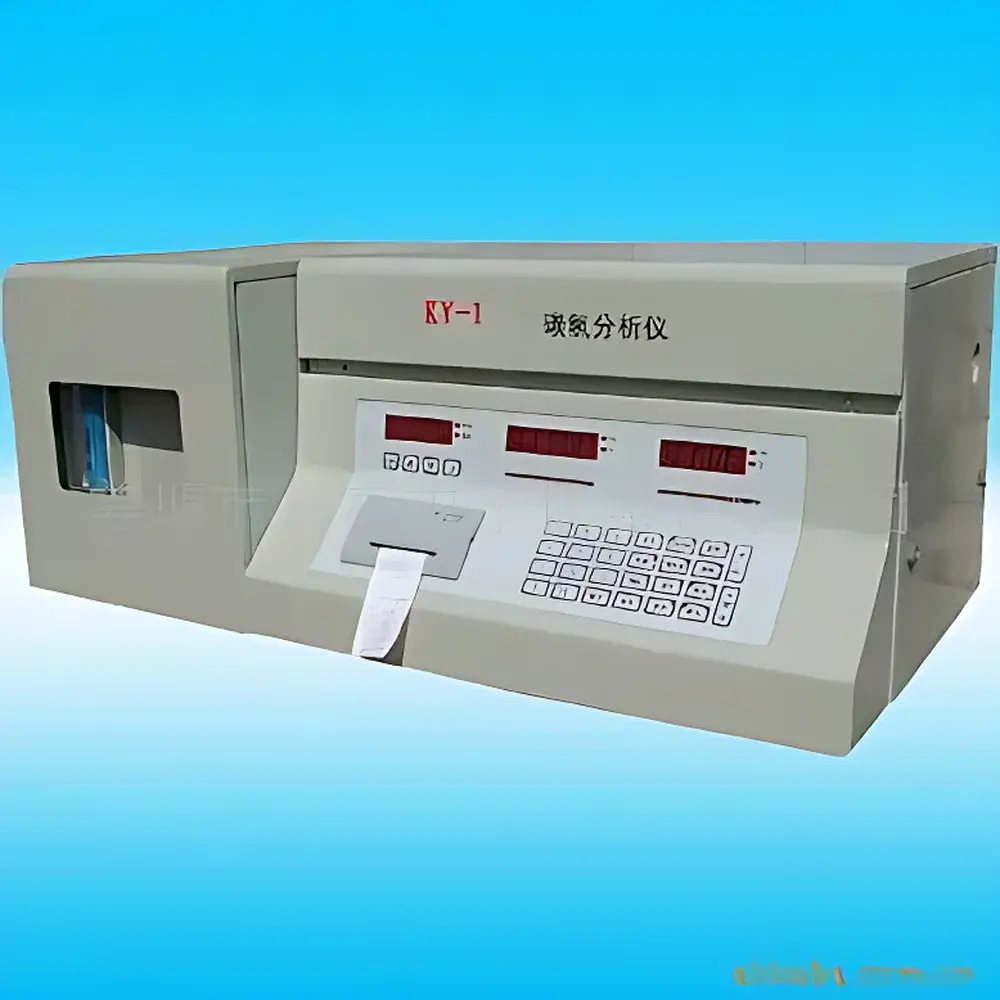
Kyoyuan KY-300 Coulometric Carbon-Hydrogen Analyzer
| Brand | Kyoyuan |
|---|---|
| Origin | Jiangsu, China |
| Manufacturer Type | Direct Manufacturer |
| Origin Category | Domestic (China) |
| Model | KY-300 |
| Price | USD 9,500 (FOB Jiangsu) |
| Measurement Principle | Coulometric Titration |
| Carbon Range | 1–99 wt% |
| Hydrogen Range | 0.1–99.9 wt% |
| Carbon Repeatability | ≤0.50% RSD |
| Hydrogen Repeatability | ≤0.15% RSD |
| Combustion Furnace Temp Range | Ambient to 1000 °C |
| Conversion Furnace Temp Range | Ambient to 500 °C |
| Temperature Control Accuracy | ±10 °C of setpoint |
| Power Supply | AC 220 V ±10%, 50 Hz |
| Rated Power | 3200 W |
| Dimensions (L×W×H) | 780 × 430 × 310 mm |
| Cooling | External electrolytic cell cooling system required |
Overview
The Kyoyuan KY-300 Coulometric Carbon-Hydrogen Analyzer is a fully automated, microprocessor-controlled instrument engineered for precise quantitative determination of total carbon and hydrogen content in solid organic materials—primarily coal, coke, biomass fuels, and other carbonaceous energy feedstocks. It operates on the principle of high-temperature combustion followed by coulometric titration: samples are combusted quantitatively in a controlled oxygen-rich atmosphere at up to 1000 °C in the primary furnace; carbon is converted to CO₂ and hydrogen to H₂O; the resulting gases pass sequentially through a catalytic conversion furnace (up to 500 °C) and a reduction furnace where CO₂ and H₂O are separated and purified. CO₂ is absorbed in a potassium hydroxide electrolyte, and its concentration is determined via coulometric titration using Faraday’s law—measuring the charge required to regenerate the titrant at the working electrode. Hydrogen content is derived from the stoichiometric water yield, also quantified coulometrically. This method eliminates gravimetric handling errors and provides direct, real-time electrochemical quantification traceable to fundamental physical constants.
Key Features
- Integrated dual-furnace architecture: independently programmable combustion furnace (ambient–1000 °C) and conversion/reduction furnace (ambient–500 °C), each with PID temperature control and digital setpoint compensation
- Microcontroller-based automation: single-chip embedded system manages ignition sequence, gas flow timing, electrolysis current regulation, endpoint detection, and data validation in real time
- High-stability coulometric cell: platinum electrodes, Ag/AgCl reference, and temperature-compensated electrolyte delivery ensure long-term baseline stability and low drift (<0.2 µA/h)
- Self-diagnostic thermal protection: dual-stage overtemperature cutoff with audible alarm and automatic furnace power shutdown if deviation exceeds ±10 °C from setpoint
- Modular gas handling: integrated O₂ purification train (CuO + Mg(ClO₄)₂), CO₂/H₂O separation column, and pressure-regulated flow control (0.5–1.2 L/min)
- Robust mechanical design: stainless-steel furnace housing, ceramic insulation, and vibration-damped base support continuous operation in industrial QC laboratories
Sample Compatibility & Compliance
The KY-300 accommodates solid samples ranging from 50 to 150 mg (typical coal subsamples per ASTM D3176 and GB/T 476). It supports heterogeneous matrices including bituminous coal, anthracite, lignite, petroleum coke, and charred biomass—provided samples are homogenized and dried to constant mass per ISO 11722. All analytical protocols comply with national and international standards: GB/T 476–2020 (Determination of carbon and hydrogen in coal), GB/T 15460–2003 (Method for analysis of carbon and hydrogen in solid fuels), and ASTM D3176–22 (Standard Practice for Ultimate Analysis of Coal and Coke). Instrument design meets general requirements for laboratory-scale combustion analyzers under ISO/IEC 17025:2017 clause 6.4.3 (equipment verification), and operational records support GLP-compliant audit trails when paired with external LIMS.
Software & Data Management
The KY-300 operates without proprietary PC software; all functions—including method setup, calibration curve storage (up to 8 user-defined curves), blank subtraction, drift correction, and statistical reporting—are executed onboard via a 4-line LED interface with membrane keypad. Results are printed directly via built-in thermal printer (20-column format) showing sample ID, date/time stamp, C% and H% values, repeatability indicators (RSD), and operator code. Raw coulometric current integrals and furnace temperature logs are retained in non-volatile memory for 99 analyses. For integration into regulated environments, optional RS-232 output enables ASCII-formatted data export to compliant laboratory information management systems (LIMS) supporting FDA 21 CFR Part 11 audit trail requirements—provided external timestamping and electronic signature modules are deployed at the host level.
Applications
- Coal quality assurance in power generation plants and coking facilities, ensuring compliance with contractual calorific value and emission factor specifications
- Research-grade elemental profiling of alternative solid fuels (e.g., torrefied wood pellets, sewage sludge ash blends) for thermochemical process modeling
- Verification of hydrogen content in activated carbons used in catalysis or gas storage, where surface functionality correlates with H/C ratio
- Quality control of metallurgical coke in blast furnace operations, where excessive hydrogen can impair reducibility and slag fluidity
- Supporting ISO 1928–2020 (solid biofuels—determination of gross calorific value) via accurate CHN input for empirical higher heating value (HHV) calculation
FAQ
What sample preparation is required prior to analysis?
Samples must be air-dried, ground to ≤200 µm particle size, and homogenized. A representative subsample (80–120 mg) is weighed precisely to 0.01 mg and encapsulated in pre-cleaned nickel or tin boats.
Is calibration required before each batch?
Yes—a certified reference material (CRM) such as NIST SRM 2682c (coal) or SARM 20 (char) must be analyzed every 10 samples or at start-of-shift to verify system linearity and recovery (target: 99.5–100.5%).
Can the instrument measure nitrogen simultaneously?
No—the KY-300 is dedicated to C/H only. Nitrogen requires separate thermal conductivity or chemiluminescence detection, available in Kyoyuan’s KY-400 CHN model.
What maintenance intervals are recommended?
Electrolyte replacement every 40–50 analyses; furnace tube inspection every 500 runs; O₂ scrubber regeneration every 200 hours of operation; full system leak check quarterly.
Does the analyzer meet CE or UL safety certification?
The KY-300 complies with IEC 61010-1:2010 for electrical safety in laboratory equipment but is not CE-marked for EU market placement; UL listing requires localized adaptation per UL 61010-1 Edition 3.





