
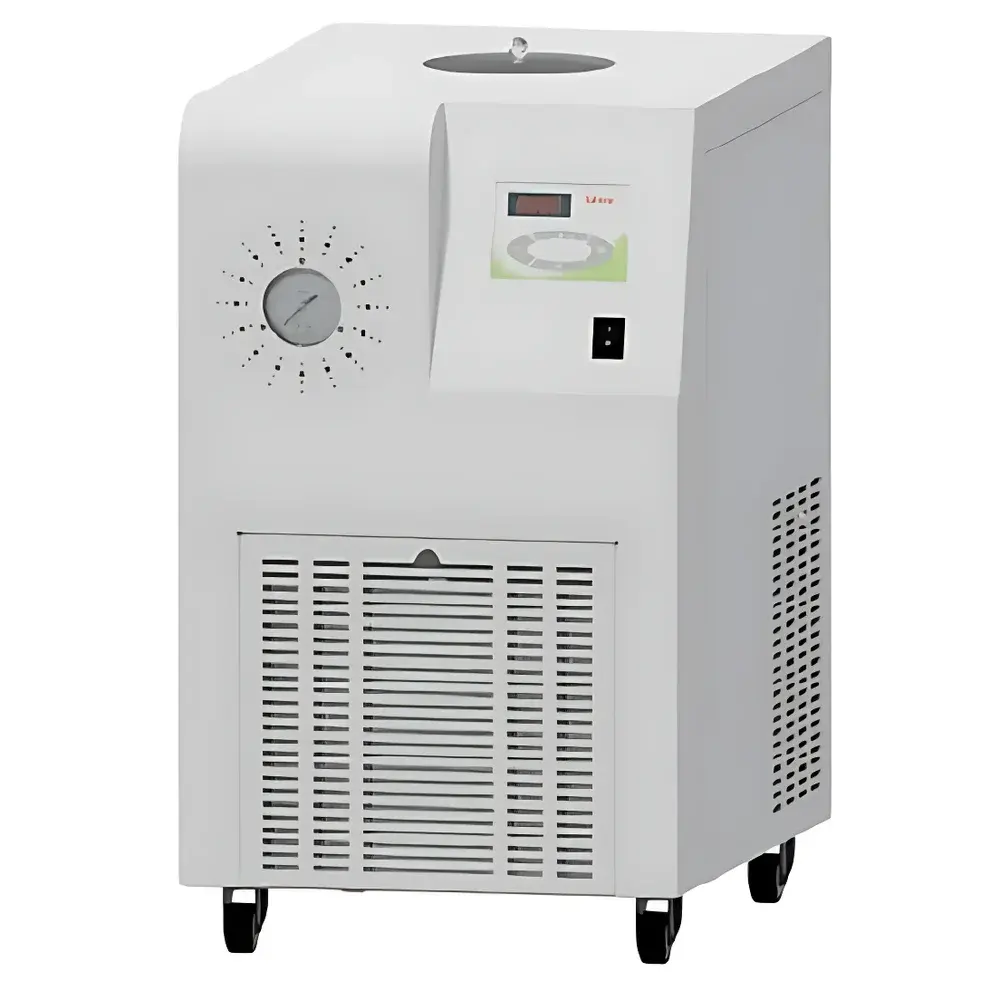
LabS FL-0904A / FL-1105A Integrated Circulating Chiller
| Brand | LabS |
|---|---|
| Origin | Guangdong, China |
| Model | FL-0904A / FL-1105A |
| Instrument Type | Integrated Circulating Chiller |
| Cooling Method | Water-Cooled |
| Temperature Range | 5–40 °C |
| Temperature Stability | ±0.5 °C |
| Refrigeration Capacity | 1600–2700 W |
| Circulating Pump Pressure | 1.0 bar |
| Circulating Pump Flow Rate | 42 L/min |
| Reservoir Volume | 8.5 L |
| Heat Exchanger Material | Stainless Steel |
| Compressor | Premium Industrial-Grade |
| Refrigerant Option | R134a or Eco-Friendly Alternative (Optional) |
| Noise Level | Low-Noise Operation |
| Control System | Microprocessor-Based Digital Controller |
| Dual-Circuit Capability | Internal + External Loop Support |
| Remote Control Interface | Optional 0–10 V or Dry Contact Input |
Overview
The LabS FL-0904A and FL-1105A are precision-engineered integrated circulating chillers designed for continuous thermal management of laboratory instrumentation requiring stable, low-noise cooling. These units operate on the vapor-compression refrigeration cycle, utilizing a high-efficiency scroll or rotary compressor paired with a stainless-steel plate heat exchanger to deliver consistent temperature control across demanding analytical and process applications. Engineered for integration with spectrometers, laser systems, ICP-OES/MS plasma sources, rotary evaporators, and other heat-sensitive equipment, they maintain setpoint accuracy within ±0.5 °C over the full 5–40 °C operating range—critical for reproducible experimental outcomes and long-term instrument reliability. The water-cooled architecture enables deployment in environments where ambient air cooling is impractical or insufficient, particularly in enclosed labs or high-heat-load configurations.
Key Features
- Microprocessor-based digital controller with real-time LED temperature display and intuitive push-button interface for rapid setpoint adjustment and status monitoring.
- Dual-circuit circulation capability: supports simultaneous internal reservoir recirculation and external closed-loop cooling of connected equipment via dedicated inlet/outlet ports.
- Industrial-grade, low-noise centrifugal pump delivering stable flow at 42 L/min against up to 1.0 bar backpressure—optimized for compatibility with narrow-bore tubing and high-resistance heat exchangers.
- Corrosion-resistant 316 stainless-steel heat exchanger ensures chemical inertness and eliminates leaching risks when cooling aqueous or mildly aggressive media (e.g., glycol-water mixtures, buffer solutions).
- High-reliability hermetic compressor from a Tier-1 OEM supplier, rated for >20,000 hours MTBF under continuous operation at rated load.
- Optional remote start/stop functionality via analog voltage (0–10 V DC) or dry contact signal—enabling seamless synchronization with host instruments’ operational cycles per ASTM E2912 and ISO/IEC 17025-compliant workflows.
- Modular refrigerant configuration: standard R134a or optional A2L-class low-GWP alternatives (e.g., R1234yf) to support institutional sustainability targets and regulatory compliance in EU and North American markets.
Sample Compatibility & Compliance
These chillers are compatible with deionized water, 30–50% ethylene glycol/water mixtures, and other non-corrosive, low-viscosity heat transfer fluids. They meet CE marking requirements for electromagnetic compatibility (EMC Directive 2014/30/EU) and low-voltage safety (LVD Directive 2014/35/EU). While not certified to UL 61010-1 or IEC 61010-1 out-of-the-box, units can be factory-modified to comply upon request—supporting GLP/GMP-aligned validation protocols. All electrical interfaces adhere to IP20 ingress protection, and mechanical construction follows ISO 14644-1 Class 8 cleanroom-compatible assembly practices.
Software & Data Management
The embedded controller logs runtime parameters—including setpoint, actual temperature, pump status, and compressor duty cycle—at 1-minute intervals for up to 30 days. Data export is supported via USB flash drive (CSV format), enabling traceability for audit trails required under FDA 21 CFR Part 11 (when used in regulated QC/QA environments with supplementary electronic signature controls). No proprietary software is required; exported logs integrate natively with LabWare LIMS, Empower, or custom Python/MATLAB analysis pipelines.
Applications
- Stabilizing optical path temperatures in FTIR, UV-Vis, and fluorescence spectrophotometers.
- Managing thermal drift in high-power diode lasers and solid-state amplifiers.
- Cooling plasma torches and nebulizers in ICP-based elemental analyzers.
- Maintaining condenser temperature during solvent recovery in rotary evaporation systems.
- Providing auxiliary cooling for HPLC column ovens and detector cells under gradient elution conditions.
- Supporting temperature-sensitive bioreactor jacketing and calorimetry cell conditioning in academic and pharmaceutical research labs.
FAQ
What is the maximum allowable ambient temperature for continuous operation?
Rated performance is guaranteed at ambient temperatures ≤35 °C with adequate ventilation (minimum 300 mm clearance on all sides). Derating applies above this threshold.
Can the chiller operate with pure water in hard-water regions?
Deionized or softened water is strongly recommended; untreated hard water may cause scale buildup in the stainless-steel heat exchanger over time, impairing thermal efficiency and voiding the 2-year compressor warranty.
Is RS-485 or Modbus RTU communication available as a factory option?
Yes—Modbus RTU over RS-485 is available as an optional communication module (order code: FL-COM-MB), enabling integration into building management systems (BMS) and centralized lab monitoring platforms.
Does the unit include a built-in filtration system for the circulating fluid?
A 50-µm inline particulate filter is installed upstream of the pump inlet; replacement cartridges (part no. FL-FIL-50) are supplied with each unit and should be serviced every 6 months under normal use.
What validation documentation is provided for GxP-regulated laboratories?
Factory-supplied IQ/OQ templates (in English) are included, aligned with ASTM E2500 and Annex 15. PQ execution requires site-specific sensor calibration and load testing per user-defined acceptance criteria.



