
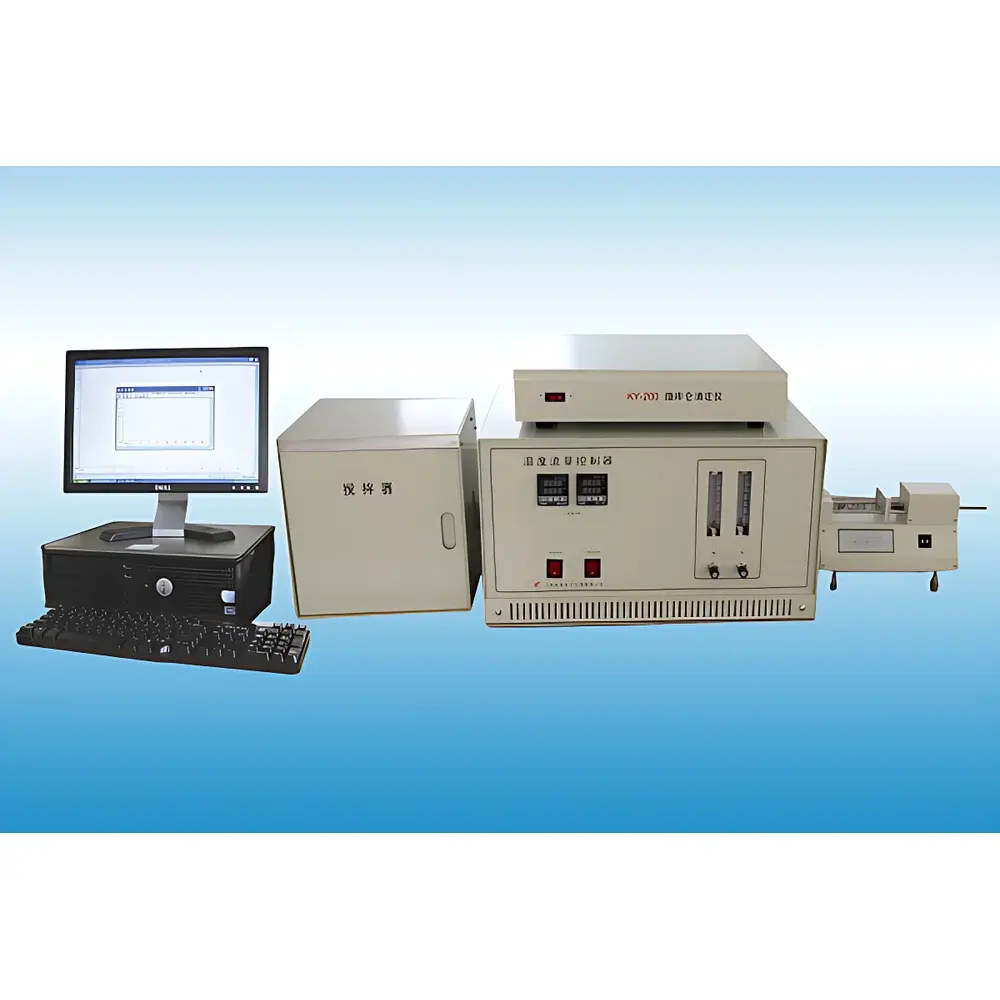
Kyoyuan KY-200CL Microcoulometric Chlorine Analyzer for Solid Waste
| Brand | Kyoyuan |
|---|---|
| Origin | Jiangsu, China |
| Manufacturer Type | Direct Manufacturer |
| Regional Classification | Domestic (China) |
| Model | KY-200CL |
| Price Range | USD 2,800 – 7,000 |
| Measurement Principle | Microcoulometric Titration (Silver Coulometric Detection) |
| Sample Forms | Solid, Liquid, Gas (with optional injectors) |
| Chlorine Range | 0.2 mg/L – 10,000 mg/L (dilution required above 5,000 mg/L) |
| Detection Limit | 0.2 mg/L (as Cl) |
| Precision | RSD ≤3% for [Cl] >10 mg/L |
| Temperature Control | Ambient to 1100 °C, ±1 °C |
| Power Requirement | 1500 W |
| Carrier Gases | Industrial-grade N₂ and O₂ |
| Cooling Method | Intelligent Fan-cooled Cracking System |
| Compliance Standards | GB/T 18612–2011, ASTM D5808–2009 |
Overview
The Kyoyuan KY-200CL Microcoulometric Chlorine Analyzer for Solid Waste is a dedicated electrochemical measurement system engineered for the precise quantification of total chlorine in heterogeneous solid matrices—including soil, sludge, fly ash, polymer residues, and incineration byproducts—as well as liquid and gaseous samples. It operates on the fundamental principle of microcoulometric titration: sample material is combusted in a high-temperature quartz furnace under controlled N₂/O₂ atmosphere (typically 800–1000 °C), converting all organic and inorganic chlorine species quantitatively to hydrogen chloride (HCl). The evolved HCl is swept into a dual-electrode coulometric titration cell, where Ag⁺ ions are generated electrolytically at the anode and react stoichiometrically with Cl⁻ in solution. The charge consumed during this reaction is measured in real time; applying Faraday’s law (1 mole Cl⁻ ≡ 96,485 C), the instrument computes absolute chlorine mass in the original sample. This method delivers trace-level sensitivity without calibration curves, eliminating matrix-dependent drift and ensuring method robustness across complex waste streams.
Key Features
- True microcoulometric detection architecture with Ag/Ag⁺ reference electrode pair and high-stability electrolyte circulation system
- Programmable high-temperature cracking zone (ambient to 1100 °C) with ±1 °C PID control and integrated thermal shielding for reproducible pyrolysis
- Fan-cooled, auto-start/stop cracking module—no external water chiller required, minimizing operational overhead
- Dual-channel digital coulometer with 16-bit ADC resolution and real-time charge integration algorithm
- Modular sample introduction: compatible with solid boat autosampler (for powders, granules, filter media), liquid syringe injector, and gas loop valve (optional)
- Embedded industrial PC with Windows-based Kyoyuan ChemLab v3.2 software for full sequence control, data acquisition, and audit-ready reporting
Sample Compatibility & Compliance
The KY-200CL is validated for direct analysis of solid waste per Chinese regulatory frameworks including HJ 680–2013 (Soil and Sediment—Determination of Total Chlorine by Microcoulometry) and GB/T 18612–2011 (Crude Oil—Determination of Organic Chlorine Content). Its oxidation protocol ensures complete conversion of refractory chlorinated compounds (e.g., PCBs, chlorinated benzenes, metal chlorides) into measurable HCl, making it suitable for EPA SW-846 Method 9056A-equivalent applications. The system supports GLP-compliant workflows: all method parameters, raw charge integrals, temperature logs, and operator IDs are timestamped and stored with SHA-256 hash integrity. Optional 21 CFR Part 11 compliance package includes electronic signatures, role-based access control, and immutable audit trails.
Software & Data Management
Kyoyuan ChemLab v3.2 provides a deterministic, script-driven environment for method development and routine operation. Users define multi-step temperature ramps, gas flow sequences, and titration gain settings via intuitive parameter grids. Real-time plots display cell current, accumulated charge, and furnace temperature—enabling immediate troubleshooting of incomplete combustion or electrolyte saturation. All results export to CSV, PDF, or LIMS-compatible XML formats. Data files include embedded metadata (sample ID, analyst, date/time, instrument serial number, calibration history), satisfying ISO/IEC 17025 documentation requirements. Batch processing supports statistical evaluation (mean, SD, RSD, confidence intervals) across up to 99 samples per run.
Applications
- Regulatory testing of landfill leachate solids and contaminated soils for total chlorine prior to disposal or remediation
- QC monitoring of municipal solid waste incinerator bottom ash and flue gas cleaning residues
- Research on dechlorination efficiency of thermal treatment processes (e.g., plasma arc, rotary kiln)
- Analysis of halogenated flame retardants (PBDEs, HBCDs) in e-waste plastics after acid digestion or direct pyrolysis
- Verification of chlorine removal in catalyst regeneration streams from petrochemical refining units
- Method validation studies supporting ISO 14040 life cycle assessment of chlorinated polymer recycling pathways
FAQ
What sample preparation is required for solid waste analysis?
Minimal preparation: homogenize and dry samples to constant weight; particle size should be ≤100 mesh. No acid digestion or extraction is needed—the instrument performs complete oxidative conversion in situ.
Can the KY-200CL distinguish between organic and inorganic chlorine?
No—it reports total chlorine content. Speciation requires coupling with GC-MS or XPS prior to analysis; however, method selectivity can be tuned via cracking temperature optimization (e.g., low-T for volatile organochlorines vs. high-T for metal chlorides).
Is routine maintenance labor-intensive?
Maintenance is limited to quarterly replacement of quartz cracking tube, biannual electrolyte refresh (AgNO₃/KNO₃ in CH₃CN/H₂O), and annual calibration verification using certified KCl standards traceable to NIST SRM 955c.
How does the system handle high-chlorine samples (>5000 mg/kg)?
Automatic dilution is not supported; users must manually prepare diluted subsamples using certified blank matrix (e.g., silica sand) to maintain linearity and avoid titration cell saturation.
Does the analyzer support remote diagnostics or network integration?
Yes—Ethernet port enables remote desktop access for technical support, and OPC UA server option allows seamless integration with plant-wide DCS or MES systems for automated result ingestion.






