
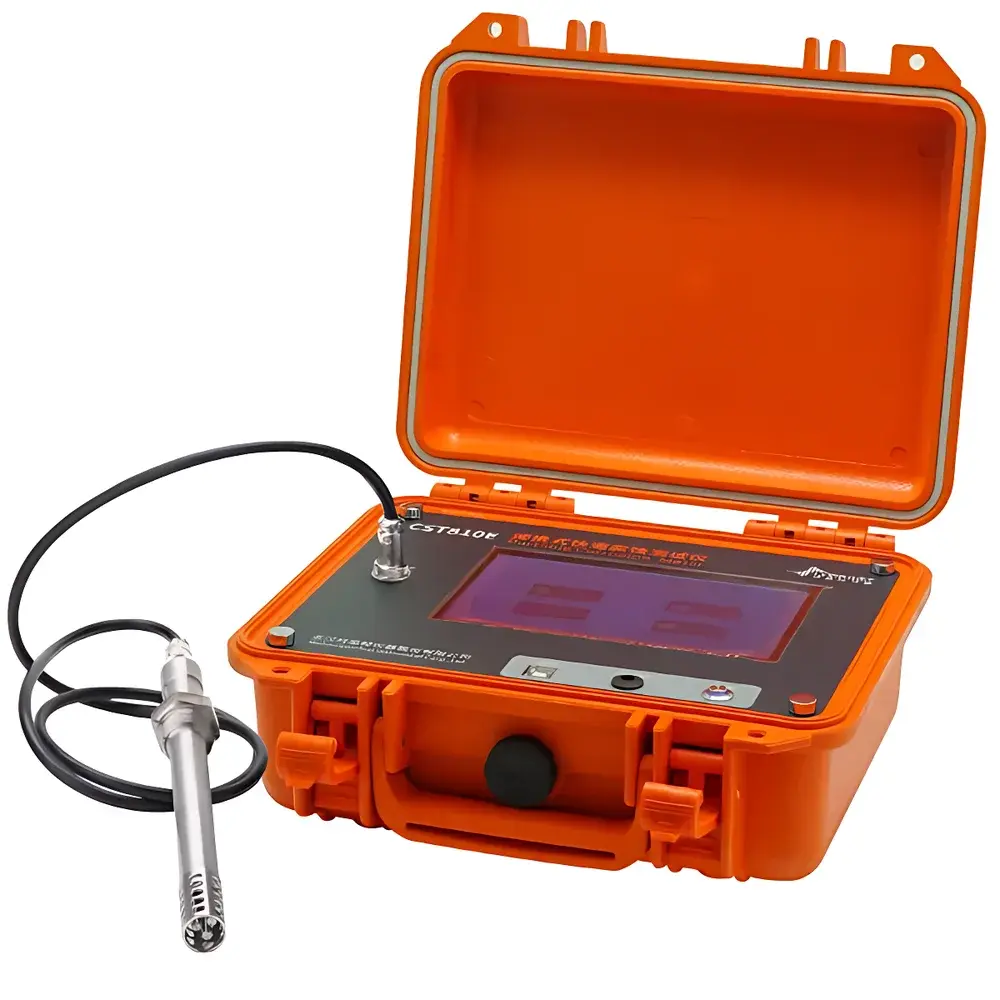
CorrTest CST810E Portable Electrochemical Corrosion Rate Monitor
| Brand | CorrTest |
|---|---|
| Origin | Hubei, China |
| Model | CST810E |
| Measurement Principle | Linear Polarization Resistance (LPR) + Electrochemical Impedance Spectroscopy (EIS) |
| Channels | 1 |
| Corrosion Rate Range | 0.1 μm/a – 10 mm/a |
| Accuracy | ±1% FS |
| Input Impedance | 1×10¹¹ Ω |
| Corrosion Potential Range | −2.5 V to +2.5 V |
| Potential Resolution | 0.1 mV |
| Solution Resistance (Rs) Range | 10 Ω – 500 kΩ |
| Polarization Resistance (Rp) Range | 10 Ω – 10 MΩ |
| AC Signal Amplitude | 1–100 mV RMS |
| Frequency Range | 0.001 Hz – 10 kHz |
| Timing Interval | 1–255 hours |
| Real-Time Clock Drift | <1 min/month |
| Data Storage | 10,000 records (timestamped) in 8 MB Flash memory |
| Power | Rechargeable Li-ion battery (60 h continuous operation) |
| Dimensions | 260 × 165 × 200 mm |
| Weight | 3.5 kg |
| Operating Temperature | −30 °C to +60 °C |
| Humidity | ≤100% RH (non-condensing) |
| Enclosure Material | Industrial-grade polymer |
| IP Rating | IP65 |
| Communication | USB 2.0, RS-232 serial interface |
| Software | EIS Tools v3.x (Windows-based, supports ASTM G102, ISO 9223, NACE SP0169, and GLP-compliant data audit trails) |
Overview
The CorrTest CST810E Portable Electrochemical Corrosion Rate Monitor is an engineered field instrument designed for quantitative, non-destructive assessment of metallic corrosion kinetics in high-resistivity electrolytes—such as oil-contaminated water, soil, concrete pore solution, and atmospheric condensates. It operates on two complementary electrochemical principles: Linear Polarization Resistance (LPR), which provides rapid, real-time estimation of instantaneous corrosion current density (icorr) via small-amplitude potential perturbation near the open-circuit potential (OCP); and low-frequency Electrochemical Impedance Spectroscopy (EIS), which resolves both polarization resistance (Rp) and uncompensated solution resistance (Rs) across a broad frequency domain (0.001 Hz – 10 kHz). This dual-mode capability ensures robust corrosion rate calculation even when Rs dominates total cell impedance—a common limitation in conventional LPR-only instruments. The device complies with ASTM G59 (Standard Practice for Conducting Potentiodynamic Polarization Resistance Measurements), ASTM G102 (Standard Practice for Calculation of Corrosion Rates and Related Information from Electrochemical Measurements), and ISO 9223 (Corrosion of metals and alloys — Corrosivity of atmospheres — Classification, determination and estimation). Its architecture eliminates reliance on reference electrode stability assumptions by directly measuring Rs, enabling accurate correction of icorr in heterogeneous or resistive media.
Key Features
- Single-channel, dual-mode electrochemical measurement: simultaneous LPR and EIS acquisition with automatic Rs compensation
- High-input-impedance (>1011 Ω) potentiostat circuitry for stable OCP monitoring and minimal current leakage in high-resistance environments
- Programmable autonomous operation: internal real-time clock enables scheduled measurements at user-defined intervals (1–255 hours), supporting unattended long-term field deployment
- Integrated 8 MB flash memory with timestamped storage of up to 10,000 complete datasets—including OCP, Rp, Rs, icorr, and calculated corrosion rate (μm/a or mm/a)
- Rechargeable lithium-ion battery providing ≥60 hours of continuous operation; compatible with universal AC adapter for lab recharging
- Ruggedized IP65-rated enclosure rated for outdoor and industrial site use, including exposure to dust, rain, and temperature extremes (−30 °C to +60 °C)
- Dual-control interface: local keypad navigation plus full remote command via RS-232 or USB, supporting integration into SCADA or centralized corrosion management systems
Sample Compatibility & Compliance
The CST810E is optimized for immersion, embedded, or surface-mounted electrochemical sensors in conductive-to-semiconductive media where traditional galvanic or weight-loss methods are impractical. It interfaces seamlessly with standard three-electrode corrosion probes (e.g., CP-81 stainless steel/Ag|AgCl probe), laboratory electrolytic cells, and custom-reinforced concrete electrodes. Its wide Rs range (10 Ω – 500 kΩ) and adaptive signal amplitude control (1–100 mV) ensure reliable performance in soils (resistivity >1000 Ω·m), hydrocarbon-water emulsions, and chloride-diffused cementitious systems. All measurements adhere to NACE SP0169 (Control of External Corrosion on Underground or Submerged Metallic Piping Systems) and support GLP/GMP audit requirements through EIS Tools’ built-in electronic signature, operator ID logging, and immutable data timestamps. Raw impedance spectra and time-series parameters are exportable in CSV and native .eis formats for third-party analysis (e.g., ZView®, EC-Lab®).
Software & Data Management
EIS Tools v3.x is a Windows-based corrosion data acquisition and visualization platform certified for use in regulated environments. It establishes bidirectional communication with the CST810E via USB or serial port, enabling full configuration, real-time telemetry, and batch download of stored records. The software automatically computes corrosion rate using Stern-Geary constants (user-definable), plots time-resolved Rp, Rs, OCP, and icorr trends, and overlays multiple datasets for comparative analysis (e.g., inhibitor screening across dosages or locations). All graphical outputs include SI-unit labeling, grid annotations, and customizable scaling. Data integrity is maintained through FDA 21 CFR Part 11–compliant features: role-based access control, electronic signatures, change history logs, and encrypted database backups (.mdb/.sqlite). Reports are exportable to PDF or Excel, with optional inclusion of instrument calibration certificates and measurement uncertainty statements per ISO/IEC 17025 guidelines.
Applications
- Real-time corrosion rate monitoring of carbon steel pipelines in oilfield produced water systems, particularly where high salinity or hydrocarbon content elevates solution resistance
- In-situ evaluation of corrosion inhibitors in refinery process streams, cooling water circuits, and offshore injection lines
- Long-term assessment of reinforcement corrosion in chloride-exposed concrete bridges, tunnels, and marine structures using embedded LPR/EIS probes
- Field validation of cathodic protection (CP) effectiveness in buried pipeline networks, including IR-drop compensated potential mapping
- Accelerated corrosion testing in soil simulant cells for geotechnical and environmental remediation studies
- Research-grade electrochemical characterization of novel alloy passivation behavior under variable pH, temperature, and redox conditions
FAQ
Does the CST810E require a reference electrode for valid measurements?
Yes—it operates in a standard three-electrode configuration (working, counter, and reference electrodes). The included CP-81 probe integrates a miniature Ag/AgCl reference, but external saturated calomel (SCE) or Cu/CuSO₄ electrodes may be used depending on application requirements.
Can the instrument distinguish between uniform and localized corrosion?
No—the CST810E quantifies average corrosion current density and derived penetration rate. Detection of pitting or crevice initiation requires complementary techniques such as electrochemical noise (EN) analysis or zero-resistance ammetry (ZRA), which are not supported by this model.
Is firmware upgrade supported in the field?
Yes—firmware updates are delivered via USB using EIS Tools and preserve all stored calibration coefficients and user settings.
What is the minimum measurable polarization resistance?
The lower limit is 10 Ω, corresponding to very high corrosion rates (>10 mm/a) in aggressive acidic or low-resistivity electrolytes.
How does the instrument handle unstable open-circuit potentials during measurement?
It applies dynamic OCP stabilization logic: delaying LPR/EIS execution until potential drift falls below 0.5 mV/min over a 60-second window, ensuring thermodynamic equilibrium prior to perturbation.



