
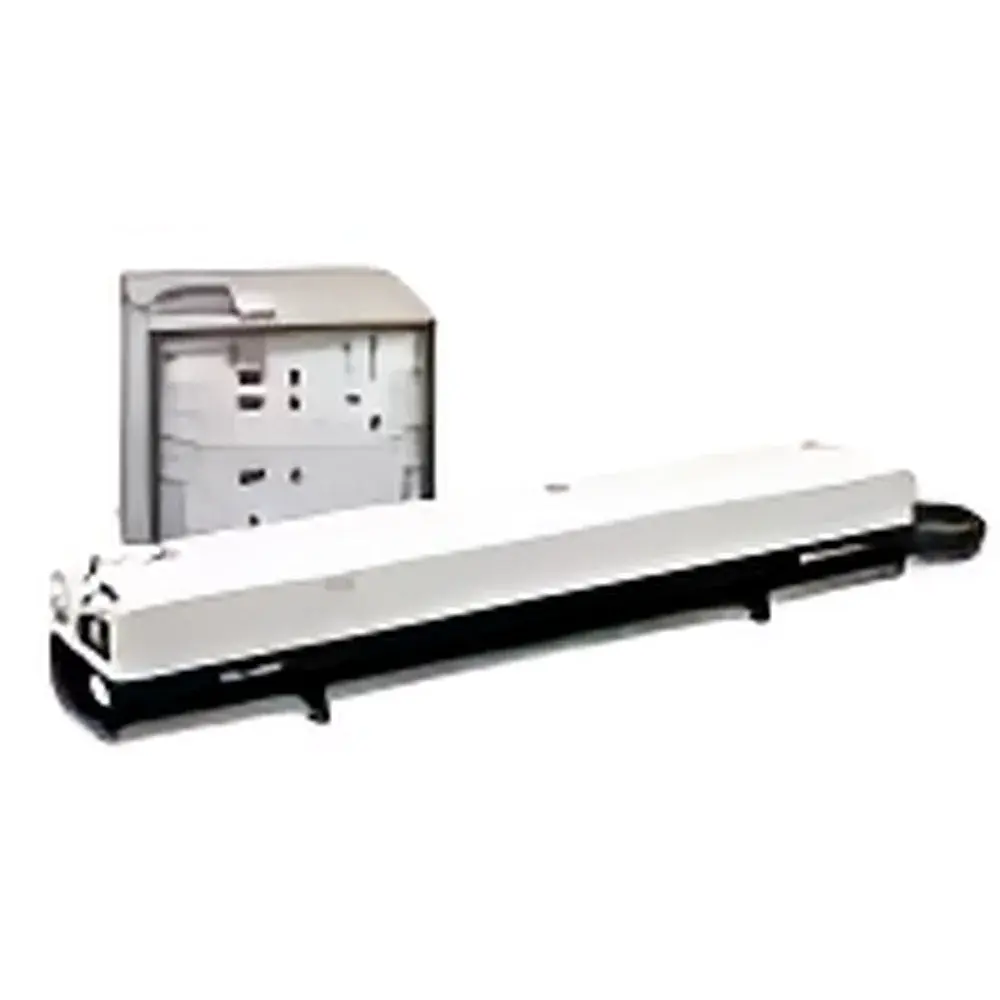
Ekspla PL2140 Series Picosecond Mode-Locked Nd:YAG Laser
| Brand | Ekspla |
|---|---|
| Origin | Lithuania |
| Manufacturer Type | OEM Manufacturer |
| Product Type | Solid-State Laser System |
| Model | PL2140 |
| Pulse Energy | up to 110 mJ |
| Wavelength | 1064 nm (fundamental) |
| Pulse Width | < 30 ps (FWHM) |
| Repetition Rate | 10–20 Hz |
| Pulse-to-Pulse Energy Stability | < 1.5% RMS (24 h) |
| Long-Term Energy Stability | < 1.0% RMS (8 h) |
| Timing Jitter | < 100 ps RMS |
| Beam Profile | Near-Gaussian, M² < 1.3 |
| Harmonic Generation Options | 2ω (532 nm), 3ω (355 nm), 4ω (266 nm) |
| Synchronization Interface | TTL/CMOS trigger input & output, < 1 ns delay accuracy |
| Control Interface | LabVIEW-compatible drivers, RS-232 and USB communication |
| Mode-Locking Method | Solid-State Passive Mode-Locking (SESAM-based), dye-free operation |
Overview
The Ekspla PL2140 Series is a high-reliability, diode-pumped, passively mode-locked solid-state Nd:YAG laser system engineered for demanding ultrafast scientific applications requiring picosecond temporal resolution. Operating at the fundamental wavelength of 1064 nm, the PL2140 leverages semiconductor saturable absorber mirror (SESAM) technology to achieve stable, self-starting passive mode-locking—eliminating the need for organic dye cells and their associated maintenance, degradation, and alignment sensitivity. This architecture ensures long-term operational robustness, reproducible pulse formation, and sub-100 ps timing jitter—critical for pump-probe spectroscopy, time-resolved fluorescence, optical parametric generation synchronization, and ultrafast material interaction studies. The laser delivers up to 110 mJ per pulse with pulse durations under 30 ps (FWHM), supporting both single-shot and repetitive acquisition modes across a precisely tunable 10–20 Hz repetition rate range. Its near-diffraction-limited beam quality (M² < 1.3) and smooth spatial profile enable efficient harmonic conversion and high-fidelity coupling into downstream optics, including optical parametric generators (e.g., PG400, PG500, PG411/511) and ultrafast spectrometers.
Key Features
- Solid-state passive mode-locking via SESAM—no dye replacement, no solvent handling, no thermal drift-induced cavity realignment
- High pulse energy stability (< 1.5% RMS over 24 h) and exceptional long-term energy reproducibility (< 1.0% RMS over 8 h)
- Precise external synchronization capability: TTL/CMOS-compatible trigger input/output with < 1 ns timing resolution and < 100 ps RMS jitter
- Integrated harmonic generation support: compatible with standard 2ω (532 nm), 3ω (355 nm), and 4ω (266 nm) nonlinear crystals for broad spectral coverage
- Full remote control via RS-232 and USB interfaces; native LabVIEW driver suite enables seamless integration into automated measurement environments
- Industrial-grade mechanical design with active cooling management and sealed optical cavity—optimized for continuous laboratory operation under GLP-compliant conditions
Sample Compatibility & Compliance
The PL2140 is designed for integration into regulated and research-grade optical laboratories. Its timing precision and pulse parameter repeatability meet requirements for traceable ultrafast metrology workflows compliant with ISO/IEC 17025 calibration frameworks. When operated in conjunction with optical parametric amplifiers or time-correlated single-photon counting (TCSPC) systems, the laser supports measurements referenced to ASTM E2750 (Standard Practice for Ultrafast Laser-Based Spectroscopic Measurements) and IEC 60825-1 (Laser Product Safety). All electrical and optical interfaces conform to CE marking directives (EMC 2014/30/EU, LVD 2014/35/EU), and firmware logs maintain audit-ready timestamps for GMP/GLP documentation. No hazardous substances are employed in the mode-locking mechanism, eliminating REACH-restricted material concerns associated with traditional dye-based systems.
Software & Data Management
The PL2140 includes a comprehensive software development kit (SDK) supporting Windows and Linux platforms. The native LabVIEW driver library provides low-level access to all operational parameters—including repetition rate setpoint, Q-switch delay, harmonic selection, and internal diagnostics—enabling full programmability within custom experimental sequences. Real-time monitoring of pulse energy (via integrated photodiode feedback), cavity temperature, and pump diode current is available through ASCII-based serial protocol or binary USB streaming. All configuration changes and system events are timestamped and logged locally, satisfying FDA 21 CFR Part 11 requirements for electronic records when deployed in regulated analytical environments. Optional MATLAB and Python API wrappers extend interoperability with open-source data analysis pipelines.
Applications
- Pump-probe transient absorption spectroscopy of photoactive materials and molecular dynamics
- Time-resolved Raman and CARS microscopy with sub-picosecond temporal gating
- Optical parametric generation (OPG/OPA) seeding for tunable ultrafast sources (e.g., PG400/PG500 series)
- Ultrafast laser-induced breakdown spectroscopy (LIBS) and ablation studies
- Calibration of streak cameras, fast photodetectors, and time-of-flight mass spectrometers
- Nonlinear optical characterization including two-photon absorption cross-section measurements
FAQ
Is the PL2140 fully compatible with third-party optical parametric generators?
Yes—the PL2140’s pulse energy, timing jitter, and beam specifications are optimized for direct integration with Ekspla’s PG400, PG500, and PG411/511 OPG/OPA systems, and it meets industry-standard synchronization requirements for non-Ekspla parametric devices.
Does the system support harmonic generation out-of-the-box?
Harmonic generation modules (SHG, THG, FHG) are optional accessories; the laser’s cavity and beam delivery are pre-aligned for rapid integration of commercially available nonlinear crystals.
Can the repetition rate be adjusted during operation without realignment?
Yes—repetition rate tuning between 10 Hz and 20 Hz is fully software-controlled and maintains optical alignment and pulse stability without manual intervention.
What level of traceability is provided for pulse energy calibration?
Each unit ships with NIST-traceable calibration certificate for the internal energy monitor; optional external calorimeter-based recalibration services are available through Ekspla’s accredited service centers.
Is remote operation supported over Ethernet or only via USB/RS-232?
Standard communication is RS-232 and USB; Ethernet connectivity requires an optional industrial interface module (Ekspla part #NET-IF-PL2140), which supports TCP/IP command protocol and SNMP status reporting.





