
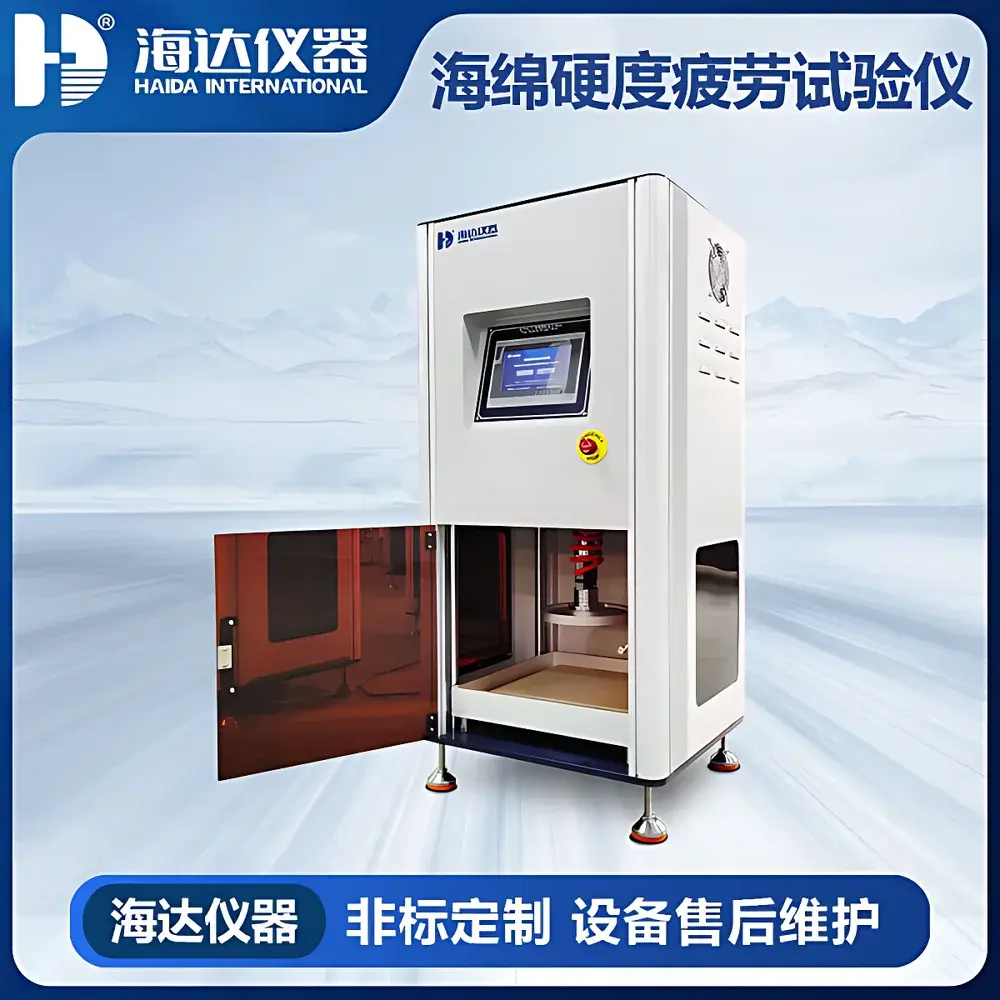
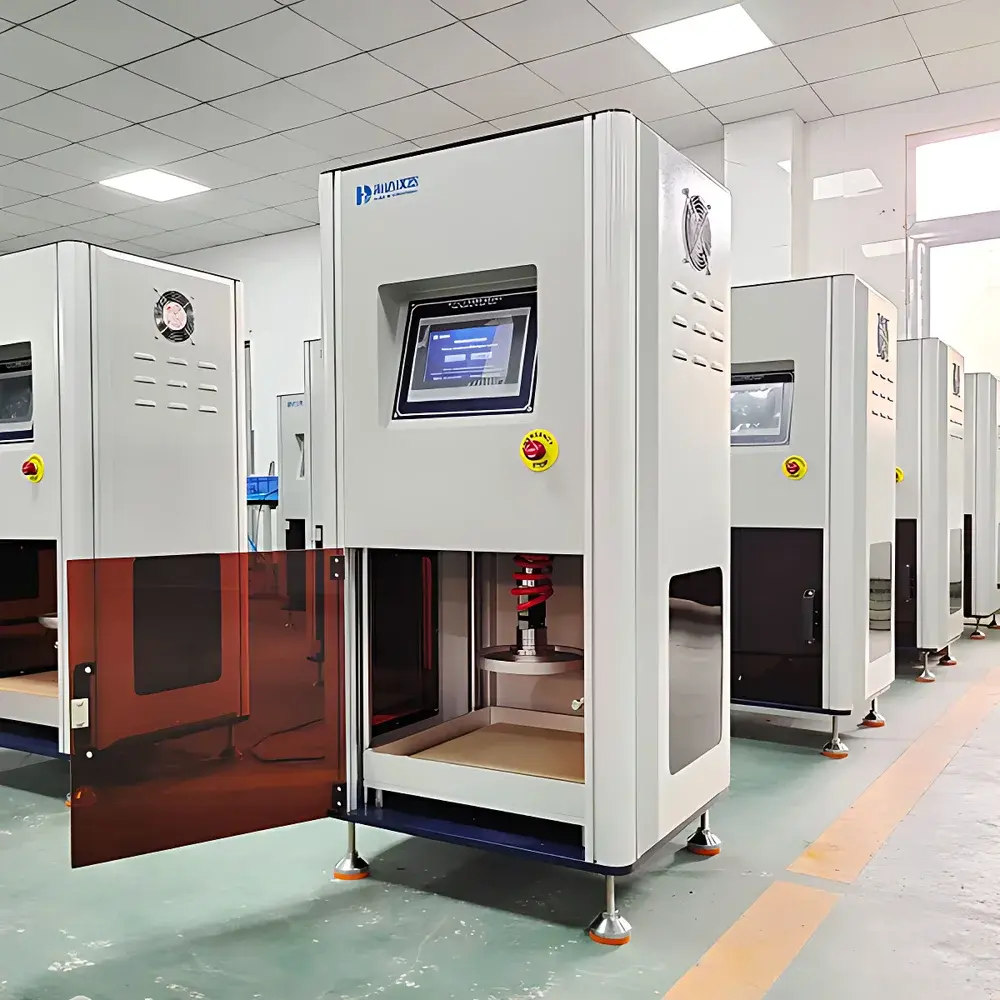
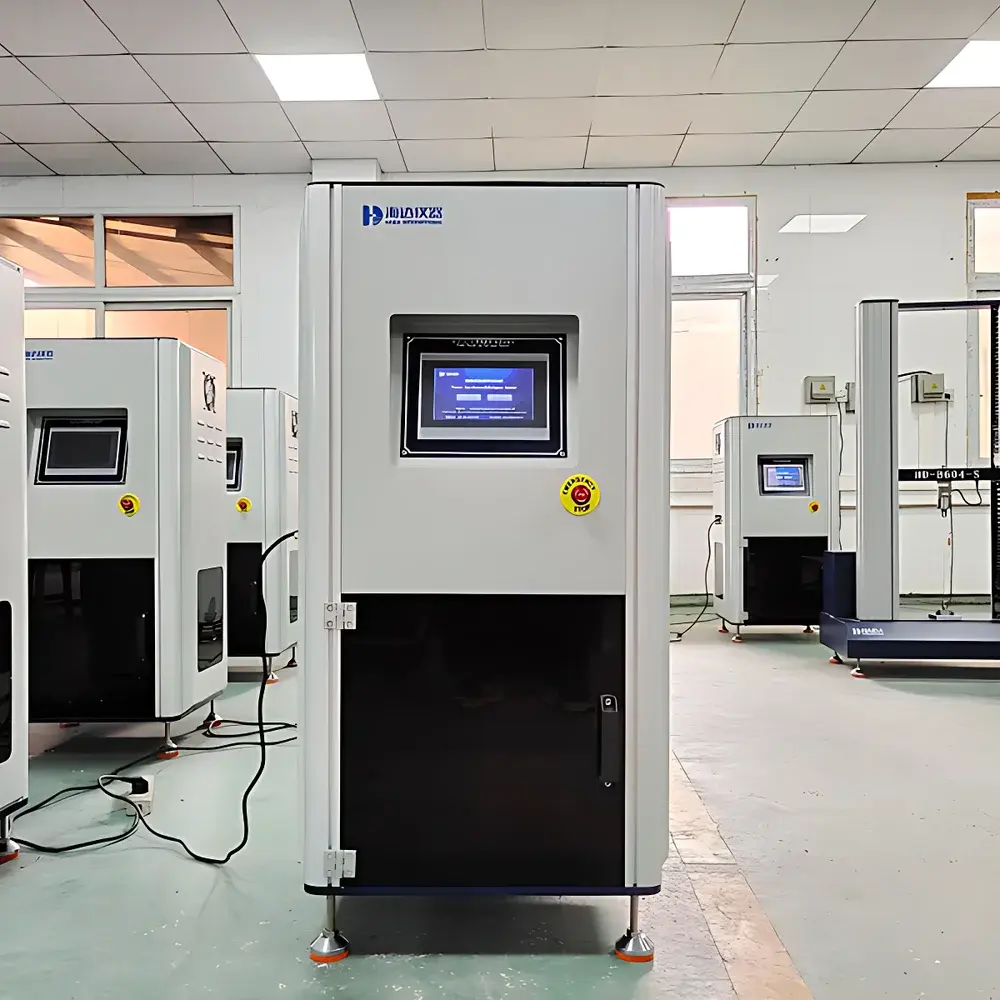
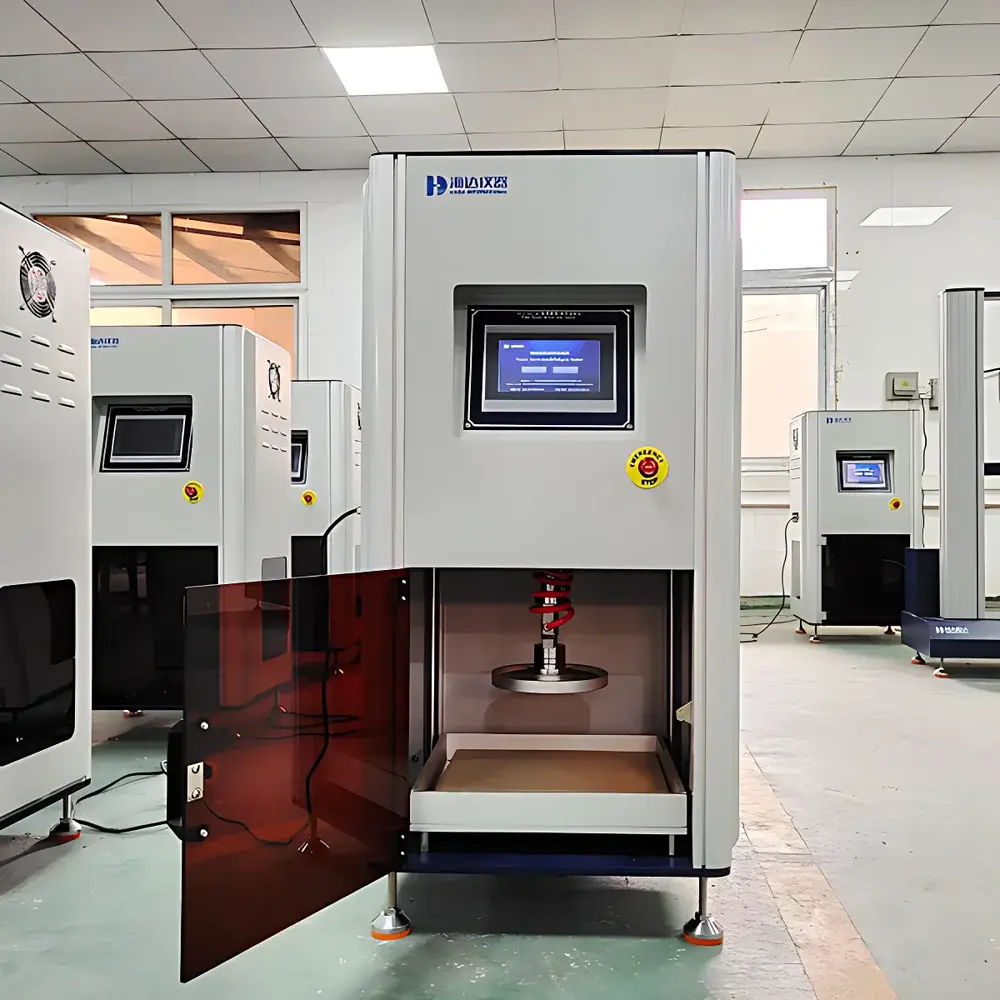
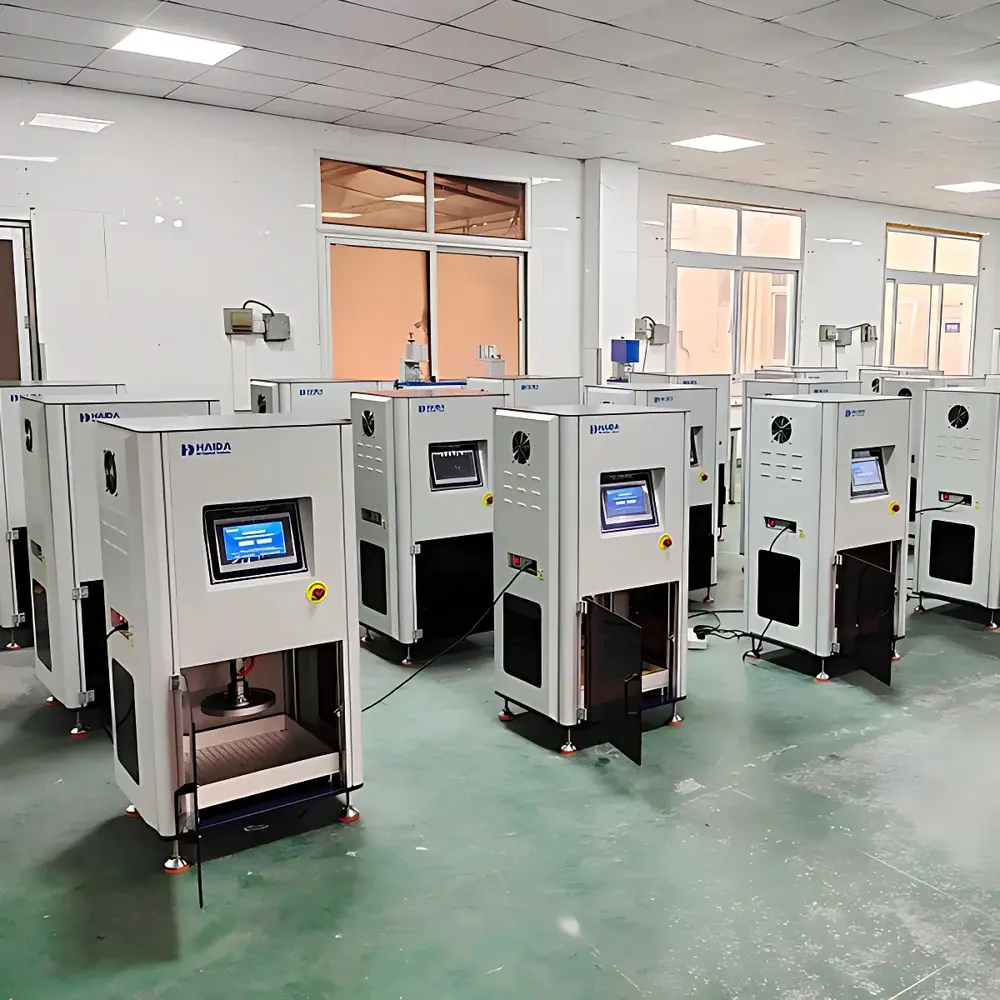
HAIDA HD-F750-1A Sponge Hardness and Fatigue Testing Machine
| Brand | HAIDA INTERNATIONAL |
|---|---|
| Origin | Guangdong, China |
| Manufacturer Type | Direct Manufacturer |
| Product Origin | Domestic (China) |
| Model | HD-F750-1A |
| Max Test Force | 1–1300 N |
| Fatigue Frequency | 70 ± 5 cycles/min (per GB/T 18941-2003 & ISO 3385:2014) |
| Host Weight | ~80 kg |
| Max Specimen Dimensions | 380 × 380 × 150 mm (L×W×H) |
| Standard Specimen Size (GB/ISO) | 380 × 380 × 50 mm |
| ASTM Standard Specimen Size | 380 × 380 × 100 mm |
| Cycle Count Range | 1–999,999 (user-definable) |
| Indentation Speed | 100 ± 20 mm/min (per GB/T 12825-2003, ISO 2439:2008, GB/T 10807-2006) |
| Fatigue Stroke Speed | 250 ± 25 mm/min (per ASTM D3574, Test Point I3) |
| Hardness Test Stroke | 180 mm |
| Effective Force Range | 1–1300 N |
| Overall Dimensions | 600 × 500 × 1080 mm (L×W×H) |
| Power Supply | 1∮ AC 220 V |
| Rated Power | ~850 W |
| Control Interface | Touchscreen |
| Load Cell Control | Integrated PCB-based closed-loop control |
| Fixture Mounting | Magnetic coupling for rapid tool change |
Overview
The HAIDA HD-F750-1A Sponge Hardness and Fatigue Testing Machine is an electromechanical testing system engineered for precision evaluation of compressive mechanical behavior in flexible polymeric foams—including polyurethane, latex, viscoelastic, and reticulated sponge materials. It operates on the principle of controlled cyclic indentation using a standardized flat-ended platen to quantify both static hardness (via progressive load-displacement response) and dynamic fatigue resistance (via repeated compression-relaxation cycles under defined amplitude, frequency, and dwell conditions). Designed in strict alignment with international standard methodologies—including ISO 2439:2008 (Indentation Hardness), ISO 3385:2014 (Fatigue Behavior), ASTM D3574 (Foam Testing—Test I3 for fatigue), GB/T 12825-2003, GB/T 18941-2003, and GB/T 10807-2006—the instrument delivers repeatable, traceable, and auditable data suitable for QC release, R&D benchmarking, and regulatory documentation.
Key Features
- High-fidelity force measurement across a wide dynamic range (1–1300 N) using calibrated load cells with integrated signal conditioning and real-time digital filtering.
- Dual-mode operational architecture supporting both static indentation hardness testing (A/B/C methods per ISO 2439) and long-term cyclic fatigue evaluation (up to 999,999 cycles).
- Modular platen system with magnetic quick-coupling interface enabling tool-free exchange between Φ200 mm (R1 mm edge radius) and Φ250 mm (R25 mm edge radius) indenters—each geometry validated per ISO and ASTM dimensional tolerances.
- Touchscreen HMI with embedded firmware offering intuitive parameter configuration, real-time force/displacement waveform visualization, and automatic pass/fail flagging based on user-defined thresholds (e.g., permanent set >10%, force decay >15%).
- Rigid structural frame (steel-reinforced base and vertical column) ensuring minimal deflection (<0.02 mm at full load), critical for maintaining test repeatability across extended fatigue runs.
- Compliance-ready hardware design featuring non-volatile memory logging, timestamped event records (start/stop/error), and configurable audit trails—foundational for GLP/GMP-aligned laboratories.
Sample Compatibility & Compliance
The HD-F750-1A accommodates specimens up to 380 × 380 × 150 mm, with standard test configurations aligned to three major regulatory frameworks: (i) ISO-compliant 380 × 380 × 50 mm specimens for hardness and fatigue; (ii) ASTM D3574-specified 380 × 380 × 100 mm blocks for high-amplitude fatigue assessment; and (iii) custom geometries supported via user-defined stroke limits and force ceilings. All test protocols adhere to documented standard operating procedures (SOPs) referencing ISO 17025:2017 requirements for method validation. The system supports compliance with FDA 21 CFR Part 11 when paired with HAIDA’s optional secure software package (v3.2+), which includes electronic signatures, role-based access control, and immutable data export in CSV/PDF formats.
Software & Data Management
The proprietary HAIDA TestSuite v3.x software provides full lifecycle test management—from method creation and calibration certificate import to raw data export and statistical summary reporting. Each test session generates a structured metadata file containing operator ID, environmental conditions (optional external sensor integration), calibration status, and instrument firmware revision. Data acquisition occurs at ≥100 Hz sampling rate, preserving transient responses during initial loading and recovery phases. Export options include ASCII-compatible CSV (with header definitions per ASTM E178), PDF test reports with embedded graphs (force vs. time, displacement vs. cycle number), and XML for LIMS integration. Audit logs record all parameter modifications, user logins, and system errors—retained for ≥12 months unless purged per institutional retention policy.
Applications
- Quality control of automotive seat foams, mattress cores, and packaging cushioning materials against hardness drift or compression set accumulation.
- Material development studies evaluating crosslink density effects on fatigue life under variable frequency (70 ± 5 cpm) and stroke depth (180 mm).
- Supplier qualification where ISO 3385-compliant fatigue endurance (e.g., ≤5% residual deformation after 80,000 cycles) is contractually mandated.
- Regulatory submissions requiring evidence of mechanical stability over shelf life—particularly for medical-grade foam components used in wound dressings or orthopedic supports.
- Failure analysis investigations correlating microstructural degradation (e.g., cell wall fracture observed via SEM) with macroscopic performance loss measured by the HD-F750-1A.
FAQ
Does the HD-F750-1A support automated calibration verification per ISO 9513?
Yes—integrated reference load checks are performed at three points (20%, 60%, and 100% of full scale) prior to each test batch, with results logged and exportable.
Can test methods be password-protected to prevent unauthorized modification?
Yes—role-based permissions (Admin, Technician, Viewer) are enforced at the firmware level; method editing requires Level 3 credentials.
Is third-party software integration (e.g., LabVIEW, MATLAB) supported?
Yes—TCP/IP and RS-232 communication protocols are implemented, with documented API commands for remote start/stop, data streaming, and status polling.
What maintenance intervals are recommended for long-term reliability?
Load cell zero-point verification every 30 days; linear guide lubrication and belt tension check every 6 months; full metrological recalibration annually or after 50,000 cycles—whichever occurs first.
Are validation documents (IQ/OQ/PQ protocols) available for GxP environments?
Yes—HAIDA provides template protocols compliant with ASTM E2500 and Annex 11, including installation verification checklists, operational boundary testing matrices, and performance qualification acceptance criteria.



