
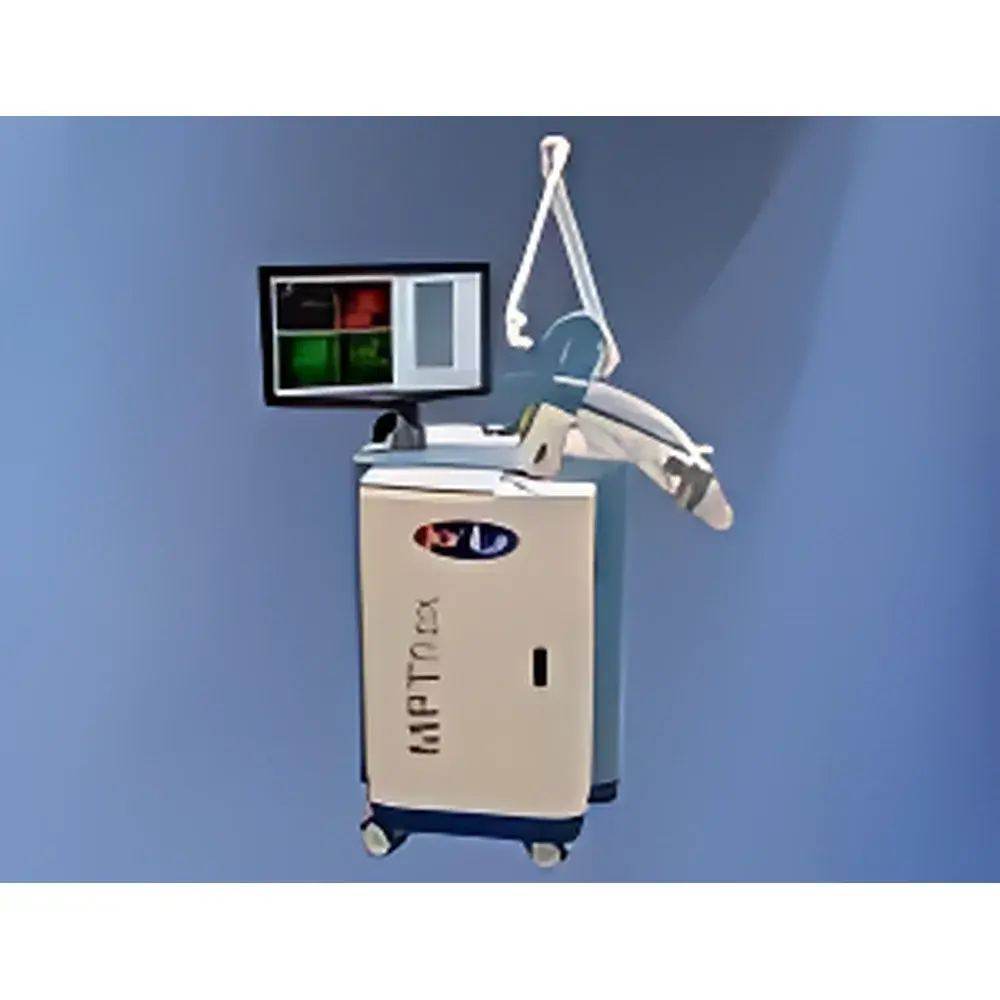
JenLab MPTflex Compact Non-invasive Multiphoton Tomographic Imaging System
| Brand | JenLab |
|---|---|
| Origin | Germany |
| Model | MPTflex |
| Laser Source | Near-infrared femtosecond laser |
| Spatial Resolution | Subcellular (≤0.5 µm lateral, ≤1.5 µm axial) |
| Imaging Depth | Up to 200 µm in human skin *in vivo* |
| Detection Mode | Fluorescence & Second Harmonic Generation (SHG) |
| Clinical Compliance | CE-marked as Class IIa medical device per MDR 2017/745 |
| Software Platform | MPTconnect v5.x with FDA 21 CFR Part 11–ready audit trail and GLP/GMP-compatible data archiving |
Overview
The JenLab MPTflex Compact Non-invasive Multiphoton Tomographic Imaging System is an engineered solution for label-free, real-time, high-resolution optical sectioning of living tissue at the subcellular level. Based on multiphoton excitation—primarily two-photon fluorescence (TPF) and second harmonic generation (SHG)—the system leverages near-infrared (NIR) femtosecond pulsed laser illumination (typically 760–860 nm) to achieve intrinsic optical sectioning without physical sectioning or exogenous contrast agents. Its non-invasive design enables longitudinal *in vivo* monitoring in clinical dermatology, preclinical research, and translational tissue engineering applications. The MPTflex integrates a compact, air-cooled Ti:sapphire laser, galvo-resonant scanning optics, and high-sensitivity GaAsP photomultiplier tubes (PMTs), delivering robust signal-to-noise performance while maintaining ergonomic usability in both examination rooms and core imaging facilities.
Key Features
- Subcellular resolution imaging: ≤0.5 µm lateral and ≤1.5 µm axial resolution in native tissue, enabling visualization of keratinocyte morphology, melanosome distribution, collagen fiber orientation, and elastin network architecture.
- Femtosecond NIR laser source: Tunable 760–860 nm output with pulse duration <100 fs, optimized for deep-tissue penetration and minimal photodamage during repeated acquisitions.
- Simultaneous multimodal detection: Parallel acquisition of TPF (e.g., NAD(P)H, FAD, melanin) and SHG (collagen I/III) signals with spectral unmixing capability via configurable emission filters.
- Compact benchtop architecture: Integrated optical path, motorized Z-stage, and lightweight handheld probe (optional) support flexible deployment in dermatology clinics, animal labs, and teaching environments.
- Real-time volumetric reconstruction: Onboard GPU-accelerated rendering engine generates en face, cross-sectional, and 3D-rendered datasets with sub-second frame rates (up to 30 fps at 512 × 512 pixels).
- Regulatory-ready platform: CE-marked under EU MDR 2017/745 as a Class IIa medical device; software complies with ALCOA+ principles and supports 21 CFR Part 11–compliant electronic signatures and audit trails.
Sample Compatibility & Compliance
The MPTflex is validated for direct, contact-based imaging of intact human skin *in vivo*, including volar forearm, facial regions, and lesional sites (e.g., melanocytic nevi, actinic keratosis). It accommodates murine, porcine, and avian models for preclinical pharmacokinetic and toxicological studies. All optical components meet ISO 13485:2016 manufacturing standards. Device operation adheres to IEC 60825-1:2014 (laser safety class 1M during clinical use) and EN 62304:2006 (medical device software lifecycle). Data export formats include DICOM-SR, TIFF stack, and HDF5—ensuring interoperability with PACS, LIS, and institutional research data management systems.
Software & Data Management
MPTconnect v5.x provides a unified interface for acquisition, processing, annotation, and reporting. Core modules include automated epidermal/dermal layer segmentation, quantitative fluorescence intensity profiling, SHG anisotropy mapping, and time-lapse drift correction. Raw data are stored with embedded metadata (operator ID, timestamp, laser power, scan parameters) and encrypted checksums. Audit logs record all user actions—including image deletion, parameter modification, and report generation—with immutable timestamps. For regulated environments, optional validation packages support IQ/OQ/PQ documentation and GxP-aligned archive retention policies.
Applications
- Clinical dermatology: Non-invasive diagnosis and margin assessment of melanoma, basal cell carcinoma, and inflammatory dermatoses via morphological and metabolic contrast.
- Translational dermatotoxicology: Real-time evaluation of topical drug penetration, UV-induced DNA damage response, and antioxidant efficacy in human skin equivalents.
- Tissue engineering: Dynamic monitoring of extracellular matrix remodeling, stem cell differentiation, and scaffold integration in 3D bioprinted constructs.
- Cosmeceutical research: Objective quantification of collagen density changes, barrier function recovery, and pigmentary response following anti-aging interventions.
- Developmental biology: Longitudinal imaging of embryonic skin morphogenesis and neural crest-derived melanocyte migration in zebrafish and chick embryos.
- Academic training: Hands-on instruction in nonlinear optics, optical biopsy principles, and digital pathology workflows aligned with ACGME and EADV curriculum guidelines.
FAQ
Is the MPTflex suitable for regulatory submission in clinical trials?
Yes—the system’s CE marking, 21 CFR Part 11–ready software, and traceable calibration protocol support use in Phase II/III dermatology trials requiring objective imaging endpoints.
Can it be integrated with existing confocal or OCT platforms?
MPTflex supports hardware synchronization via TTL triggers and offers SDK access for custom integration with third-party modalities, though co-registration requires external mechanical alignment fixtures.
What maintenance is required for long-term stability?
Annual laser power calibration and PMT gain verification are recommended; JenLab provides remote diagnostics and on-site service contracts compliant with ISO 13485 servicing requirements.
Does it support live animal imaging beyond skin?
Yes—cranial window preparations in mice, corneal imaging in rabbits, and intestinal mucosa visualization in ex vivo organ culture have been published using MPTflex configurations with water-immersion objectives.
How is data security handled for multi-center studies?
Data encryption at rest (AES-256) and in transit (TLS 1.2+), role-based access control, and anonymization tools ensure compliance with GDPR, HIPAA, and local ethics board mandates.




