
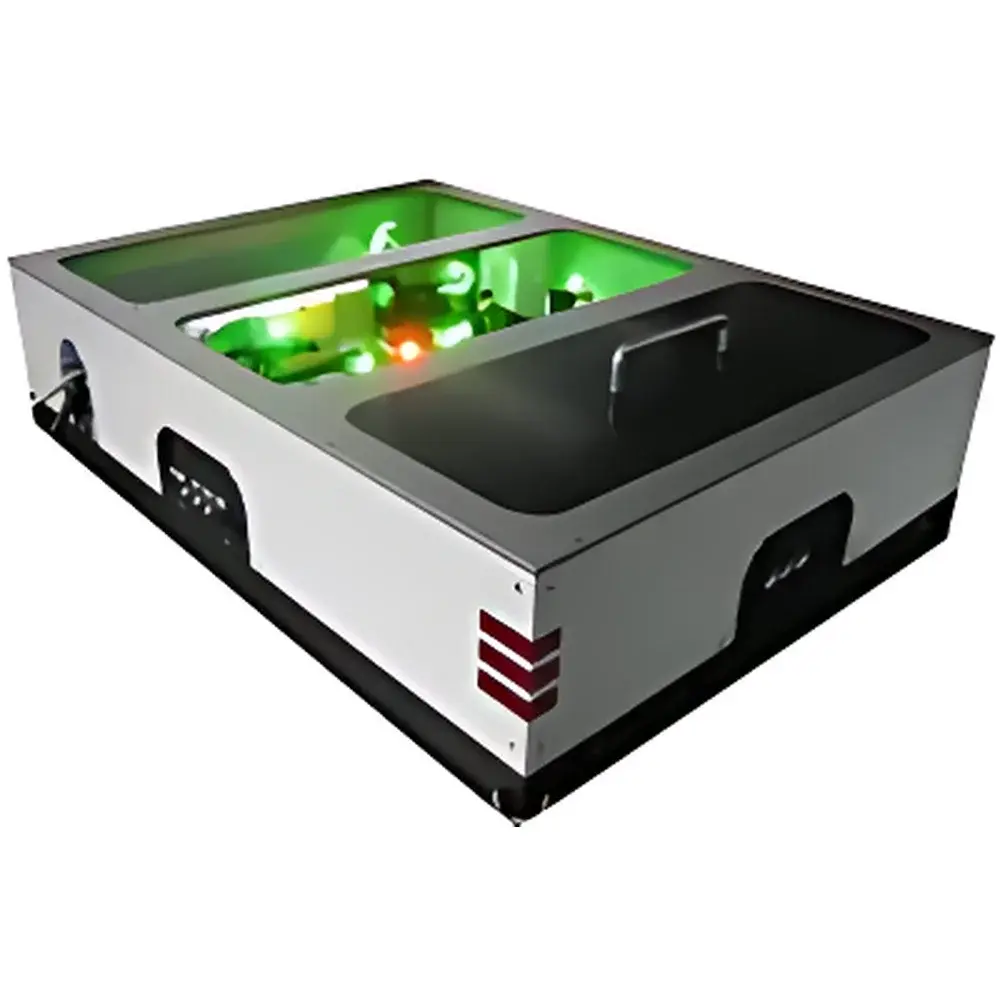
VENTEON PULSE:ONE BASIC Femtosecond Ti:Sapphire Laser System
| Brand | VENTEON |
|---|---|
| Origin | Germany |
| Type | Imported |
| Model | Basic Edition (BE) |
| Pump Laser | Integrated 3–4 W DPSS, umbilical-free |
| Spectral Bandwidth | >200 nm (@ −10 dBc) |
| Pulse Duration | <8 fs |
| Pulse Energy | >2.5 nJ |
| Repetition Rate | 80 MHz |
| RMS Intensity Noise | <0.5 % |
| Beam Height | 76.2 mm |
| Dimensions (L×W×H) | 608 × 268 × 117 mm |
| Weight | ~40 kg |
| Cooling | Optional water-cooled base plate |
| Design | Monolithic, rigid optomechanical integration |
| Compliance | Designed for GLP-aligned lab environments |
Overview
The VENTEON PULSE:ONE BASIC is a turnkey femtosecond titanium:sapphire (Ti:Sa) laser system engineered for precision ultrafast science in resource-constrained laboratory settings. Operating on the fundamental principle of Kerr-lens mode-locking (KLM), it generates transform-limited optical pulses with durations under 8 femtoseconds directly from the oscillator—without external compression—leveraging the broad gain bandwidth of Ti:Sa crystal (typically spanning 650–1100 nm). Its monolithic architecture integrates all critical optomechanical components—including the Ti:Sa crystal, high-damage-threshold mirrors, and dispersion-compensating chirped mirrors—onto a single, thermally stable base plate. This design eliminates alignment-sensitive mounts and minimizes mechanical drift, enabling long-term passive stability without active stabilization electronics. The system is pumped by an integrated, umbilical-free 3–4 W diode-pumped solid-state (DPSS) laser operating at 532 nm, delivering sub-8 fs pulses at 80 MHz repetition rate with >2.5 nJ pulse energy and spectral bandwidth exceeding 200 nm (measured at −10 dBc), corresponding to near-Fourier-transform-limited time-domain performance. It serves as a foundational source for time-resolved spectroscopy, multiphoton microscopy, and pump-probe investigations where reliability, footprint efficiency, and operational simplicity are prioritized over ultra-high average power.
Key Features
- Monolithic “rock-solid” mechanical design with direct mounting of optics onto a rigid, optionally water-cooled aluminum base plate—reducing adjustable elements to a minimum and eliminating thermal-induced misalignment.
- Umbilical-free 3–4 W DPSS green pump laser integrated within the same chassis, minimizing coupling losses and enhancing system robustness and portability.
- Sub-8 fs pulse duration directly from oscillator output, verified via autocorrelation and spectral phase characterization (e.g., FROG or SPIDER-ready configuration).
- Beam height standardized at 76.2 mm (3 inches) for seamless integration into existing optical tables and commercial microscope or spectrometer platforms.
- RMS intensity noise <0.5 % (10 Hz–10 MHz), ensuring high signal-to-noise ratio in quantitative time-resolved measurements.
- Compact footprint of only 260 mm × 600 mm—among the smallest in its class—enabling deployment in space-limited cleanrooms, teaching labs, or mobile research units.
Sample Compatibility & Compliance
The PULSE:ONE BASIC is designed for use with standard Ti:Sa-compatible optical components and does not require sample interaction per se; rather, it functions as a coherent excitation source for downstream instrumentation. Its output is compatible with common ultrafast diagnostics (e.g., second-harmonic generation autocorrelators, spectrometers with ≥0.1 nm resolution, RF spectrum analyzers for noise analysis) and nonlinear optical setups (e.g., OPA pumping, THz generation). From a regulatory standpoint, the system adheres to IEC 60825-1:2014 (laser safety classification Class IV) and incorporates interlock-ready connectors for integration into facility-wide safety protocols. Its stable, hands-off operation supports GLP-compliant experimental workflows, and its reproducible pulse parameters facilitate traceable calibration against NIST-traceable reference standards (e.g., via calibrated photodiodes and autocorrelators). While not FDA-certified as a medical device, its design aligns with engineering controls referenced in ISO 13485 for R&D-grade instrumentation used in preclinical biophotonics development.
Software & Data Management
The PULSE:ONE BASIC operates as a fully autonomous, hardware-controlled oscillator—no proprietary software is required for basic operation. All critical parameters (pump power, cavity alignment status, thermal load feedback) are monitored via embedded analog sensors and displayed on the front-panel LED interface. For advanced integration, analog monitoring outputs (0–10 V) are provided for pulse energy, pump power, and cavity temperature, enabling synchronization with external DAQ systems (e.g., National Instruments PXI, Keysight U1000 series) and LabVIEW- or Python-based automation frameworks. The system’s deterministic startup behavior and minimal warm-up drift (<0.5 % power variation over 4 hours) eliminate the need for real-time closed-loop feedback in most applications. Audit trails for operational logs (e.g., cumulative runtime, thermal cycles) can be recorded externally via TTL-triggered timestamps, supporting 21 CFR Part 11–aligned documentation practices when paired with validated electronic lab notebook (ELN) systems.
Applications
- Multiphoton fluorescence microscopy (MPM) requiring high peak intensity and minimal photodamage—particularly in live-tissue imaging where <10 fs pulses improve axial resolution and reduce background scattering.
- Transient absorption and time-resolved photoluminescence spectroscopy, where sub-8 fs timing resolution enables direct observation of carrier thermalization, exciton formation, and vibronic coherences in quantum materials.
- Pump-probe experiments in surface science and catalysis, leveraging the system’s low RMS noise and long-term amplitude stability for reliable differential reflectivity measurements at µOD sensitivity.
- Seed source for chirped-pulse amplification (CPA) systems and optical parametric amplifiers (OPAs), where oscillator stability directly impacts amplified pulse contrast and temporal fidelity.
- Ultrafast electron diffraction (UED) and photoelectron spectroscopy (PES) setups demanding jitter-free synchronization between optical pump and electron probe pulses.
FAQ
Is the PULSE:ONE BASIC suitable for industrial OEM integration?
Yes—the monolithic design, absence of fiber coupling, and standardized beam height make it well-suited for embedding into larger instruments such as commercial ultrafast microscopes or portable spectroscopic analyzers.
Does the system support wavelength tuning?
No—this is a fixed-center-wavelength oscillator optimized for maximum bandwidth near 790 nm; tunability requires external prism or grating compressors and is not part of the BASIC edition.
What cooling options are available beyond air cooling?
The base plate includes threaded ports and gasketed interfaces for direct connection to facility chilled water (8–25 °C), significantly improving thermal management during extended operation or in ambient temperatures above 28 °C.
Can the pulse duration be verified in-house?
Yes—autocorrelation traces can be acquired using commercially available SHG autocorrelators (e.g., APE PulseCheck, Swamp Optics GRENOUILLE); the system’s high spatial coherence and M² <1.1 ensure reliable measurement repeatability.
Is remote monitoring or control supported?
Basic analog monitoring signals (pulse energy, pump power, temperature) are accessible via BNC outputs; full digital control is not implemented in the BASIC edition to preserve simplicity and long-term reliability.




