
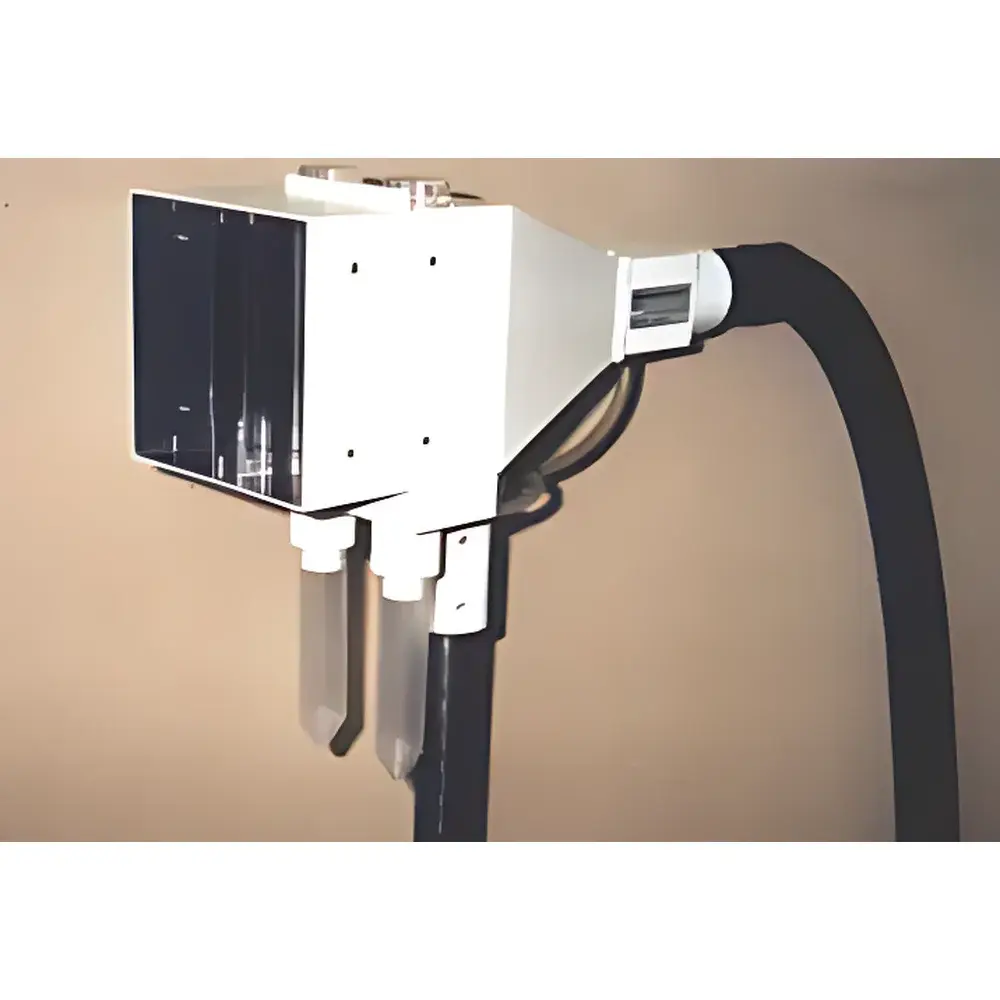
Eigenbrodt NES 210 Fog Water Sampler
| Brand | Eigenbrodt |
|---|---|
| Origin | Germany |
| Manufacturer Type | Authorized Distributor |
| Origin Category | Imported |
| Model | NES 210 |
| Pricing | Available Upon Request |
Overview
The Eigenbrodt NES 210 Fog Water Sampler is a precision-engineered atmospheric hydrometeor collection instrument designed for quantitative, long-term fog water harvesting and chemical analysis in ecological and meteorological research. Operating on the principle of inertial impaction combined with controlled laminar flow separation, the NES 210 captures fog droplets (typically 1–40 µm aerodynamic diameter) from ambient air without significant evaporation or re-entrainment losses. Developed in collaboration with the German Weather Service (Deutscher Wetterdienst) and the Meteorological Observatory Hohenpeißenberg under the scientific guidance of Dr. Peter Winkler, the sampler integrates aerodynamic design rigor with field-deployable robustness. Its dual-inlet configuration draws ambient air at a calibrated volumetric flow rate of 125 m³/h, ensuring representative sampling across variable fog events while maintaining low pressure drop and minimal turbulence—critical for preserving droplet integrity and minimizing post-collection evaporation.
Key Features
- Aerodynamically optimized dual-inlet geometry with semi-circular flow guidance to suppress vortex formation and ensure laminar airflow through the impactor chamber
- Patented sedimentation chamber featuring a central vertical channel connected to a capillary-porous compression surface—enabling efficient droplet coalescence via combined capillary action and controlled low-pressure suction
- Edge-retention flanges on both sides of the sedimentation chamber prevent re-suspension of deposited liquid under high-velocity airflow conditions
- Two independent, chemically inert collection bottles (typically borosilicate glass or fluoropolymer-lined) mounted symmetrically for parallel or sequential sampling and cross-validation
- Modular stainless-steel and anodized aluminum construction rated for continuous outdoor deployment in alpine, coastal, and forested environments (IP65 enclosure rating)
- No moving parts or power requirements—passive operation ensures zero electromagnetic interference and compatibility with remote, off-grid monitoring stations
Sample Compatibility & Compliance
The NES 210 is validated for collection of natural fog water containing dissolved ions (e.g., Cl⁻, NO₃⁻, SO₄²⁻), trace metals (e.g., Fe, Zn, Pb), organic compounds (e.g., formic acid, methanesulfonic acid), and stable isotopes (δ²H, δ¹⁸O). Its inert wetted path minimizes adsorption and leaching artifacts, supporting compliance with ISO 16140-2 (validation of microbiological methods) and ASTM D5905 (standard practice for collection of atmospheric precipitation). When integrated into GLP-compliant environmental monitoring networks, the sampler supports traceable chain-of-custody protocols for subsequent ion chromatography (IC), ICP-MS, and isotope ratio mass spectrometry (IRMS) analysis. It meets structural and operational requirements outlined in the WMO Guide to Instruments and Methods of Observation (CIMO Guide, Chapter 12, Fog and Cloud Water Sampling).
Software & Data Management
As a passive mechanical sampler, the NES 210 does not incorporate embedded electronics or firmware. However, it is fully interoperable with external environmental data acquisition systems—including Campbell Scientific CR1000X, Vaisala WXT530, or Onset HOBO U30 loggers—via auxiliary sensors (e.g., wind speed/direction, relative humidity, temperature, visibility) deployed in proximity. Sample metadata (start/end time, ambient conditions, volume collected) is recorded manually or via barcode-scanned field logs synchronized to UTC timestamps. For regulatory reporting, collected data aligns with EPA Method IO-3.3 (Fog and Cloud Water Collection) and supports audit-ready documentation under 21 CFR Part 11 when paired with electronic lab notebooks (ELNs) featuring electronic signatures and version-controlled workflows.
Applications
- Quantifying fog drip contributions to hydrological budgets in cloud forests and Mediterranean ecosystems
- Tracing atmospheric transport pathways of marine aerosols, anthropogenic pollutants, and biogenic volatile organic compounds (BVOCs)
- Long-term trend analysis of nitrogen deposition and acidification in sensitive alpine catchments
- Isotopic fingerprinting of fog water sources (e.g., oceanic vs. continental moisture origin) for paleoclimate proxy development
- Calibration and validation of satellite-based fog detection algorithms (e.g., MODIS, Sentinel-3 SLSTR) and numerical weather prediction (NWP) models
- Baseline characterization for environmental impact assessments near industrial zones or transportation corridors
FAQ
What is the recommended maintenance interval for the NES 210 in continuous field deployment?
Routine inspection and cleaning of the sedimentation chamber and capillary surface are advised every 7–14 days in high-fog-frequency sites; monthly in moderate climates. Use deionized water and lint-free wipes—no solvents or abrasives.
Can the NES 210 be used for supercooled fog sampling below 0 °C?
Yes—the passive design and absence of thermal gradients prevent artificial freezing; however, ice accumulation on inlet surfaces must be monitored and removed manually during prolonged sub-zero events.
Is calibration required prior to deployment?
No factory calibration is performed, as the sampler relies on geometric and fluid-dynamic principles rather than sensor-based measurement. Flow rate verification using a certified anemometer and pitot tube is recommended during site commissioning.
Which collection bottle materials are compatible with trace-metal analysis?
Pre-cleaned, acid-washed FEP or PFA fluoropolymer bottles are recommended for ultra-trace metal work; borosilicate glass bottles are suitable for major ion and isotopic analysis.
Does Eigenbrodt provide installation support or site-specific design guidance?
Yes—application engineers offer free pre-deployment consultation including mast height recommendations, wind-shadow assessment, and integration schematics for co-located meteorological sensors.
Related Products







