
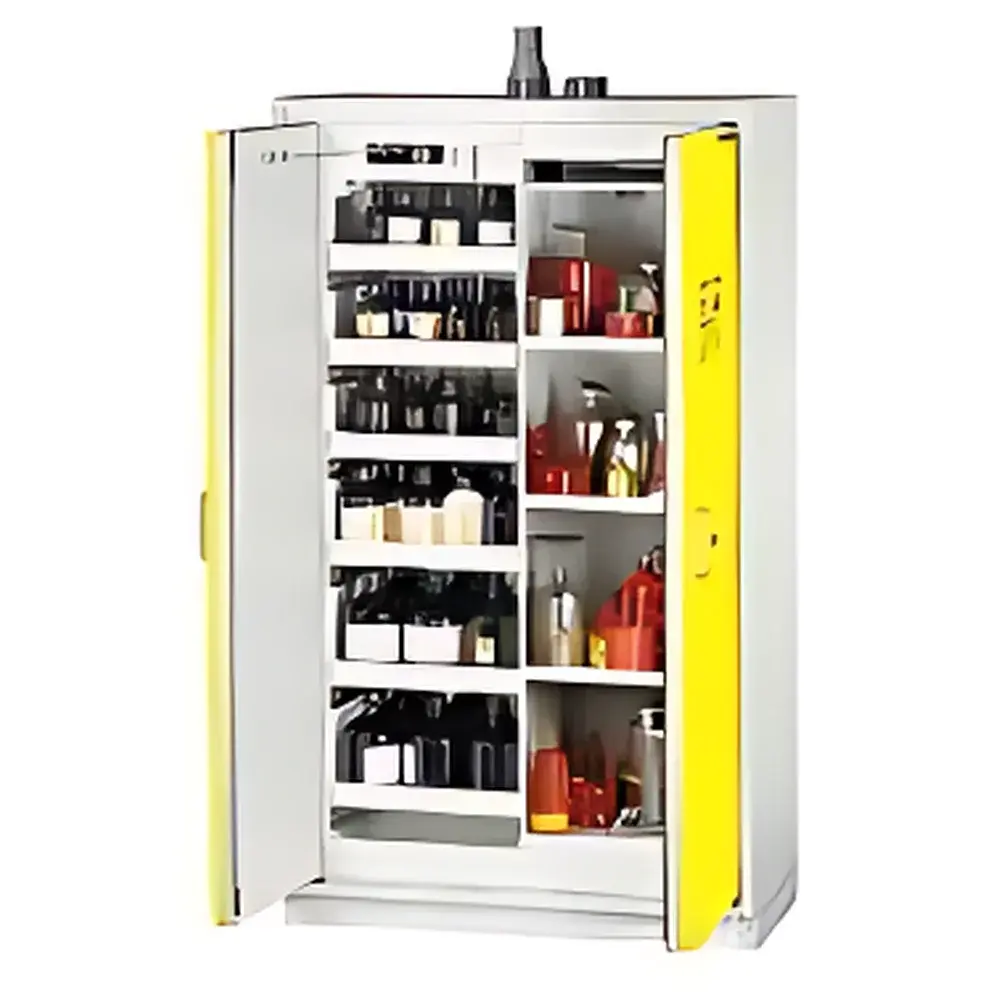
Dueperthal Acid-Base Storage Cabinet
| Brand | Dueperthal |
|---|---|
| Origin | Germany |
| Type | Corrosive Chemical Storage Cabinet |
| Fire Resistance Rating | 90 min |
| Construction Material | Powder-Coated Steel or Stainless Steel Options |
| Compliance | DIN 12927, GS/CE Marked, ISO 9001 Certified |
| Door Configuration | Hinged or Folding Door Options |
| Interior Configuration | Adjustable Shelving, Pull-Out Trays, or Drawer Systems |
| Capacity Range | Standard Floor-Standing Units (Custom Sizing Available) |
Overview
The Dueperthal Acid-Base Storage Cabinet is an engineered safety solution designed specifically for the secure containment and segregation of corrosive substances—including strong acids (e.g., sulfuric, nitric, hydrochloric) and caustic alkalis (e.g., sodium hydroxide, potassium hydroxide)—within laboratory, pharmaceutical, and industrial chemical handling environments. Built upon Dueperthal’s four-decade legacy in hazardous material management, this cabinet employs passive fire protection principles grounded in DIN 12927-compliant thermal insulation and structural integrity testing. Its 90-minute fire resistance rating ensures sustained containment under standardized furnace exposure conditions (DIN EN 1363-1), preventing thermal runaway, pressure buildup, and secondary ignition risks during emergency scenarios. Unlike general-purpose storage units, the Acid-Base Cabinet integrates chemically inert interior linings, spill-containment sumps with ≥50 mm depth, and corrosion-resistant fasteners—critical for mitigating degradation from vapor-phase attack and accidental splashes.
Key Features
- Double-walled steel construction with 38 mm mineral wool insulation, certified to maintain internal temperature below 180 °C for 90 minutes during fire exposure
- Chemical-resistant epoxy-powder coating (standard) or electropolished stainless steel (optional) for long-term resistance to acid/alkali vapors and condensates
- Integrated 50 mm deep leak-tight sump capable of retaining ≥110% of the largest container volume per compartment
- Self-closing, three-point latching doors with automatic release at 50 °C (DIN 14470-1 compliant fusible link)
- Grounding terminals (M6) pre-installed for static dissipation in flammable liquid handling zones
- Adjustable galvanized steel shelves with 30 kg uniform load capacity; optional pull-out trays with anti-slip rubber lining
- Modular ventilation interface (60 mm diameter) compatible with lab exhaust ducting systems (requires external fan and monitoring)
Sample Compatibility & Compliance
This cabinet is validated for storage of Class 8 corrosive substances per UN Transport Classification and aligns with GHS hazard communication requirements. It supports safe segregation of incompatible chemicals—including nitric acid alongside sodium hydroxide—when deployed in dual-compartment configurations. All models comply with German and EU regulatory frameworks: DIN 12927 (storage cabinets for hazardous substances), DIN EN 14470-1 (fire-resistant safety cabinets), GS Mark (tested by TÜV Rheinland), and CE marking under Machinery Directive 2006/42/EC. Quality assurance follows ISO 9001:2015 protocols, with full traceability of raw materials and third-party type testing documentation available upon request. Not intended for volatile organic compounds requiring explosion-proof certification (see Dueperthal Ex-rated cabinets for ATEX Zone 1/2 applications).
Software & Data Management
While the Acid-Base Storage Cabinet operates as a passive mechanical safety system without embedded electronics, it is fully compatible with enterprise-level Laboratory Information Management Systems (LIMS) and Chemical Inventory Management Platforms via standardized asset tagging (ISO/IEC 15420-compliant barcode labels). Optional RFID-enabled door sensors (sold separately) support audit-ready access logging aligned with GLP and GMP Annex 11 requirements. Digital twin integration is supported through Dueperthal’s BIM object library (Revit, ArchiCAD), facilitating facility-wide hazardous material zoning compliance in new-build or retrofit projects.
Applications
- University and research laboratory core facilities managing multi-user chemical inventories
- Pharmaceutical QC labs storing reference standards, titrants, and reagent-grade acids/bases under cGMP-controlled environments
- Contract manufacturing organizations (CMOs) requiring documented segregation per ICH Q7 Annex 12
- Municipal water treatment plants storing chlorine-based disinfectants and pH-adjustment agents
- Electronics manufacturing cleanrooms using high-purity HF or ammonium hydroxide solutions
- Hospital central supply departments storing sterilant concentrates and waste neutralization agents
FAQ
Does this cabinet meet OSHA or NFPA standards for corrosive storage in the U.S.?
Yes—while designed to DIN/EN specifications, its fire-resistance performance, spill containment, and ventilation readiness satisfy equivalency pathways under NFPA 30 and OSHA 1910.1200(h)(2) for hazardous chemical storage. Third-party U.S. certification (UL 1275) is available on request.
Can I store oxidizers such as hydrogen peroxide in this cabinet?
No—oxidizers require dedicated storage per NFPA 430 and must be physically separated from organic materials and reducing agents. Dueperthal offers separate Oxidizer-Specific Cabinets with enhanced ventilation and non-organic interior linings.
Is custom sizing or integration with building HVAC possible?
Yes—Dueperthal provides engineering consultation for site-specific adaptations, including recessed wall-mounting, integrated ducted exhaust, and seismic anchoring kits compliant with IBC 2021 Chapter 16.
What maintenance intervals are recommended for long-term reliability?
Annual inspection of door seals, latch functionality, and sump integrity is advised per DIN 12927 Section 7.3. Coating integrity checks should occur quarterly in high-humidity or high-vapor environments.



