
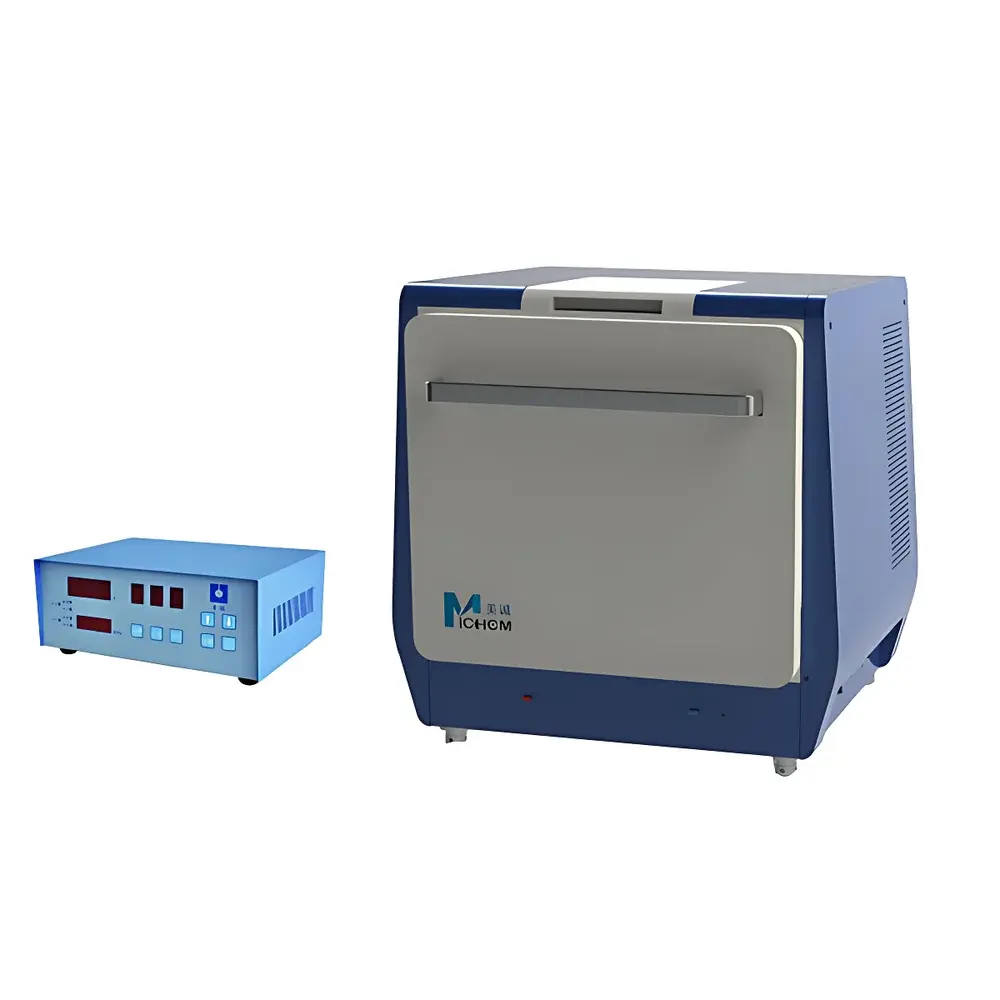
MICHEM ME6C Industrial-Grade Microwave Digestion System
| Brand | MICHEM |
|---|---|
| Origin | Beijing, China |
| Model | ME6C |
| Microwave Frequency | 2450 ± 13 MHz |
| Output Power | 1200 W (0–100% PID-controlled) |
| Maximum Temperature | 300 °C |
| Temperature Control Accuracy | ±0.5 °C |
| Pressure Control Range | 0–6 MPa (≈900 psi) |
| Pressure Control Accuracy | ±0.01 MPa |
| Cavity Volume | 45 L |
| Cavity Coating | Dupont PFA (perfluoroalkoxy) |
| Outer Vessel Material | Reinforced PEEK (10 MPa rating) |
| Inner Vessel Material | TFM (high-purity modified PTFE) |
| Safety Features | Six-layer protection including dual-pressure/temperature monitoring, auto-shutdown on overpressure, rupture disc, patented lateral-release safety door (ZL 200420032536), waveguide attenuator, and cavity interlock |
| Microwave Leakage | ≤0.3 mW/cm² |
| Cooling Airflow | 3 m³/min (reaches safe opening temperature within 20 min) |
| Sample Capacity | 1 vessel (standard configuration) |
| Stirring | Dual-mode (electromagnetic + mechanical), 0–5000 rpm, 360° reversible rotation |
| Control System | Microprocessor-based (C-type), LED display, 15 pre-programmable methods, 8-step ramping per method |
| Compliance | Meets GB/T 18801–2015 (China), IEC 61000-6-3, and general requirements for ISO/IEC 17025-accredited laboratories |
Overview
The MICHEM ME6C Industrial-Grade Microwave Digestion System is a robust, single-vessel platform engineered for rapid, reproducible, and fully controlled sample decomposition under elevated temperature and pressure conditions. It operates on the principle of microwave-assisted acid digestion—where targeted dielectric heating induces rapid molecular agitation in polar solvents (e.g., HNO₃, HCl, HF, or H₂O₂), accelerating oxidative breakdown of organic matrices and mineral lattices. Unlike open-vessel hotplate digestion, the ME6C employs sealed high-pressure reaction vessels to sustain temperatures up to 300 °C and pressures up to 6 MPa, enabling complete dissolution of refractory materials—including silicates, alloys, biological tissues, and polymer composites—without volatile element loss. Its industrial-grade cavity (45 L volume), PFA-coated interior (Dupont-certified), and reinforced PEEK/TFM vessel architecture ensure long-term resistance to aggressive reagents and thermal cycling. Designed for compliance-driven environments, the system supports trace-level elemental analysis workflows requiring minimal blank contribution, high inter-batch reproducibility, and auditable process control.
Key Features
- Industrial-strength 45 L cavity with Dupont PFA coating—chemically inert against concentrated HF, aqua regia, and hot perchloric acid at sustained 300 °C exposure
- Single-magnetron 1200 W generator with full-range PID power modulation (0–100%), eliminating thermal overshoot and ensuring stable energy delivery
- Dual-sensor real-time monitoring: Pt100 platinum resistance thermometer (±0.5 °C accuracy) and direct-contact pressure transducer (±0.01 MPa resolution) co-located within the same vessel
- Six-tier safety architecture: (1) active pressure/temperature slope control, (2) redundant hardware interlocks, (3) calibrated rupture disc (200/400 psi thresholds), (4) patented lateral-release safety door (ZL 200420032536), (5) waveguide attenuation system, and (6) cavity-mounted microswitches with fail-safe shutdown
- 360° bidirectional rotating turntable with integrated magnetic stirring (0–5000 rpm), ensuring homogeneous field distribution and eliminating cold spots across heterogeneous samples
- Microprocessor-based C-type controller with LED interface, supporting 15 user-defined multi-step programs (up to 8 ramps per method), automatic data logging, and password-protected parameter editing
Sample Compatibility & Compliance
The ME6C accommodates standard 10–1500 mL reaction vessels—including TFM-lined inner vessels and reinforced PEEK outer containment sleeves rated to 10 MPa burst pressure. It is validated for digestion of soils, sediments, sludge, plant tissue, animal organs, pharmaceutical excipients, catalysts, and geological samples per EPA Method 3051A, 3052, and ASTM D5511. Vessel geometry and rotational dynamics maintain uniform microwave coupling regardless of sample viscosity or density gradient. The system meets electromagnetic compatibility standards IEC 61000-6-3 and adheres to national safety limits (GB/T 18801–2015) for microwave leakage (≤0.3 mW/cm²). While not FDA 21 CFR Part 11–certified out-of-the-box, its audit-ready operation logs (time-stamped temperature/pressure profiles, method IDs, operator tags) support GLP/GMP-aligned validation protocols when deployed with documented SOPs and periodic instrument qualification (IQ/OQ/PQ).
Software & Data Management
The ME6C’s embedded C-type controller records all critical process variables—time, temperature, pressure, and power output—at 1-second intervals during each run. Data are stored internally (non-volatile memory) and exportable via USB to CSV format for integration into LIMS or statistical process control platforms. Each method includes editable ramp-hold parameters, safety thresholds, and post-digestion cooling profiles. Although no PC software is bundled with the base ME6C configuration, the controller’s firmware supports firmware updates and method synchronization via standard USB mass storage mode. For laboratories requiring electronic signatures and audit trails, third-party validation packages (e.g., IQ/OQ documentation kits) are available upon request to meet ISO/IEC 17025 Clause 5.5.2 and USP analytical instrument qualification requirements.
Applications
The ME6C serves as a primary sample preparation tool for elemental quantification by ICP-OES, ICP-MS, AAS, and AFS—particularly where low detection limits, high matrix tolerance, and regulatory compliance are mandatory. Its ability to retain volatile analytes (e.g., As, Se, Hg, Sb) makes it suitable for environmental monitoring (EPA 6010D, 6020B), clinical toxicology (CLIA-waived specimen prep), food safety testing (AOAC 999.10), and geochemical exploration (ISO 11466). Beyond digestion, the platform supports microwave-assisted extraction (MAE) of pesticides from crops, accelerated protein hydrolysis for amino acid analysis, and solvent-free organic synthesis under controlled pressure—demonstrating versatility across QC, R&D, and contract testing laboratories.
FAQ
What is the maximum operating temperature and pressure of the ME6C?
The system is rated for continuous operation up to 300 °C and 6 MPa (≈900 psi), with real-time monitoring and automatic cutoff if either limit is exceeded.
Does the ME6C support multi-sample throughput?
The standard ME6C configuration is optimized for single-vessel processing to maximize control precision and safety margin; however, optional rotor adapters allow sequential runs without manual cavity reconfiguration.
How is temperature measured—and is calibration traceable?
Temperature is measured via a Pt100 sensor inserted directly into the reaction vessel; calibration follows DIN EN 60751 and can be verified using NIST-traceable dry-block calibrators.
Can the ME6C digest silica-rich samples such as ceramics or fly ash?
Yes—when used with HF-containing reagent mixtures and appropriate TFM/PEEK vessels, it achieves >99.5% dissolution efficiency for SiO₂ matrices per ASTM D5511 Annex A4.
Is remote monitoring or network connectivity supported?
No Ethernet or Wi-Fi interface is built-in; however, USB data export enables offline review and integration with lab-wide data management systems via standardized file ingestion protocols.
Related Products



