
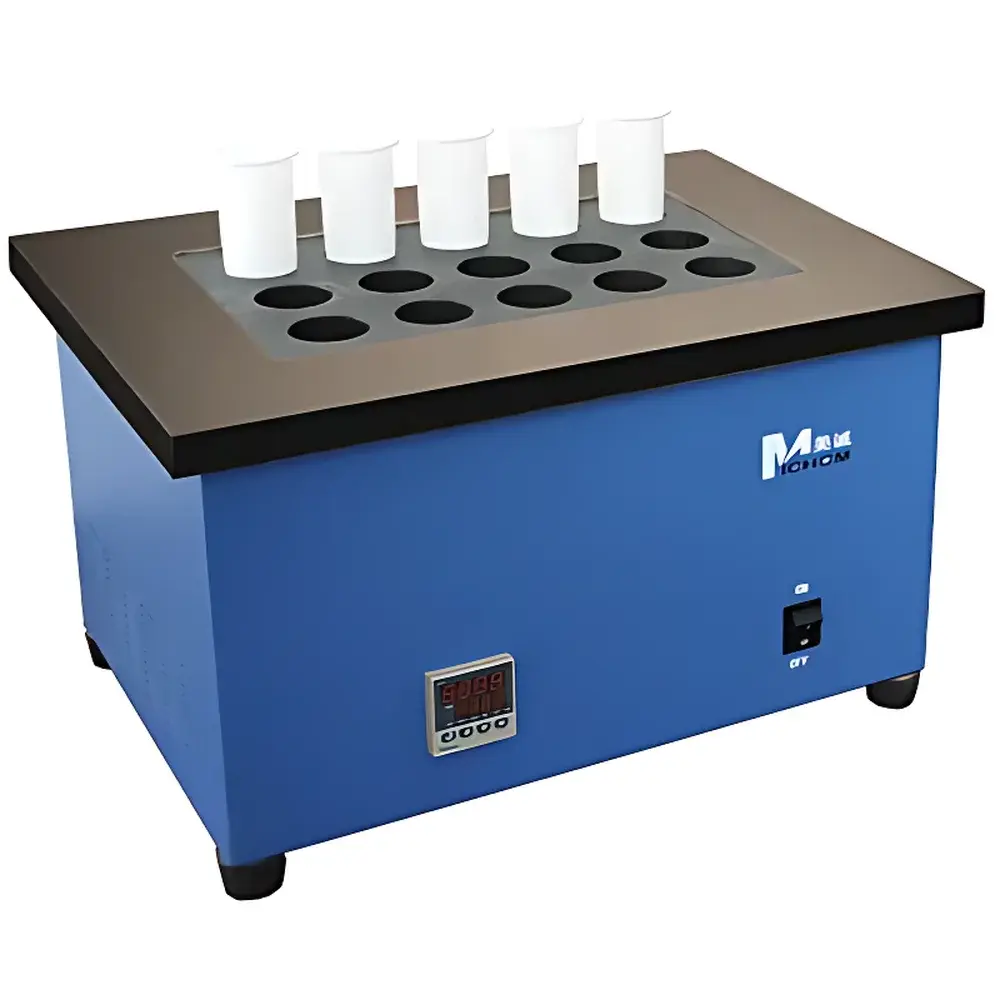
MICHEM DR-15 Graphite Block Digestion System
| Brand | MICHEM |
|---|---|
| Model | DR-15 |
| Heating Material | PTFE-coated graphite block |
| Max. Power | 1200 W |
| Control System | 30-step PID digital temperature controller |
| Max. Temperature | 240 °C |
| Temp. Accuracy | ±1.0 °C |
| Sample Capacity | 15 × 100 mL vessels |
| Well Dimensions | Φ42 × 40 mm (diameter × depth) |
| Temp. Uniformity | ±2.0 °C across wells |
| Power Supply | AC 220 V / 50 Hz / 10 A |
| Device Dimensions | 470 × 350 × 270 mm |
| Compliance | Designed for EPA, ASTM, and ISO-compliant sample preparation workflows |
Overview
The MICHEM DR-15 Graphite Block Digestion System is a benchtop, atmospheric-pressure sample digestion instrument engineered for reproducible, high-throughput acid digestion of environmental, biological, food, pharmaceutical, and industrial samples prior to elemental analysis by AAS, ICP-OES, ICP-MS, or HG-AFS. Unlike open-vessel hot plates or ceramic heating mantles, the DR-15 employs a monolithic, high-density graphite block with uniform thermal mass and proprietary PTFE (polytetrafluoroethylene) coating—ensuring exceptional thermal conductivity, chemical inertness, and long-term stability under aggressive HNO₃, HCl, HF, and H₂O₂ matrices. Its operation relies on conductive heating via direct contact between sample vessels and the precisely regulated graphite surface, eliminating convective air gaps and minimizing inter-well temperature deviation to ≤ ±2.0 °C. This architecture supports standardized, GLP-aligned digestion protocols—including EPA Method 3050B, 3051A, and 3052 pre-digestion steps—as well as post-microwave “acid removal” (i.e., open-vessel evaporation to near-dryness or direct volumetric dilution), significantly reducing analyst exposure to fumes and improving procedural traceability.
Key Features
- PTFE-coated graphite heating block: Resists corrosion from concentrated mineral acids (including hydrofluoric acid at controlled concentrations) and alkaline digestants; surface remains non-stick and easily cleaned with ethanol or dilute base.
- Precision 30-segment PID digital temperature control: Enables programmable ramp-hold profiles (e.g., 95 °C → 120 °C → 150 °C → 240 °C) with independent setpoint adjustment per step; temperature stability maintained within ±1.0 °C at target setpoints.
- Optimized thermal homogeneity: Engineered well geometry (Φ42 × 40 mm) and graphite density ensure consistent heat transfer across all 15 positions—critical for multi-sample batch processing where inter-sample variance must remain below analytical uncertainty thresholds.
- Energy-efficient design: 1200 W maximum power draw with rapid thermal response (<15 min to reach 240 °C from ambient); no preheating required for routine digestions.
- Modular compatibility: Accepts standard borosilicate glass, quartz, or PFA digestion tubes (100 mL capacity); optional custom well sizing available for specialized vessel formats (e.g., tall-form Teflon® vessels).
Sample Compatibility & Compliance
The DR-15 accommodates a broad range of solid and semi-solid matrices—including soils, sediments, plant tissues, animal tissues, food composites, polymer ash, and catalyst residues—when digested using EPA-recommended acid mixtures (e.g., HNO₃/H₂O₂ or HNO₃/HF/H₃BO₃). Its atmospheric operation eliminates pressure-related safety constraints while maintaining sufficient thermal energy for complete organic matrix destruction and analyte solubilization. The system meets essential requirements for ISO/IEC 17025-accredited laboratories: full temperature logging capability (via optional RS-232/USB interface), audit-trail-ready firmware, and alignment with FDA 21 CFR Part 11 principles when integrated with compliant LIMS or ELN platforms. All materials contacting reagents comply with USP Class VI biocompatibility standards and are free of heavy metal leachables.
Software & Data Management
While the DR-15 operates via standalone front-panel controls, it supports external data acquisition through its built-in RS-232 serial port (optional USB-to-serial adapter). When connected to validated laboratory software (e.g., LabWare LIMS, Thermo Fisher SampleManager, or custom Python-based scripts), real-time temperature profiles, program execution logs, and operator ID stamps can be archived for regulatory review. Firmware includes password-protected method storage (up to 10 user-defined programs), automatic end-of-program shutdown with audible alert, and overtemperature cut-off (260 °C hardware limit). No cloud connectivity or proprietary cloud platform is embedded—ensuring full data sovereignty and compatibility with air-gapped GMP environments.
Applications
- Preparation of certified reference materials (CRMs) for trace metal certification (e.g., NIST SRM 2711a, GBW 07401).
- Routine digestion of wastewater sludge and airborne particulate filters prior to ICP-OES quantification.
- High-volume QA/QC testing in food safety labs: Pb, Cd, As, and Hg determination in cereals, infant formula, and seafood per EU Commission Regulation (EC) No 1881/2006.
- Pharmaceutical excipient screening per USP heavy metals test, using sulfuric-nitric acid digestion.
- Supporting microwave digestion workflows: primary low-temperature oxidation step or final HF-assisted silica dissolution followed by open-vessel evaporation and direct dilution to volume.
FAQ
Can the DR-15 be used with hydrofluoric acid (HF)?
Yes—provided HF concentration remains ≤ 5% v/v and digestion time is limited to ≤ 60 min at ≤ 180 °C. Always use PFA or quartz vessels and perform in a certified fume hood with HF-specific PPE.
Is temperature calibration traceable to NIST?
The unit ships with a factory calibration certificate (±1.0 °C at 100 °C and 240 °C); field recalibration using a NIST-traceable RTD probe (e.g., Fluke 720A) is supported via service mode.
Does the DR-15 meet CE or UL safety standards?
It complies with IEC 61010-1:2010 for electrical safety and EN 61326-1:2013 for EMC; CE marking is applied for export to EEA markets.
Can I integrate it into an automated sample prep line?
Not natively—but robotic arm endpoints (e.g., Hamilton STAR, Tecan Fluent) can position vessels onto the block; timing synchronization requires external PLC-level coordination.
What maintenance is required?
Annual inspection of PTFE coating integrity and PID sensor drift; wipe graphite surface with 70% isopropanol after each use; avoid abrasive cleaners or metal scrapers.



