
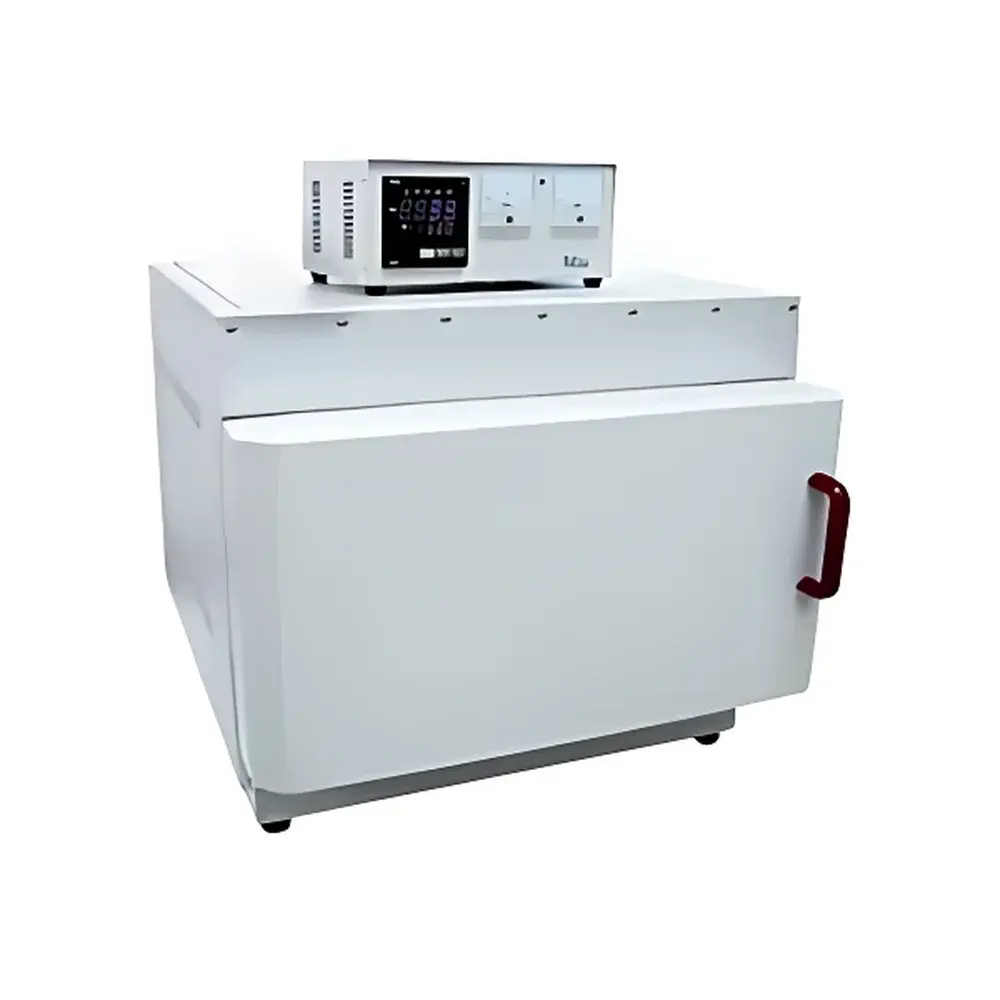
MICHEM TM Series 1400°C Ceramic Fiber Muffle Furnace
| Brand | MICHEM |
|---|---|
| Origin | Beijing, China |
| Model | TM Series 1400 |
| Type | Box-Type Muffle Furnace |
| Max Temperature | 1400°C |
| Temperature Control Accuracy | ±1°C |
| Power Rating | 2 kW (6 L) / 3 kW (9 L) / 5 kW (20 L) / 6 kW (30 L) |
| Heating Element | HRE Ultra-High-Temperature Alloy |
| Internal Dimensions | 200×250×120 mm (6 L) / 200×300×150 mm (9 L) / 250×400×200 mm (20 L) / 300×400×250 mm (30 L) |
| Ramp Time to Max Temp | ≤50 min (6 L & 9 L) / ≤60 min (20 L) / ≤80 min (30 L) |
| Insulation | High-Density Ceramic Fiber (100–130 mm thickness) |
| Voltage/Current | 220 V / 16 A (6 L & 9 L) |
| Weight | 55 kg (6 L) / 70 kg (9 L) / 85 kg (20 L) / 98 kg (30 L) |
Overview
The MICHEM TM Series 1400°C Ceramic Fiber Muffle Furnace is a high-performance box-type laboratory furnace engineered for precision thermal processing in analytical chemistry, materials science, metallurgy, and quality control laboratories. Designed around the principles of radiant heat transfer and thermal isolation, it employs a fully insulated ceramic fiber chamber with optimized geometry to achieve uniform temperature distribution and minimal thermal lag. Unlike traditional refractory brick furnaces, its lightweight ceramic fiber insulation (density ≥128 kg/m³, thermal conductivity <0.08 W/m·K at 1000°C) enables rapid heating, low standby energy loss, and surface temperatures below 60°C during extended operation at 1000°C—reducing ambient heat load and improving lab safety. The furnace operates under open-air atmospheric conditions and is not rated for vacuum or controlled-atmosphere applications. Its maximum operating temperature of 1400°C complies with ASTM E1112 and ISO 8573-1 requirements for high-temperature calibration reference sources and thermal stability validation.
Key Features
- Ultra-rapid ramp capability: Reaches 1400°C in ≤50 minutes for 6 L and 9 L models; ≤60 minutes for 20 L; ≤80 minutes for 30 L—enabling high-throughput ashing, calcination, and sintering workflows.
- HRE (High Resistance Element) ultra-high-temperature alloy heating elements provide stable resistivity up to 1400°C, extended service life (>3,000 h at 1350°C), and resistance to thermal cycling fatigue.
- Precision PID temperature controller with 30 programmable segments, ramp rate control per step, and ±1°C accuracy across full range; meets GLP traceability requirements via optional audit trail logging.
- Double-layer ceramic fiber insulation (100–130 mm thick) ensures thermal efficiency >75% at 1200°C and minimizes external surface temperature rise—verified per IEC 61000-3-2 for electromagnetic compatibility and EN 61000-6-3 for emission limits.
- Integrated safety architecture includes automatic power cutoff upon door opening, over-temperature cutout (independent from main controller), and grounded chassis design compliant with IEC 61010-1 Ed.3 for laboratory electrical equipment.
- Modular mechanical construction supports CE marking readiness, with standardized 220 V / 16 A (smaller units) and 380 V / 16 A three-phase (larger units) input configurations—compatible with standard industrial lab power infrastructure.
Sample Compatibility & Compliance
The TM Series accommodates crucibles, boats, and trays made from alumina, silicon carbide, platinum, or quartz—subject to material-specific maximum use temperature limits. It is routinely employed for ASTM D3174 (ash content in coal), ISO 1171 (ash determination in solid mineral fuels), and USP (residue on ignition). The furnace’s thermal uniformity (±3°C within central 60% volume at 1400°C, per internal verification protocol) satisfies calibration traceability requirements for thermocouple verification and high-temperature sensor validation. All models are manufactured in accordance with GB/T 10066.1–2004 (General Safety Requirements for Industrial Electric Heating Equipment) and include documentation supporting IQ/OQ protocols for GMP-regulated environments.
Software & Data Management
While the base configuration features a standalone PP3-series PID controller with front-panel keypad and LED display, optional RS485 Modbus RTU interface enables integration into centralized LabVantage or Thermo Fisher SampleManager LIMS platforms. Data logging (temperature, time, segment status) can be exported as CSV via USB port for 21 CFR Part 11-compliant electronic records when paired with validated third-party software. Firmware supports user-defined alarm thresholds, password-protected parameter editing, and event-triggered data capture—including door-open events and over-temperature faults—for full audit trail generation.
Applications
- Gravimetric analysis: Ash content determination in food, pharmaceuticals, polymers, and environmental samples per AOAC 923.03 and EPA Method 1694.
- Thermal treatment: Annealing of metal alloys, pre-sintering of ceramics, and binder burnout in powder metallurgy feedstocks.
- Calibration support: Serving as a stable high-temperature reference source for thermocouple calibration labs accredited to ISO/IEC 17025.
- Research-grade pyrolysis: Controlled thermal decomposition studies requiring precise ramp-hold-cool profiles in catalysis and nanomaterial synthesis.
- Quality assurance: Routine verification of refractory material performance, coating durability, and thermal shock resistance testing.
FAQ
What is the recommended maintenance schedule for the HRE heating elements?
HRE elements require no routine replacement under normal operation; however, visual inspection every 200 operational hours is advised. Replace if visible oxidation pitting or localized thinning exceeds 15% of original cross-section.
Can this furnace be used under inert gas purge?
Yes—though not supplied with gas fittings, the chamber allows optional N₂ or Ar purging via two 6 mm threaded ports (front and rear); ensure gas flow rate remains <1.5 L/min to avoid cooling effects and pressure differentials.
Is the temperature uniformity verified per ASTM E220?
Uniformity mapping is performed during factory acceptance testing per ASTM E220 Annex A3; a certificate of conformance (including 9-point measurement grid at 1400°C) is provided with each unit.
Does the controller support GLP-compliant electronic signatures?
The base PP3 controller does not support electronic signatures; however, when connected to validated third-party SCADA or LIMS systems with 21 CFR Part 11 modules, full signature-capable audit trails are achievable.
What is the expected lifetime of the ceramic fiber insulation at continuous 1400°C operation?
Under continuous operation at 1400°C, ceramic fiber insulation maintains structural integrity for ≥18 months; degradation accelerates above 1420°C or under repeated thermal shock cycles exceeding 100°C/min.



