
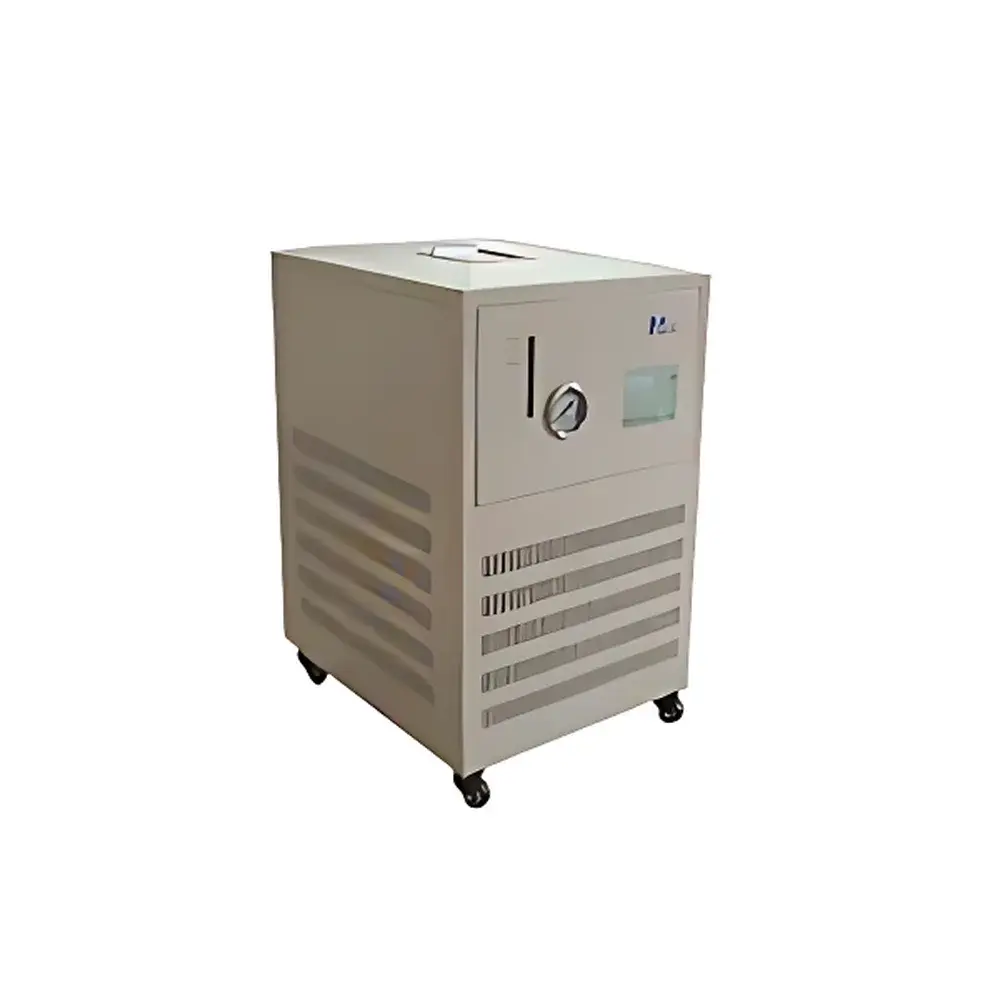
MICHEM MC-7000C Circulating Chiller
| Brand | MICHEM |
|---|---|
| Origin | Beijing, China |
| Model | MC-7000C |
| Instrument Type | Split-System Circulating Chiller |
| Cooling Method | Water-Cooled |
| Temperature Range | 5–35 °C |
| Cooling Capacity | 7000 W |
| Temperature Stability | ±0.1 °C |
| Circulation Pump Pressure | 7 bar |
| Circulation Flow Rate | 6 L/min |
| Reservoir Volume | 80 L |
| Operation Mode | Continuous |
Overview
The MICHEM MC-7000C is a high-performance split-system circulating chiller engineered for precision thermal management of analytical instruments, laser systems, and other laboratory equipment requiring stable, continuous coolant delivery. It operates on a closed-loop refrigeration cycle utilizing inverter-driven compressor technology to deliver precise temperature control across a wide operating range (5–35 °C) with exceptional energy efficiency and low acoustic emission. Unlike open-loop tap-water cooling—historically common but unsustainable due to high water consumption (up to 1440 tons/year at 10 L/min over 8 h/day) and scaling risks in hard-water regions—the MC-7000C eliminates reliance on municipal water supply while maintaining consistent thermal load dissipation. Its design conforms to fundamental thermodynamic principles of vapor-compression refrigeration, integrating PID-based feedback control with real-time modulation of compressor frequency to match instantaneous heat rejection demands. This adaptive power regulation ensures minimal thermal overshoot, reduced mechanical stress, and extended system longevity.
Key Features
- Inverter-controlled scroll compressor enabling stepless speed adjustment; achieves ±0.1 °C temperature stability and reduces energy consumption by >30% compared to conventional on/off compressors of equivalent cooling capacity.
- Soft-start functionality limits inrush current during compressor activation—gradually ramping input power over 20 seconds—to prevent voltage spikes and enhance component reliability.
- High-efficiency centrifugal circulation pump delivering up to 6 L/min at adjustable pressure up to 7 bar; constructed with corrosion-resistant materials suitable for deionized or inhibited glycol-water mixtures.
- 80-liter insulated stainless-steel reservoir with level sensor, overflow protection, and integrated air venting to minimize cavitation and ensure bubble-free flow.
- Microprocessor-based controller with intuitive LED interface, real-time monitoring of inlet/outlet temperatures, flow rate, compressor frequency, and fault diagnostics.
- Split-system architecture separates heat-generating components (compressor, condenser) into an outdoor unit, minimizing indoor noise (<58 dB(A)) and heat load within the laboratory environment.
Sample Compatibility & Compliance
The MC-7000C is compatible with a broad spectrum of laboratory instrumentation requiring active cooling, including ICP-OES/MS plasma sources, HPLC column ovens, X-ray diffractometers, NMR probe preamplifiers, and high-power lasers. Its closed-loop operation supports use with water-glycol blends (up to 30% v/v), enabling sub-ambient operation down to 5 °C even in ambient conditions up to 35 °C. The unit complies with IEC 61000-6-3 (EMC emission standards) and IEC 61000-6-2 (immunity), and meets CE safety requirements under EN 61000-1-2. While not certified to ISO/IEC 17025 or GLP-specific validation protocols out-of-the-box, its PID-controlled thermal performance, audit-ready operational logs (via optional RS485/Modbus interface), and traceable setpoint history support integration into regulated environments adhering to FDA 21 CFR Part 11 when paired with validated data acquisition software.
Software & Data Management
The MC-7000C features embedded firmware supporting local parameter configuration and real-time status display. For networked deployment, optional RS485 serial communication enables integration with LabVIEW, MATLAB, or custom SCADA platforms via Modbus RTU protocol. Logged parameters—including setpoint, actual temperature, flow rate, compressor frequency, and alarm events—are timestamped and exportable as CSV files for QA/QC documentation. Remote monitoring and control are achievable through third-party building management systems (BMS) or centralized lab infrastructure platforms. Firmware updates are performed via USB interface, ensuring long-term maintainability without hardware replacement.
Applications
- Thermal stabilization of inductively coupled plasma (ICP) torches and RF generators in elemental analysis systems.
- Cooling of high-intensity light sources (e.g., xenon arc lamps, LED arrays) in spectrophotometers and fluorescence microscopes.
- Temperature regulation of chromatographic columns, detectors, and autosampler trays in HPLC/UHPLC systems.
- Heat removal from vacuum pump jackets, cryocooler cold heads, and RF amplifiers in physics and materials science setups.
- Supporting controlled-environment testing chambers where external heat rejection must be isolated from conditioned lab space.
FAQ
What types of coolant fluids are compatible with the MC-7000C?
Deionized water, ASTM D1193 Type IV water, or water-glycol mixtures (ethylene or propylene glycol, ≤30% v/v) are recommended. Avoid chlorinated or highly conductive solutions to prevent corrosion and electrical leakage.
Can the MC-7000C operate continuously for 24/7 laboratory use?
Yes. Designed for uninterrupted duty cycles, it includes redundant thermal protection, automatic defrost logic, and self-diagnostic routines to ensure operational continuity under sustained load.
Is remote monitoring supported natively?
Native Ethernet or Wi-Fi connectivity is not included, but RS485/Modbus RTU provides full telemetry and control integration with existing lab networks using standard industrial protocols.
Does the unit require periodic refrigerant servicing?
No scheduled maintenance is required for the sealed R410A refrigerant circuit. Annual inspection of pump seals, reservoir cleanliness, and condenser coil integrity is recommended for optimal service life.
How does the split-system configuration improve laboratory workflow?
By relocating heat-dissipating components outdoors, the indoor unit minimizes ambient temperature rise, reduces HVAC load, and lowers audible noise—critical for vibration-sensitive applications such as atomic force microscopy or interferometry.



