
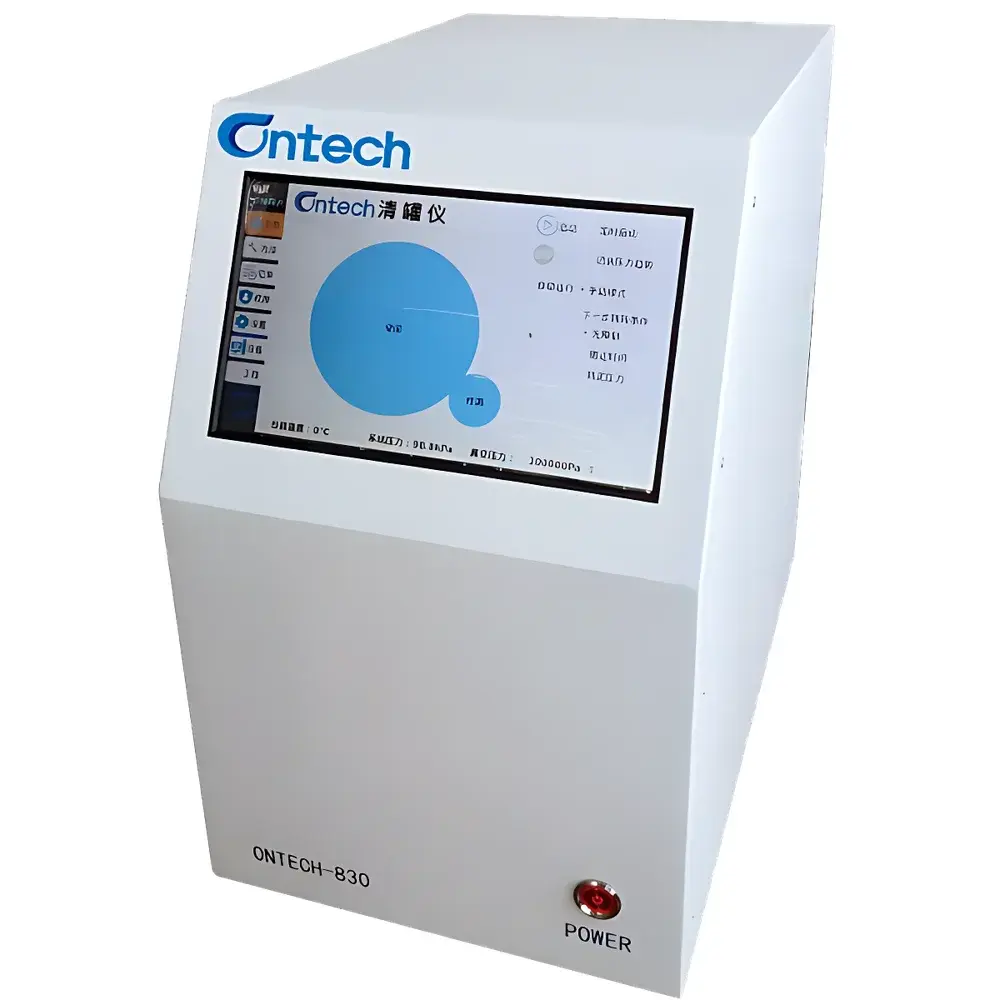
Ontech 830 Automated SUMMA Canister Cleaning System
| Brand | Ontech |
|---|---|
| Model | Ontech 830 |
| Origin | Guangdong, China |
| Type | Domestic Instrument |
| Price | USD 31,200 (approx.) |
| Sample Capacity | 1 L, 3 L, 6 L, and 15 L SUMMA canisters & Tedlar® bags |
| Cleaning Stations | 8 positions (for 3 L and 6 L canisters) |
| Pressure Measurement | Dual-system (diffused silicon sensor + vacuum silicon sensor) |
| Construction | 316 stainless steel tubing and components, silanized for inertness |
| Control Interface | Touchscreen + PC software |
| Compliance | HJ 759–2023, HJ 1012–2018, GB/T 14678–1993, HJ 1078–2019, HJ/T 194–2005 |
Overview
The Ontech 830 Automated SUMMA Canister Cleaning System is an engineered solution for rigorous, reproducible preparation of electropolished stainless-steel SUMMA canisters and Tedlar® sampling bags used in ambient air and emission source VOC monitoring. Designed to meet the stringent blank control requirements of modern regulatory protocols—including China’s national VOC monitoring programs (2018–2021) and method-specific validation criteria—the system implements a fully automated, multi-stage cleaning cycle comprising high-purity nitrogen purge, heated evacuation, humidified rinse, and final vacuum stabilization. Its operation is grounded in fundamental principles of gas-phase contamination removal: thermal desorption kinetics are enhanced by precise temperature control (integrated heated oven), while residual trace organics are eliminated via dynamic dilution under controlled humidity and pressure gradients. This ensures ultra-low background levels (<5 pptv for C2–C12 hydrocarbons, typical), essential for compliance with HJ 759–2023 (determination of ambient VOCs by canister sampling/GC-MS) and analogous EPA TO-14/TO-15 workflows.
Key Features
- Eight-position cleaning station optimized for standard 3 L and 6 L SUMMA canisters; compatible with 1 L, 15 L canisters and Tedlar® bags via interchangeable adapters.
- Dual-pressure sensing architecture: diffused silicon transducers (0–100 kPa range) for ambient-pressure diagnostics and high-stability vacuum silicon sensors (1 × 10⁻³–100 kPa) for accurate low-pressure monitoring during evacuation—enabling real-time leak detection and cycle validation.
- Integrated heated oven (ambient to 120 °C, ±0.5 °C stability) eliminates condensation artifacts and accelerates desorption of semi-volatile compounds without thermal degradation of canister passivation layers.
- Modular 316 stainless-steel fluidic path, fully silanized per ASTM D6196-19 specifications, minimizing surface adsorption and memory effects across repeated cycles.
- No multi-port valves: each canister connects to an independent, dedicated gas line—eliminating cross-contamination pathways inherent in shared valve manifolds.
- Embedded QA/QC logging: timestamped cycle records include pressure decay curves, temperature profiles, purge durations, and final vacuum hold results—exportable as CSV or PDF for audit-ready documentation.
Sample Compatibility & Compliance
The Ontech 830 supports all widely adopted SUMMA canister formats (Restek, Entech, Markes) and standard Tedlar® film bags (SKC, Supelco). Its cleaning performance has been verified against key Chinese environmental standards: HJ 759–2023 mandates ≤10 pptv procedural blanks for >95% of target VOCs (e.g., benzene, toluene, isoprene); HJ 1012–2018 requires <0.05 ppmv total hydrocarbon carryover after cleaning; and HJ/T 194–2005 specifies ≤2% relative standard deviation for replicate blank analyses. The system’s design inherently supports GLP-compliant workflows, with electronic signatures, user access levels, and immutable audit trails aligned with FDA 21 CFR Part 11 expectations for regulated laboratories.
Software & Data Management
Control is executed via a dual-interface architecture: a local 10.1″ industrial touchscreen (IP65-rated) for immediate operation, and optional Windows-based PC software (compatible with Win10/11) for advanced scheduling, remote monitoring, and batch report generation. All cycle data—including raw sensor outputs, alarm events, and maintenance logs—are stored in encrypted SQLite databases with automatic daily backups. Export functions support direct integration into LIMS environments via ODBC drivers. Software updates are delivered via secure HTTPS channels with SHA-256 signature verification.
Applications
- Ambient air monitoring networks (national, regional, and urban air quality stations) requiring daily canister turnaround for time-integrated VOC speciation.
- Fixed-source emission testing per HJ 1078–2019, where sulfur-containing VOCs (e.g., methanethiol, dimethyl sulfide) demand ultra-clean sampling media to avoid false positives.
- Industrial fenceline monitoring programs, supporting both grab sampling and passive accumulation protocols with validated blank integrity.
- Pre-concentration lab infrastructure upstream of GC-MS or GC-FID systems—ensuring consistent trap loading efficiency and chromatographic baseline stability.
- Method development and validation studies requiring statistically robust blank characterization across multiple canister lots and storage durations.
FAQ
What standards does the Ontech 830 explicitly support?
HJ 759–2023, HJ 1012–2018, GB/T 14678–1993, HJ 1078–2019, and HJ/T 194–2005—covering VOC, sulfur compound, and hydrocarbon analysis in ambient and source emissions matrices.
Can the system clean 15 L canisters?
Yes, using optional adapter kits; the standard 8-position configuration is optimized for 3 L and 6 L, but mechanical and pressure-control parameters scale linearly across volume ranges.
Is silanization performed in-house or required pre-installation?
All internal wetted surfaces undergo factory-applied, QC-verified silanization per ASTM D6196-19; no user re-silanization is needed under normal operation.
How is leak integrity verified during cleaning?
Via real-time pressure decay analysis over a user-defined hold period (default: 30 min), with automatic pass/fail classification based on ≤0.1 kPa/h threshold per HJ 759–2023 Annex B.
Does the system support 21 CFR Part 11 compliance?
Yes—through configurable electronic signatures, role-based access control, and tamper-evident audit logs with cryptographic hashing of all critical events.
Related Products







