
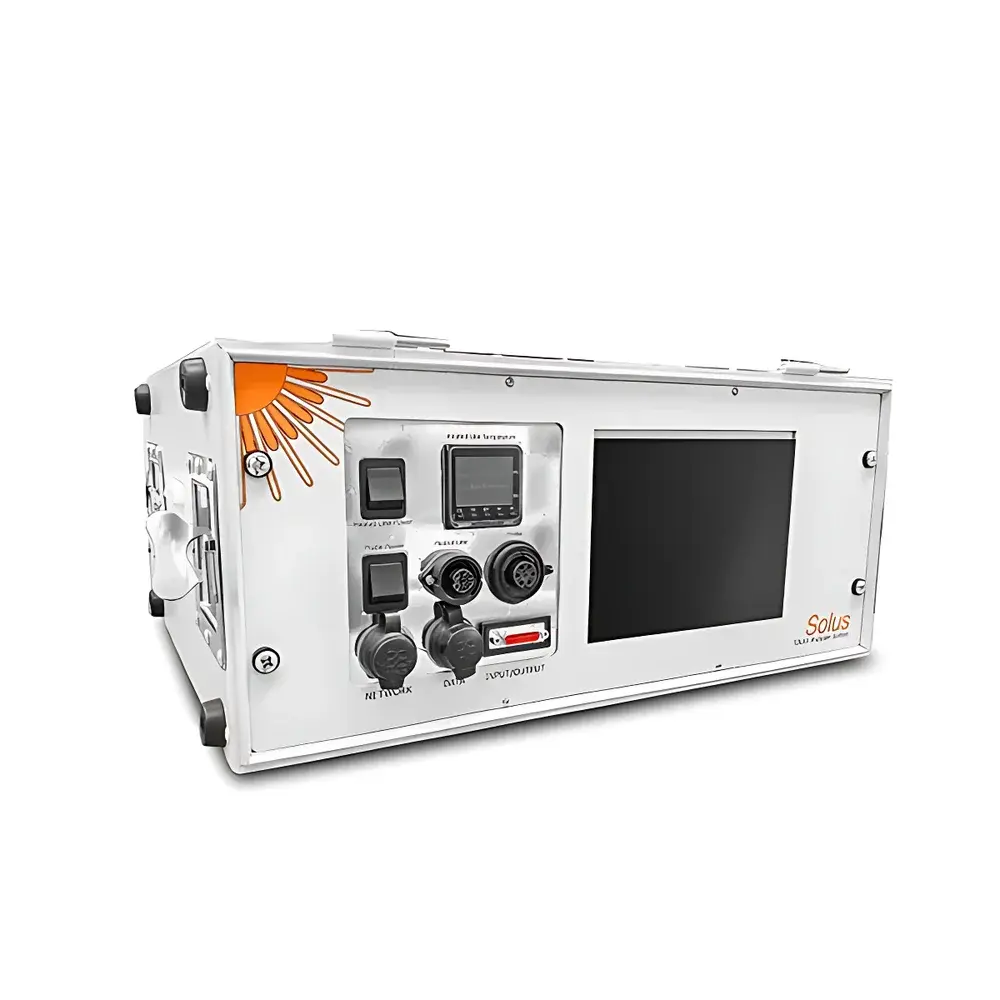
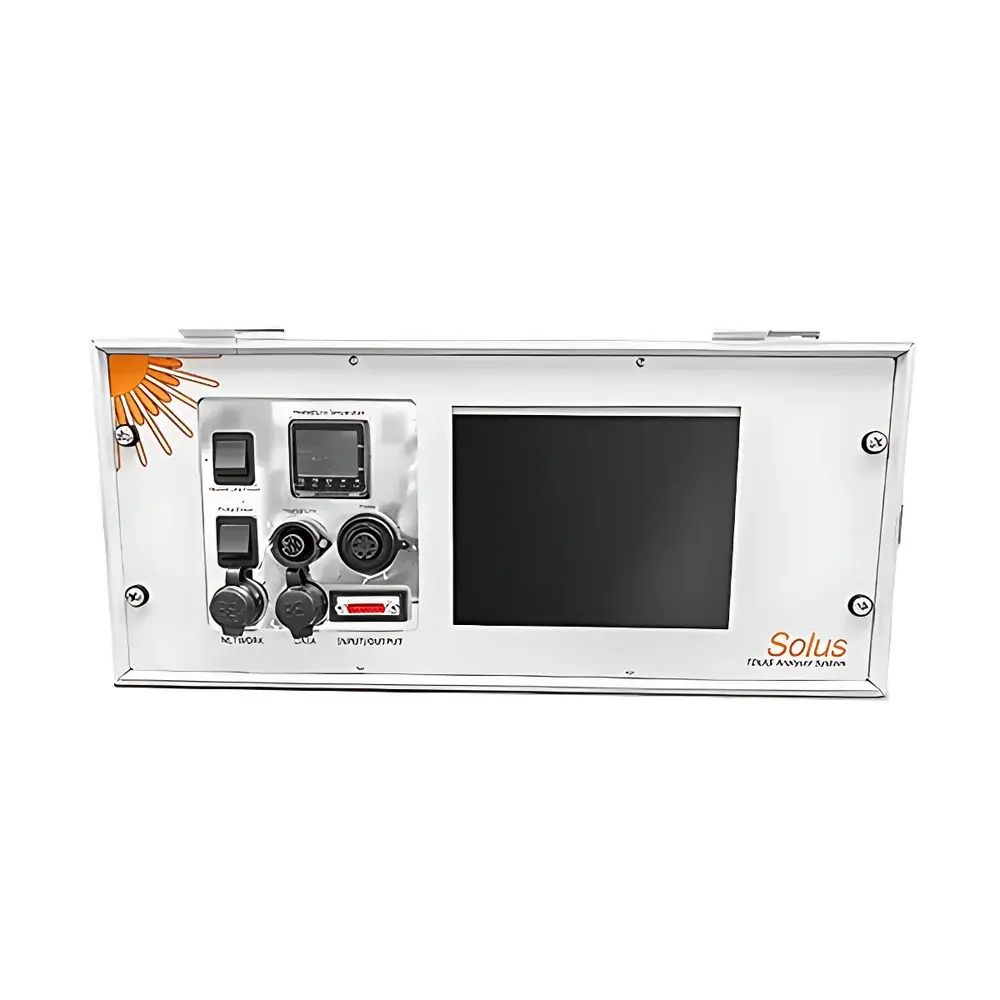
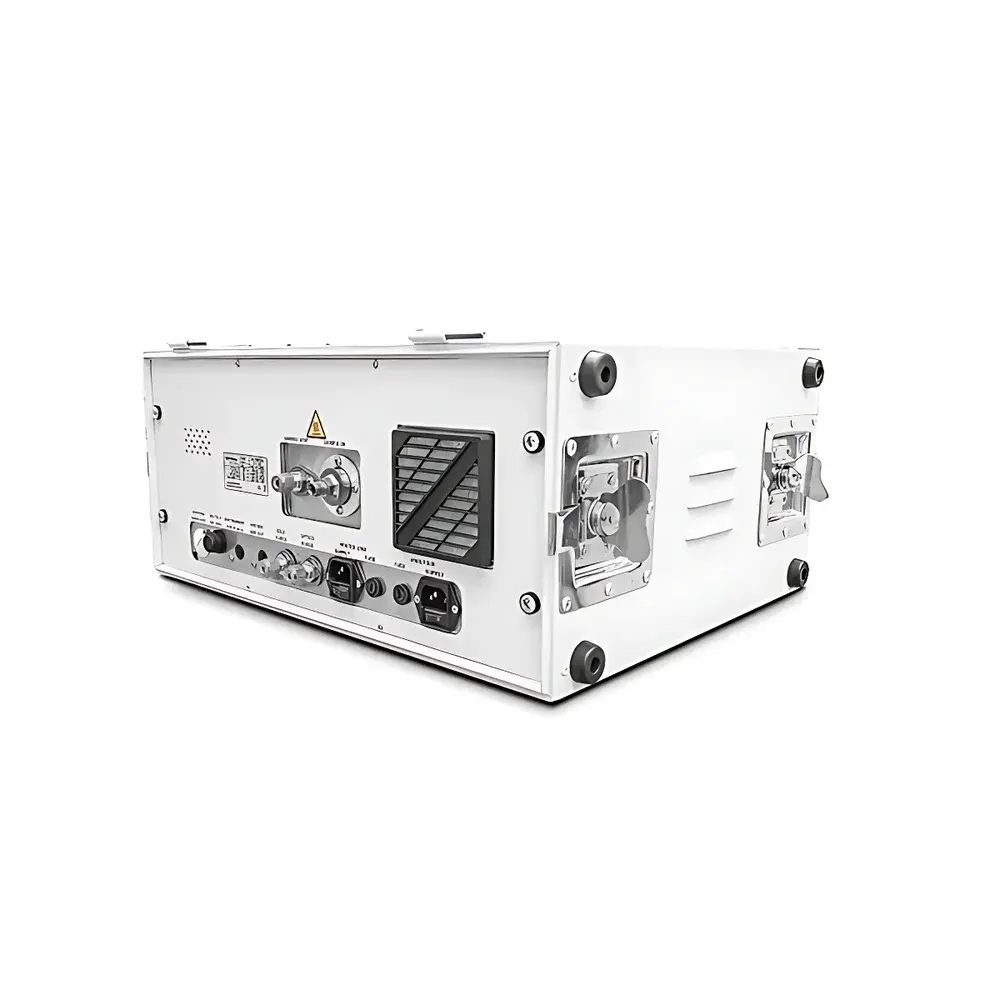
Protea SOLUS-NH3 Online Tunable Diode Laser Absorption Spectroscopy (TDLAS) Analyzer for Ammonia and Hydrogen Chloride
| Brand | Protea |
|---|---|
| Origin | United Kingdom |
| Model | SOLUS-NH3 |
| Instrument Type | Online Gas Analyzer |
| Detection Principle | Tunable Diode Laser Absorption Spectroscopy (TDLAS) in Near-Infrared (NIR) |
| Target Gases | NH₃, HCl (with H₂O compensation) |
| Response Time | < 3 s |
| Sample Volume | 15 mL |
| Integrated Sampling System | Yes (filter, purge valve, mass flow control) |
| Optional Integrated Zirconia O₂ Sensor | Yes |
| Optional Embedded PC | Yes |
| Construction | Carbon-fiber chassis with thermal insulation |
| Calibration | Zero-air–free operation |
| Compliance | Designed for continuous emissions monitoring (CEM) in accordance with EN 15267, MCERTS, and EPA Method 320 derivatives |
Overview
The Protea SOLUS-NH3 is an online, extractive gas analyzer engineered for real-time, selective quantification of ammonia (NH₃) and hydrogen chloride (HCl) in industrial process and environmental emission streams. It employs tunable diode laser absorption spectroscopy (TDLAS), a well-established optical technique that exploits the unique ro-vibrational absorption signatures of target molecules in the near-infrared (NIR) spectral region. By precisely tuning the laser wavelength across narrow, gas-specific absorption lines—typically sub-picometer linewidth—the SOLUS-NH3 achieves high spectral selectivity, effectively eliminating cross-sensitivity from interfering species such as CO₂, SO₂, NOₓ, and water vapor (H₂O). The system operates on a direct-absorption principle without optical multipass cells, enabling rapid, stable measurements with minimal drift over extended unattended periods. Its design prioritizes robustness under fluctuating temperature and pressure conditions typical of stack and duct environments, making it suitable for continuous compliance-grade monitoring where regulatory reporting integrity is paramount.
Key Features
- Single-laser, dual-gas capability: Simultaneous or sequential measurement of NH₃ and HCl using wavelength-scanning TDLAS with built-in H₂O compensation algorithms.
- Sub-3-second response time: Achieved through high-speed laser modulation and real-time digital signal processing, supporting dynamic process control applications such as SCR ammonia slip optimization.
- Low-volume extractive sampling: Requires only 15 mL of sample gas per analysis cycle, reducing pump load and minimizing condensation risk in heated sample lines.
- Fully integrated sampling module: Includes sintered metal filter (heatable to 180 °C), automated purge valve, and precision mass flow controller—all housed within the main analyzer enclosure.
- Optional zirconia-based O₂ sensor: Co-located with the gas stream for stoichiometric correction and combustion efficiency assessment, compliant with EN 14181 QAL1 requirements.
- Embedded industrial PC (optional): Enables local data logging, protocol translation (Modbus TCP/RTU, OPC UA), and remote diagnostics via Ethernet or cellular gateway.
- Maintenance-minimized architecture: No consumable calibration gases, zero-air generators, or optical alignment procedures required during routine operation.
- Thermally stabilized carbon-fiber chassis: Provides mechanical rigidity, low thermal expansion, and passive insulation—critical for field deployment in ambient temperature ranges from −20 °C to +50 °C.
Sample Compatibility & Compliance
The SOLUS-NH3 is validated for use with hot, humid, and particulate-laden gas matrices typical of waste incineration, cement kilns, chemical synthesis reactors, and marine diesel exhaust. Sample conditioning is limited to heated filtration and flow regulation; no chemical scrubbers or cryogenic drying are needed due to the inherent water-vapor tolerance of NIR-TDLAS. The analyzer meets key international performance standards including EN 15267-3 (QAL1 certification framework), MCERTS (UK Environmental Agency), and aligns with EPA Performance Specification 18 (PS-18) for extractive NH₃ analyzers. When deployed with optional O₂ sensing and configured for 10-minute averaged reporting, it satisfies EU Industrial Emissions Directive (IED) monitoring requirements for WID (Waste Incineration Directive) and LCPD (Large Combustion Plant Directive) compliance.
Software & Data Management
Firmware includes embedded data acquisition engine supporting configurable averaging intervals (1–60 s), linearized concentration output (ppm or mg/m³ @ STP), and diagnostic flags for signal-to-noise ratio, laser temperature stability, and filter status. Communication protocols include Modbus TCP (primary), Modbus RTU (RS-485), and optional OPC UA server for integration into DCS or SCADA systems. All configuration changes, calibration events (if performed), and alarm logs are timestamped and stored locally with audit-trail capability. While not FDA 21 CFR Part 11 certified out-of-the-box, the system supports third-party validation packages for GLP/GMP environments requiring electronic record integrity and user-access controls.
Applications
- Ammonia slip monitoring in Selective Catalytic Reduction (SCR) and Selective Non-Catalytic Reduction (SNCR) systems for power plants and industrial boilers.
- Real-time HCl quantification in municipal solid waste (MSW) and hazardous waste incinerators to ensure WID-compliant acid gas abatement.
- Onboard ship emission monitoring for IMO MARPOL Annex VI Tier III compliance, particularly in Emission Control Areas (ECAs).
- Engine test cell exhaust analysis for R&D of aftertreatment systems, including NH₃ storage capacity and HCl formation during low-temperature diesel combustion.
- Process safety interlocks in chlor-alkali and fertilizer production facilities where NH₃/HCl leak detection is critical for occupational exposure limits (OELs) adherence.
FAQ
Does the SOLUS-NH3 require periodic calibration with certified standard gases?
No. The analyzer uses fundamental spectroscopic line parameters traceable to HITRAN database and does not rely on empirical calibration curves. Zero stability is maintained via laser wavelength referencing and thermal drift compensation—no zero gas or span gas is required for routine operation.
Can it operate in high-dust environments like cement kiln stacks?
Yes. The heated sintered stainless-steel inlet filter (up to 180 °C) and purge valve prevent particulate accumulation. For extreme dust loading (>100 mg/m³), an external cyclone or ceramic filter is recommended upstream.
Is the system compatible with existing CEMS infrastructure?
Yes. It outputs 4–20 mA analog signals and supports Modbus TCP/RTU natively. Integration with certified CEMS data acquisition systems (e.g., Siemens Desigo, ABB Advant, Honeywell Experion) has been verified in multiple installations.
What is the minimum detectable concentration for NH₃ and HCl?
Detection limits are application-dependent but typically reach 0.2 ppm for NH₃ and 0.5 ppm for HCl at 1-s integration time, improving with longer averaging. Actual MDLs must be confirmed during site-specific QAL2 testing per EN 14181.
How is moisture interference handled when measuring NH₃ in wet flue gas?
The NIR absorption lines used are selected for minimal H₂O overlap, and proprietary multivariate algorithms dynamically correct residual water vapor broadening effects using co-measured H₂O signal—no external dew point sensor is needed.
Related Products







