
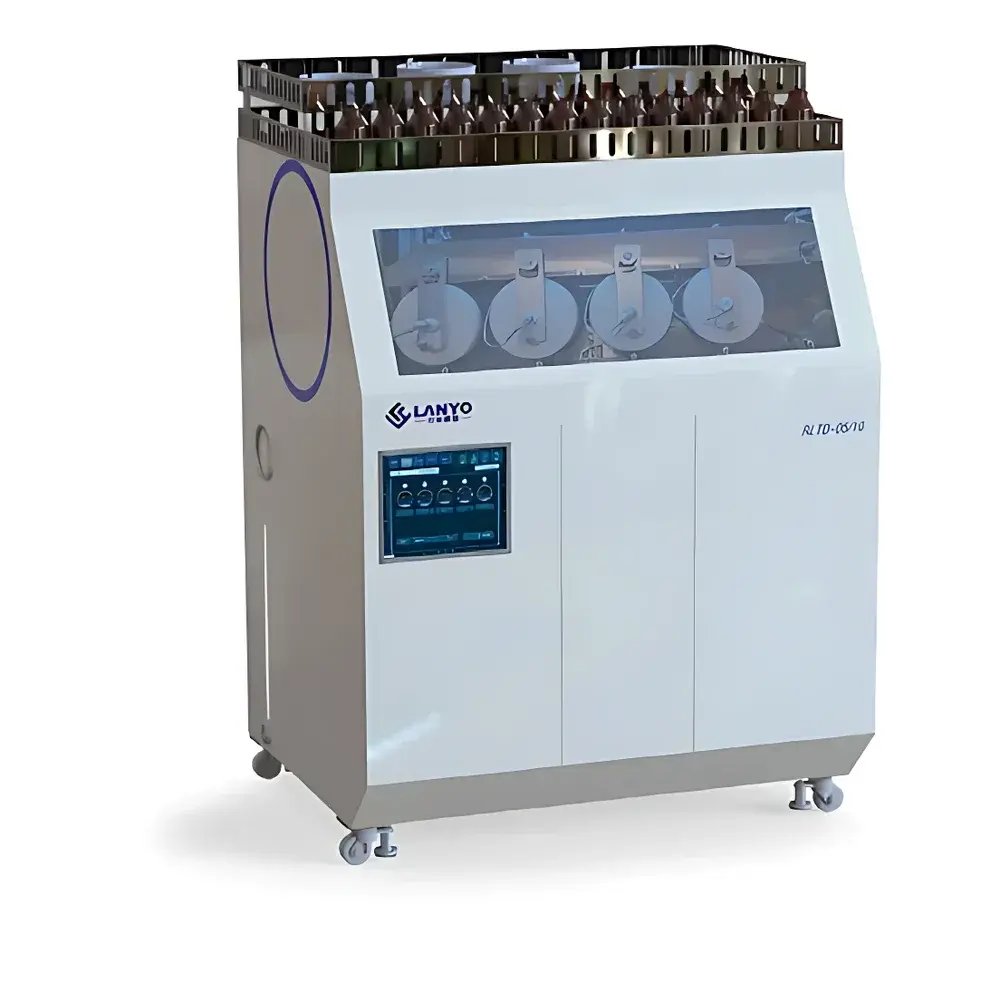
English Product Name
| Origin | Beijing, China |
|---|---|
| Manufacturer Type | Authorized Distributor |
| Origin Category | Domestic (China-made) |
| Model | RLTD-05 / RLTD-10 |
| Pricing | Available Upon Request |
Overview
The Lanyou RLTD-05 and RLTD-10 Rapid Low-Temperature Soil Sample Dryers are engineered for precision, regulatory compliance, and operational efficiency in environmental laboratories handling soil, sediment, and sludge matrices. Unlike conventional hot-air ovens or desiccators, these instruments employ a controlled convective drying principle combined with gentle mechanical agitation—operating strictly within a narrow thermal window of 35 ± 5 °C. This low-temperature regime is scientifically selected to minimize volatilization loss of labile elements (e.g., Hg, As, Se, methylated organometallics) and preserve redox-sensitive speciation while achieving full moisture removal. The system adheres to the thermodynamic and kinetic constraints defined in key Chinese environmental standards—including HJ/T 166–2004, NY/T 395–2012, and DZ/T 0130.4–2006—ensuring that dried samples retain representative elemental composition and physical integrity required for downstream analysis by ICP-MS, AAS, XRF, or sequential extraction protocols.
Key Features
- Independent dual-zone temperature control: Each drying chamber (RLTD-05: 5 positions; RLTD-10: 10 positions) maintains 35 ± 5 °C via PID-regulated heating elements and real-time NTC sensor feedback—no shared thermal mass or cross-chamber drift.
- Non-metallic wet-path architecture: All sample-contact surfaces—including rotating quartz drying drums, silicone-free polymer baffles, and PTFE-coated drive shafts—are certified metal-free (<0.1 ppb Ni/Cr/Fe leachables per ASTM D5127), eliminating exogenous contamination risk during drying.
- Automated homogenization: Integrated low-shear rotational mixing occurs continuously throughout the drying cycle (0–2.5 h), ensuring uniform moisture distribution and preventing crust formation or localized over-drying.
- Hardware-isolated sample compartments: Physically segregated chambers prevent aerosol transfer, particulate carryover, or cross-contamination between heterogeneous samples (e.g., high-As paddy soil vs. Cr-contaminated industrial fill).
- Traceable process logging: Internal microcontroller records timestamped temperature setpoints, actual chamber readings, rotation speed (RPM), and total runtime for each position—exportable as CSV for GLP/GMP audit trails.
Sample Compatibility & Compliance
The RLTD series accommodates standard 100–500 g air-dried or field-moist soil/sediment specimens in pre-weighed quartz crucibles (supplied). It supports clay-rich, organic-rich (up to 25% OM), and sulfidic matrices without caking or adhesion. Compliance is validated against multiple national technical specifications: HJ/T 166–2004 (soil monitoring), NY/T 395–2012 (agricultural soils), DZ/T 0130.4–2006 (geochemical labs), and EJ 428–1989 (radionuclide studies). Instrument design aligns with ISO/IEC 17025:2017 clause 7.2.2 (method validation) and supports laboratory adherence to US EPA Method 5035A (low-temperature drying for VOC-preserving workflows) when used with inert gas purging (optional accessory).
Software & Data Management
The embedded control interface provides local touchscreen operation with password-protected user roles (Operator, Supervisor, Administrator). Full system telemetry—including per-position temperature deviation history, motor duty cycle, and error logs—is stored onboard for ≥12 months. Optional Ethernet/Wi-Fi connectivity enables remote monitoring via secure HTTPS API and integration into LIMS platforms (e.g., LabWare, STARLIMS) using HL7 or ASTM E1384-compliant data schemas. Audit trail functionality satisfies FDA 21 CFR Part 11 requirements for electronic records, including operator ID, timestamp, action type, and original value vs. modified value tracking.
Applications
- Preparation of reference materials and proficiency testing samples requiring certified moisture content and elemental stability.
- Routine batch processing in national soil census programs where throughput (>200 samples/week per RLTD-10 unit) and inter-laboratory comparability are critical.
- Research on element speciation dynamics (e.g., Fe/Mn redox couples, As(III)/As(V) ratios) where thermal degradation must be excluded.
- Third-party environmental testing labs serving regulatory clients under CNAS accreditation—leveraging documented traceability and SOP-aligned drying cycles.
- Field-deployable drying support for mobile labs conducting rapid site assessments under HJ 25.1–2019 (contaminated site evaluation guidelines).
FAQ
Does the RLTD dryer meet ISO/IEC 17025 calibration requirements for accredited testing labs?
Yes—each unit ships with a factory-verified calibration certificate (NIST-traceable RTD sensors), and annual recalibration services are available through Lanyou’s CNAS-accredited service center.
Can the instrument dry samples containing volatile organic compounds (VOCs)?
It is not designed for VOC retention; however, optional nitrogen purge kits reduce oxidative degradation pathways and are compatible with EPA Method 5035A workflows.
What maintenance is required for long-term reliability?
Quartz drums require ultrasonic cleaning after every 50 cycles; drive belts and seals are rated for 10,000+ hours and inspected during biannual preventive maintenance.
Is method validation documentation provided?
Yes—users receive a complete validation package including precision/repeatability data (RSD <2.1% across 10 replicates), recovery studies for 22 elements (Cd, Pb, Cu, Zn, Ni, Cr, As, Hg, etc.), and comparative drying profiles versus oven-dried controls per HJ/T 166–2004 Annex B.





