
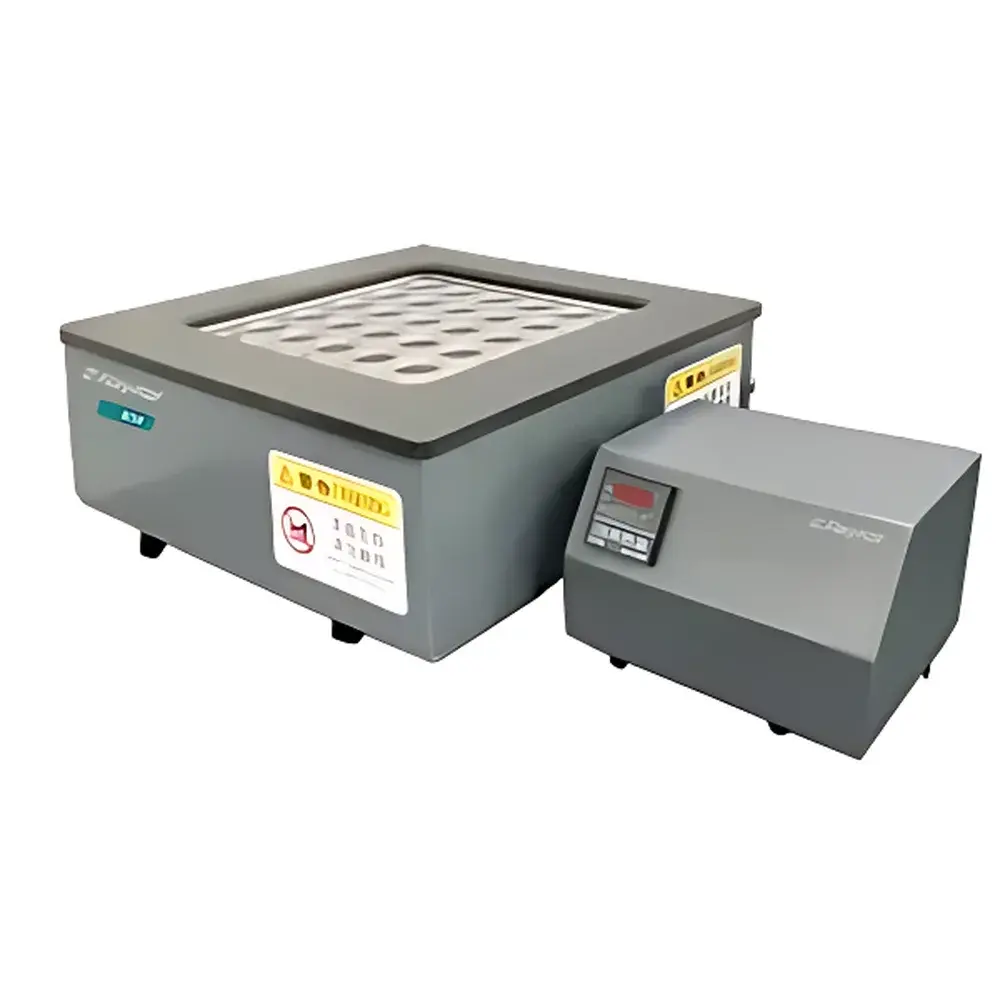
Ruike M36 Smart Graphite Block Digestion System
| Origin | Fujian, China |
|---|---|
| Manufacturer Type | Authorized Distributor |
| Model | M36 |
| Pricing | Available Upon Request |
Overview
The Ruike M36 Smart Graphite Block Digestion System is a high-capacity, semi-automated sample preparation platform engineered for laboratories requiring consistent, reproducible acid digestion of up to 36 samples per run. It serves as a critical front-end solution for elemental analysis workflows—particularly in conjunction with atomic absorption spectrometry (AAS), inductively coupled plasma optical emission spectrometry (ICP-OES), and inductively coupled plasma mass spectrometry (ICP-MS). The system employs a solid high-purity graphite heating block with 3D circumferential heating architecture, ensuring rapid thermal response and exceptional temperature uniformity across all sample positions. Operating within a programmable range of ambient temperature to 450 °C, the M36 accommodates diverse digestion protocols—from open-vessel HNO₃/HCl/HF-based mineralization of environmental matrices to high-temperature closed-vessel digestion of refractory biological or geological samples. Its modular design separates the control electronics from the heating module, mitigating thermal stress on sensitive circuitry and enhancing long-term operational reliability under aggressive chemical environments.
Key Features
- High-purity graphite block with isotropic thermal conductivity and corrosion-resistant surface coating—resistant to concentrated nitric, hydrochloric, hydrofluoric, and perchloric acids at elevated temperatures
- Independent PID temperature control with auto-tuning capability; user-definable ramp/hold profiles and real-time deviation monitoring
- Modular architecture: physically isolated heating block and control unit—prevents acid vapor infiltration and thermal degradation of electronic components
- Multi-layer insulation housing with surface temperature ≤60 °C during operation—complies with IEC 61010-1 safety requirements for laboratory equipment
- Integrated dual-safety protection: over-temperature cutoff (±2 °C accuracy) and earth-leakage circuit interruption (ELCI) rated to 30 mA
- Ergonomic, sloped front panel with tactile keypad and backlit LCD display—designed for glove-compatible operation in fume hood environments
Sample Compatibility & Compliance
The M36 supports standard 50 mL and 100 mL digestion tubes (PTFE, quartz, or borosilicate glass), as well as custom-sized vessels up to 150 mL height. It is validated for use with EPA Methods 3050B, 3051A, 3052, and ASTM D5511/D5512 for solid waste and soil digestion, and aligns with ISO 11047 (foodstuffs—determination of heavy metals) and GB/T 5009.12–2017 (Chinese national standard for lead determination in food). All wetted surfaces meet USP Class VI biocompatibility criteria, and the system’s thermal stability profile satisfies GLP audit requirements for trace metal analysis—ensuring data integrity under FDA 21 CFR Part 11–compliant software configurations (when paired with Ruike’s optional LIMS-integrated control suite).
Software & Data Management
While the base M36 operates via embedded firmware with local parameter storage (up to 20 user-defined methods), optional connectivity modules enable RS-232/USB-to-PC communication for remote method upload, real-time temperature logging, and CSV export of time-stamped thermal profiles. When integrated with Ruike’s Digilab Control Suite (v3.2+), the system supports full audit trail generation—including operator ID, method version, start/stop timestamps, temperature deviation alerts, and electronic signature capture—meeting ALCOA+ principles for data reliability in regulated environments. Method templates are preloaded for common matrices (e.g., “Soil_3051A_HF”, “Food_11047_NH4OH”) and can be exported/imported in XML format for cross-laboratory protocol harmonization.
Applications
The M36 is routinely deployed in accredited testing laboratories for heavy metal quantification in regulatory-compliant workflows: Cd, Pb, As, Cr, and Hg determination in food and dietary supplements (per EU Commission Regulation (EU) No 1881/2006); total recoverable metals in wastewater, sediments, and landfill leachates (per EPA SW-846); elemental screening of cosmetics (ISO 11930 Annex C); and multi-element analysis in pharmaceutical excipients (USP /). Its thermal consistency enables inter-laboratory method transfer validation, and its footprint (480 × 360 × 280 mm) allows integration into automated sample prep lines with robotic arm compatibility (via optional I/O trigger interface).
FAQ
What sample tube materials are compatible with the M36 heating block?
Standard PTFE, quartz, and borosilicate glass digestion tubes (50–150 mL capacity) are supported; quartz tubes require pre-conditioning at 200 °C for 30 minutes prior to HF-containing protocols.
Does the M36 support programmable multi-step temperature ramps?
Yes—up to 5 ramp-and-hold segments per method, with independent rate control (0.1–30 °C/min) and hold duration (1–999 min) settings.
Is the system compliant with ISO/IEC 17025 documentation requirements?
When operated with Digilab Control Suite and configured with electronic signatures, audit trails, and calibration certificate linkage, it fulfills Clause 7.7 (Equipment) and Clause 7.8 (Reporting Results) traceability mandates.
Can the M36 be used for microwave-assisted digestion sample transfer?
It is not designed for direct microwave vessel handling; however, it is frequently employed for post-microwave open-vessel evaporation and residue dissolution steps following microwave digestion.
What maintenance intervals are recommended for sustained accuracy?
Graphite block surface inspection and cleaning with 10% HNO₃ every 200 runs; thermocouple calibration verification annually or after 1,000 operating hours—certified by Ruike-accredited service centers.



