
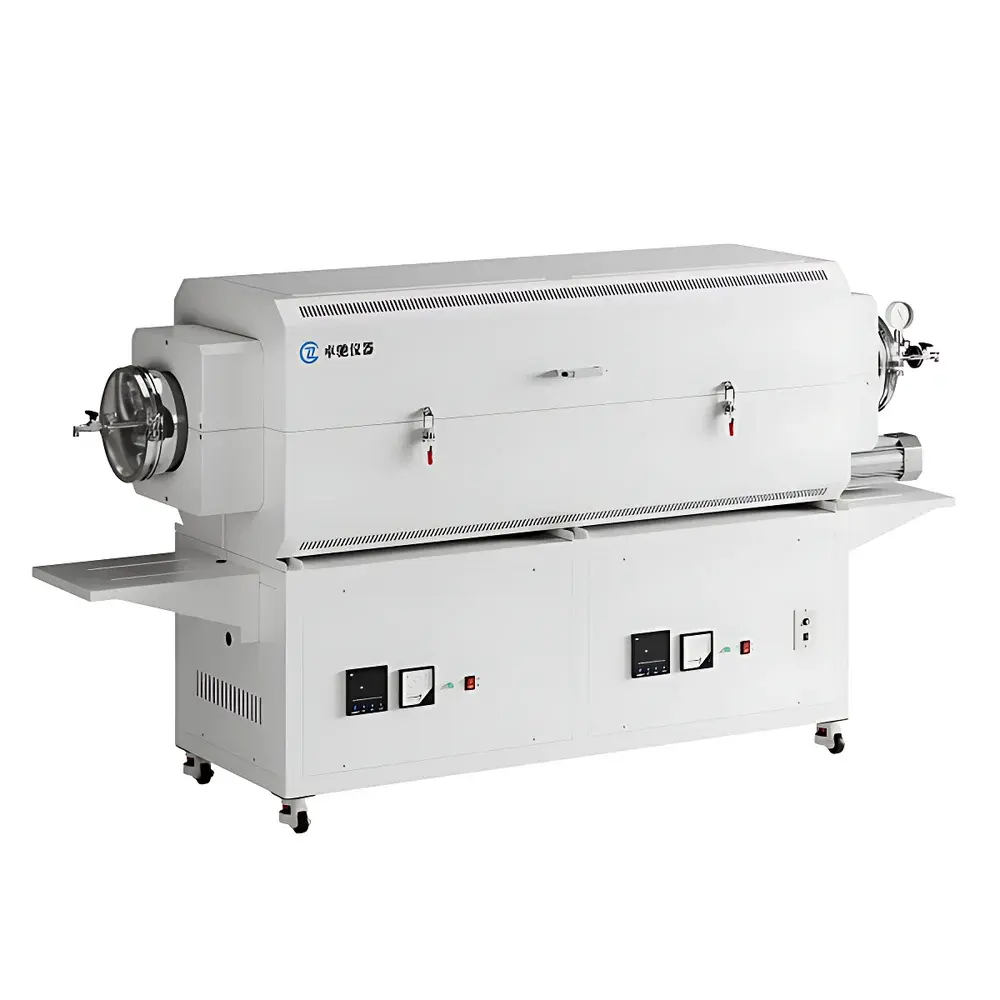
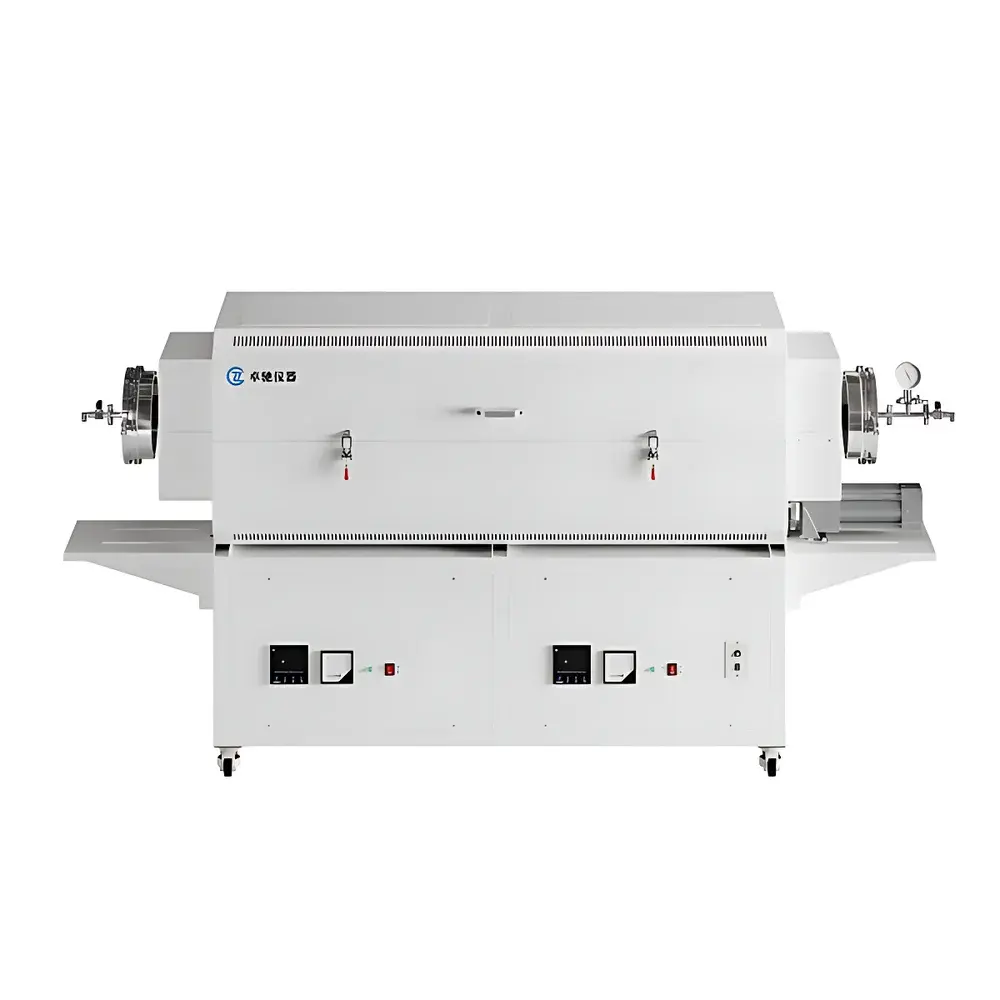
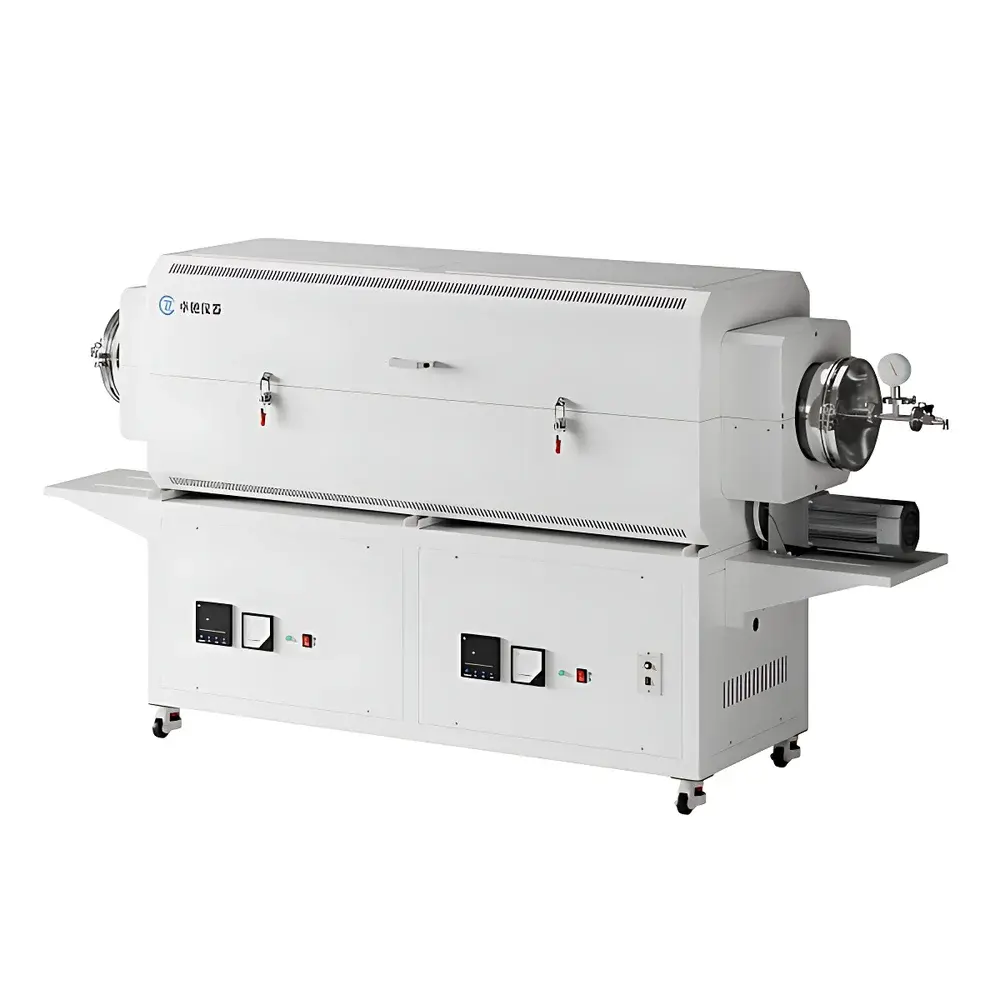
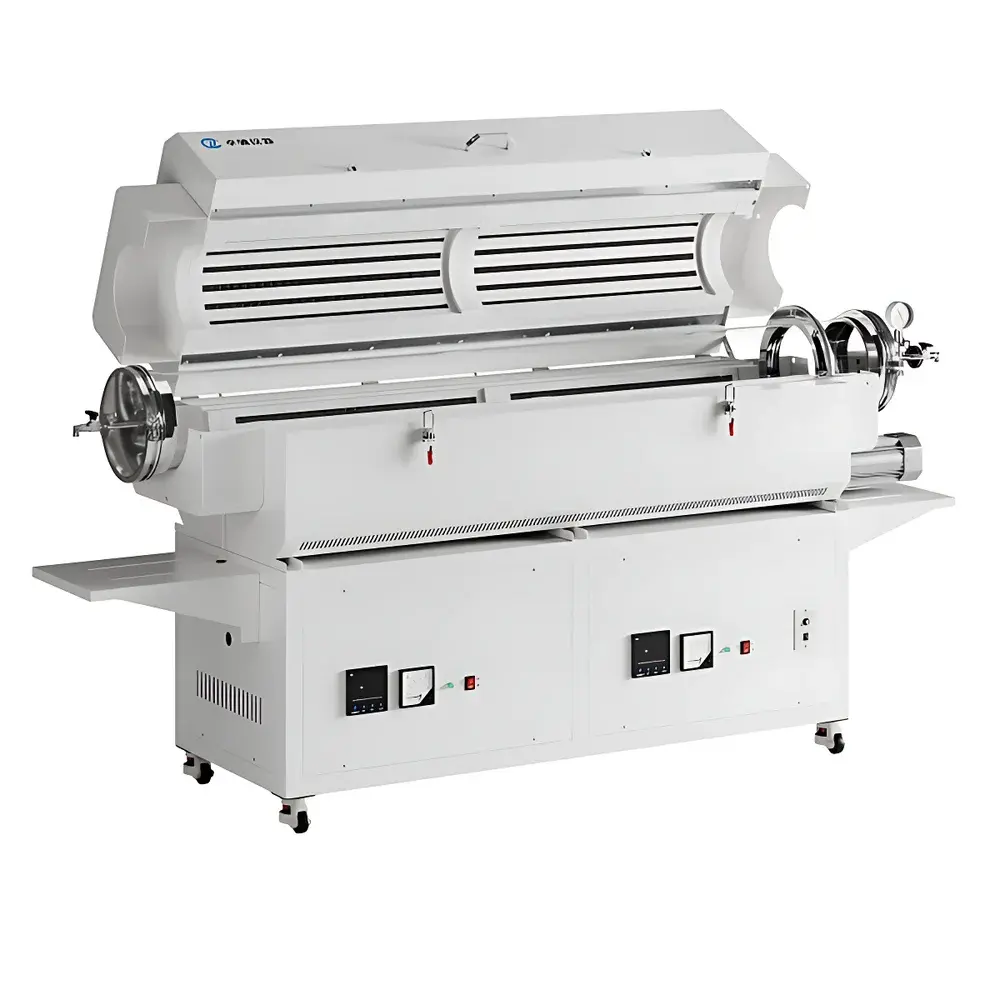
Zhuochi ZCSK3-12-8 Rotary Vacuum Tube Furnace
| Brand | Zhuochi |
|---|---|
| Origin | Zhejiang, China |
| Model | ZCSK3-12-8 |
| Max Temperature | 1200 °C |
| Temperature Uniformity | ±1 °C |
| Max Power | 12 kW |
| Heating Rate (to max temp) | ≤20 °C/min |
| Heating Method | Resistance wire (0Cr27Al7Mo2 alloy) |
| Chamber Dimensions | Ø200 × 1300 mm |
| Effective Tube Length | 1200 mm |
| Tube OD | Ø200 mm |
| Vacuum Level | −0.1 MPa |
| Control System | LTDE 30-segment programmable PID controller with K-type thermocouple |
| Power Supply | 380 V, 50 Hz |
| Compliance | CE-marked electrical architecture, GLP-ready temperature logging interface |
Overview
The Zhuochi ZCSK3-12-8 Rotary Vacuum Tube Furnace is an engineered thermal processing system designed for controlled-atmosphere and vacuum-based high-temperature treatments of powders, granular solids, and ceramic precursors. It operates on the principle of resistive heating via high-stability 0Cr27Al7Mo2 alloy resistance wire, coupled with precise axial rotation of the quartz or stainless-steel tube to ensure uniform thermal exposure and prevent particle sedimentation during prolonged heat treatment. The furnace supports continuous operation from 100 °C to 1200 °C under vacuum (−0.1 MPa), inert gas (N₂, Ar), reducing (H₂/N₂ mix), or reactive (NH₃, CH₄) atmospheres—making it suitable for applications including solid-state synthesis, CVD precursor decomposition, catalyst activation, and vacuum annealing of functional ceramics.
Key Features
- Rotary mechanism enables homogeneous thermal distribution across bulk powder samples, minimizing thermal gradients and agglomeration risks during calcination or sintering.
- Vacuum-tight quartz or optional stainless-steel tube (Ø200 mm × 2000 mm) with flanged end caps and dual-gas inlet/outlet ports for flexible atmosphere control.
- High-efficiency insulation using six-sided modular alumina polycrystalline fiber boards backed by ceramic fiber blanket, achieving low surface temperature (<60 °C at 1200 °C) and energy savings up to 30% versus conventional muffle furnaces.
- LTDE 30-segment programmable PID controller with K-type thermocouple feedback, offering ±1 °C temperature stability and real-time ramp/soak profiling with automatic shutdown on completion or fault detection.
- Dual-stage overtemperature protection: primary limit set at 1250 °C and secondary hardware cutoff at 1300 °C; all safety circuits comply with IEC 61000-6-2 EMC immunity standards.
- Robust mechanical construction: cold-rolled steel enclosure with phosphate conversion coating and epoxy-polyester powder coating (white RAL 9010); integrated angle-steel base housing power electronics, cooling fans, and compensation wiring.
Sample Compatibility & Compliance
The ZCSK3-12-8 accommodates batch loads up to 5–8 kg of fine powders (e.g., LiCoO₂, SiC, Y₂O₃, metal oxides) or granular feedstocks (50–500 µm). Its Ø200 mm internal diameter and 1200 mm heated zone support standardized crucible formats (e.g., alumina boats, graphite susceptors). The furnace meets structural and electrical safety requirements per EN 61000-3-2 (harmonic current emission) and EN 61000-3-3 (voltage fluctuations). While not certified for Class I Div 1 hazardous locations, its sealed tube design and interlocked vacuum/gas valves align with OSHA 1910.120 and ISO 15190 laboratory safety guidelines. Data logging outputs are compatible with GLP-compliant audit trails when paired with external USB/RS485 recorders.
Software & Data Management
The LTDE controller provides native USB and RS485 Modbus RTU interfaces for integration into centralized lab management systems. Optional PC software (Zhuochi FurnaceLink v3.2) enables remote parameter upload/download, real-time temperature curve visualization, CSV export of time–temperature–vacuum logs, and password-protected user profiles. All temperature setpoints, ramp rates, hold durations, and alarm thresholds are stored in non-volatile memory with timestamped change history—supporting 21 CFR Part 11 compliance when used with validated electronic signature modules and audit trail configuration.
Applications
- Controlled-atmosphere calcination of battery cathode materials (e.g., NMC, LFP) under Ar/H₂ to optimize crystallinity and oxygen stoichiometry.
- Vacuum annealing of optical fibers and sapphire substrates to reduce defect density without surface oxidation.
- CVD pre-treatment of carbon nanotube growth substrates using Fe/Al₂O₃ catalysts under CH₄/H₂ flow at 750–900 °C.
- Thermal reduction of metal oxide precursors (e.g., NiO → Ni, CuO → Cu) in H₂/N₂ environments for conductive ink formulation.
- Dehydroxylation and phase transformation studies of layered double hydroxides (LDHs) and MOFs under dynamic vacuum conditions.
FAQ
Can this furnace operate continuously at 1200 °C for extended periods (e.g., >48 h)?
Yes—provided ambient cooling airflow is maintained and the tube seal integrity is verified prior to each run. Continuous operation requires periodic inspection of heating element tension and thermocouple calibration every 200 h.
Is the rotary drive motor explosion-proof?
No—the standard AC induction motor is rated IP54 and intended for use in non-hazardous laboratory environments only. For ATEX Zone 2 installations, a custom-certified motor and sealed junction box must be specified at order.
What vacuum pump compatibility is recommended?
A two-stage oil-sealed rotary vane pump (e.g., Edwards RV8) or dry scroll pump (e.g., Agilent IDP-10) is required to achieve and maintain −0.1 MPa. Vacuum gauge interface is standard Pirani + thermocouple combo (0.1 Pa to 10⁵ Pa range).
Does the furnace include a gas mixing manifold?
No—gas mixing (e.g., N₂/H₂ ratios) must be performed externally using mass flow controllers (MFCs) upstream of the furnace inlet port. Optional OEM-integrated MFC kits are available upon request.
How is temperature uniformity validated across the heated zone?
Uniformity is verified per ASTM E220 using three calibrated K-type thermocouples placed at center, +300 mm, and −300 mm positions along the tube axis. Typical deviation is ≤±3 °C over the full 1200 mm zone at 1100 °C.



