
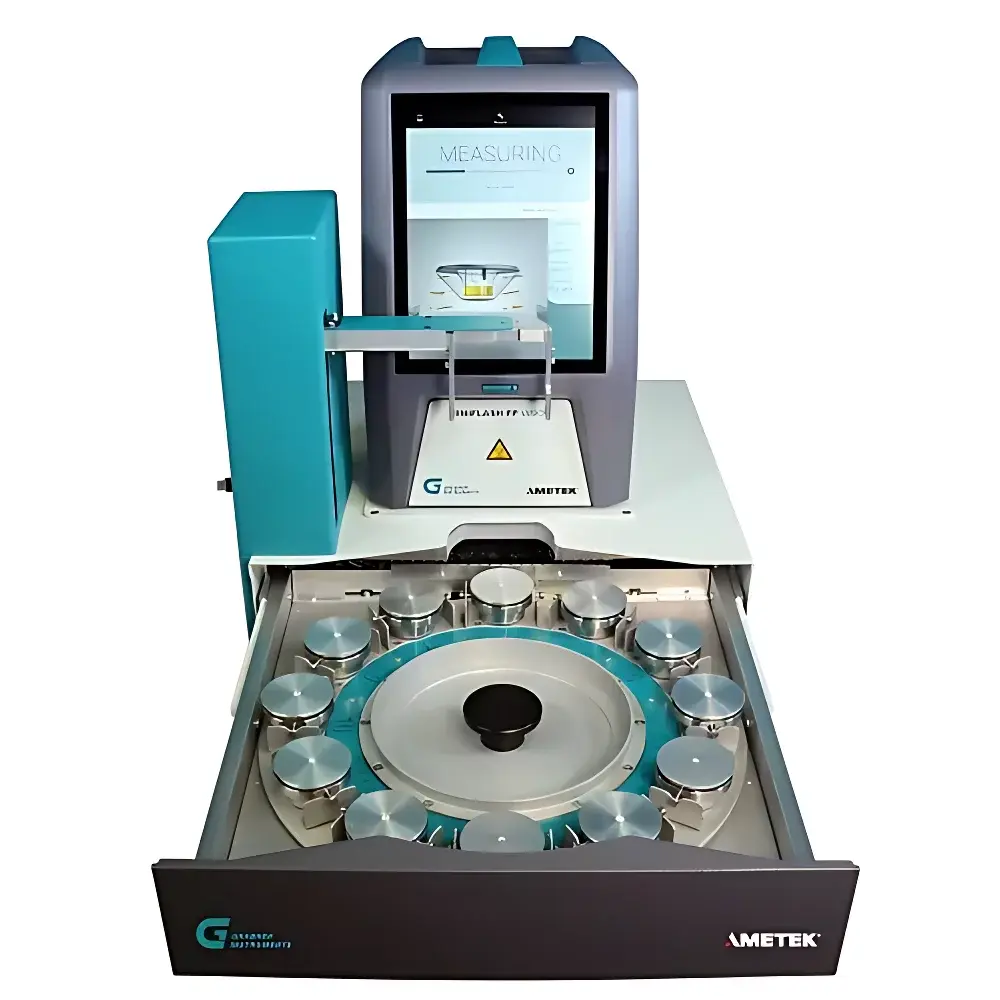
GRABNER MINIFLASH FPA VISION 12-Position Automated Flash Point Analyzer
| Brand | GRABNER |
|---|---|
| Origin | Austria |
| Model | MINIFLASH FPA VISION |
| Detection Method | Closed-Cup |
| Operation Mode | Fully Automatic |
| Temperature Range | −25 °C to 400 °C |
| Ignition Source | Electric Arc |
| Repeatability | ≤0.5 °C |
| Compliant Standards | ASTM D6450, ASTM D7094 |
Overview
The GRABNER MINIFLASH FPA VISION 12-Position Automated Flash Point Analyzer is a precision-engineered, modular accessory designed exclusively for integration with the GRABNER MINIFLASH FP(H) VISION series of closed-cup flash point analyzers. Based on the ASTM D6450 (equilibrium method) and ASTM D7094 (dynamic method) standards, this system employs a controlled electric arc ignition source within a sealed test chamber to determine the lowest temperature at which vapors above a liquid sample ignite momentarily under specified test conditions. The FPA VISION extends the core instrument’s throughput capability without compromising measurement integrity—enabling unattended, high-reliability flash point determination across an extended thermal range from −25 °C to 400 °C. Its compact footprint (0.18 m²), industrial-grade construction, and seamless interoperability with the VISION platform reflect GRABNER’s long-standing commitment to miniaturization, robustness, and laboratory workflow optimization in petroleum and chemical quality control environments.
Key Features
- 12-position automated sample carousel with precise robotic positioning and integrated sample identification via barcode or RFID support (optional)
- Modular architecture—fully compatible with both MINIFLASH FP VISION (low-temperature focus) and FPH VISION (high-temperature extension) instruments
- Industrial-grade enclosure with corrosion-resistant coating and reinforced electromechanical components for continuous operation in demanding QC/QA labs
- Switch-mode power supply delivering stable, low-noise DC power—reducing thermal drift and improving long-term calibration stability
- Optional external liquid cooling interface for the autosampler chamber—maintains ambient chamber temperature below 30 °C during extended high-temperature testing sequences
- Sub-second instrument reconfiguration: switch between FP and FPH modes in under 5 seconds via software-defined hardware handshake
Sample Compatibility & Compliance
The MINIFLASH FPA VISION supports a broad spectrum of petroleum-derived and synthetic liquids—including gasoline, diesel, jet fuel, lubricants, biodiesel blends, solvents, and intermediate petrochemicals—with minimal sample volume requirements (typically 0.5–2.0 mL per test). All measurements adhere strictly to the procedural rigor of ASTM D6450 (for low-viscosity, volatile samples) and ASTM D7094 (for higher-boiling, viscous, or thermally unstable materials). The system’s closed-cup design, temperature ramp control accuracy (±0.1 °C), and arc ignition timing synchronization meet the metrological traceability requirements of ISO/IEC 17025-accredited laboratories. When deployed in regulated environments, the full VISION platform—including FPA integration—supports audit-ready data logging aligned with FDA 21 CFR Part 11 (electronic records/signatures) and GLP/GMP documentation workflows.
Software & Data Management
The FPA VISION operates natively within GRABNER’s VISION Cockpit™ software suite—a Windows-based, network-capable application built for Industry 4.0 integration. Cockpit™ enables centralized management of method templates, calibration schedules, user permissions, and result archiving across distributed lab sites. Each test cycle logs full metadata: sample ID, operator, timestamp, environmental conditions (ambient T/RH), instrument status flags, raw sensor traces, and pass/fail compliance against predefined specification limits. Export formats include CSV, PDF reports (with digital signatures), and direct SQL database push for LIMS or ELN integration. Remote access—authorized via role-based authentication—allows supervisors to monitor real-time instrument status, queue progress, and historical performance metrics across global facilities.
Applications
- Routine flash point screening in refinery QC labs for crude cuts, distillates, and finished fuels
- Regulatory compliance testing for transportation safety (UN TDG, IMDG Code, ADR/RID classifications)
- Research and development of novel biofuels and low-carbon synthetic hydrocarbons
- Stability assessment of formulated products such as hydraulic fluids, transformer oils, and metalworking coolants
- Batch release testing in pharmaceutical excipient manufacturing where solvent flammability is a critical release parameter
FAQ
Is the MINIFLASH FPA VISION certified for use in hazardous area laboratories?
Yes—when installed with appropriate barrier configurations and grounding protocols, the FPA VISION meets ATEX Category 3G (Zone 2) and IECEx requirements for non-incendive operation in classified locations.
Can the FPA VISION be retrofitted to legacy MINIFLASH FP or FPH instruments?
No—it is exclusively compatible with the VISION-generation hardware (FP VISION and FPH VISION models released from 2020 onward) due to updated communication protocols and mechanical interface specifications.
What maintenance intervals are recommended for the electric arc ignition system?
The tungsten-alloy electrodes require inspection every 500 tests; replacement is advised after 2,000 ignitions or upon visible pitting or erosion observed during visual check.
Does the system support multi-language user interfaces?
Yes—Cockpit™ software provides localized UI and report generation in English, German, French, Spanish, Chinese (Simplified), Japanese, and Korean.
How is temperature calibration verified across the full −25 °C to 400 °C range?
Calibration is performed using NIST-traceable reference materials (e.g., cyclohexane, n-decane, tetradecane) at defined anchor points; GRABNER recommends annual third-party verification with documented uncertainty budgets per ISO/IEC 17025.
Related Products





