
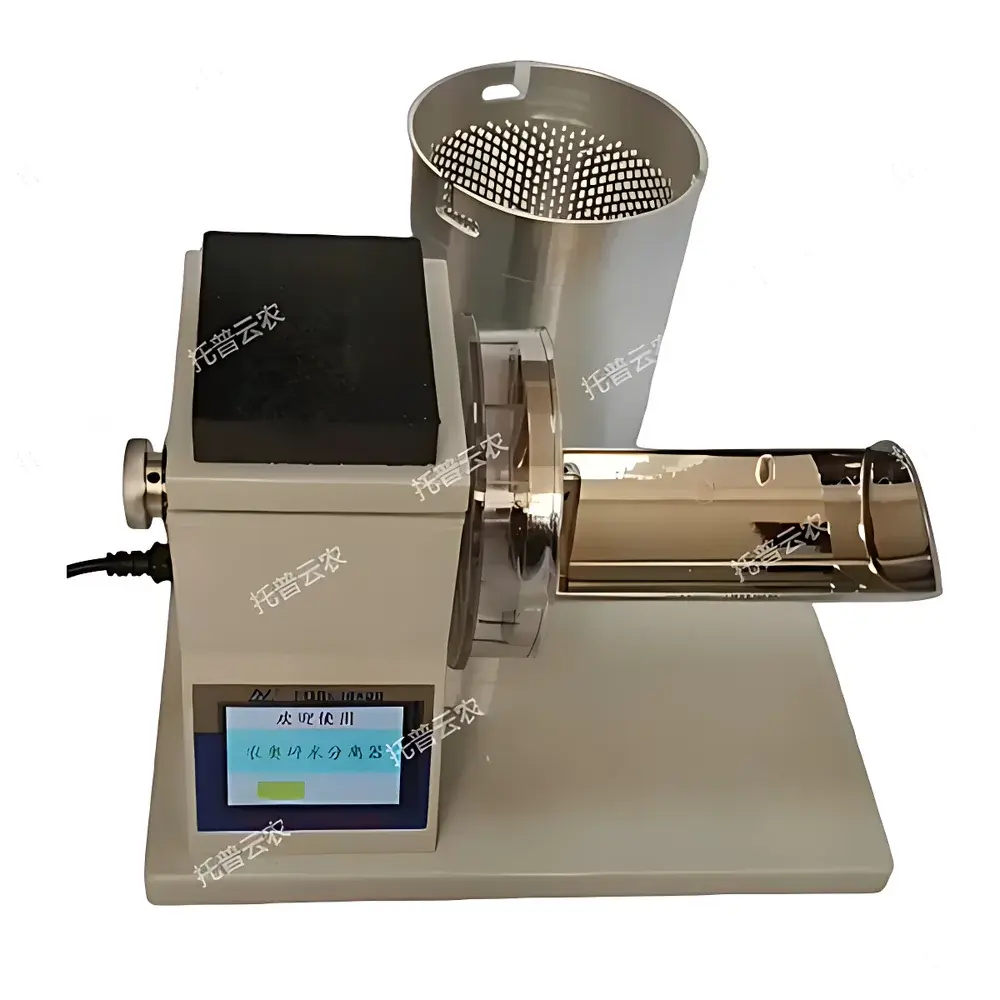
Top Cloud-agri TP-SM2.0 Gravimetric Broken Rice Separator
| Brand | Top Cloud-agri |
|---|---|
| Origin | Zhejiang, China |
| Manufacturer Type | Direct Manufacturer |
| Country of Origin | China |
| Model | TP-SM2.0 |
| Pricing | Available Upon Request |
| Separation Drum Dimensions | 140 × 200 mm |
| Drum Rotational Speed | 28 rpm |
| Motor Power | 40 W |
| Separation Duration | Adjustable up to 2 min (programmable timer) |
| Sample Capacity | 50–150 g per batch |
| Maximum Weighing Capacity | 2 kg (resolution: 0.1 g) |
| Input Voltage | AC 220 V |
| Display | ≥3.5-inch color touchscreen with real-time weight/time interface |
| Data Handling | Automatic weight logging, raw data storage, whole-grain percentage calculation |
Overview
The Top Cloud-agri TP-SM2.0 Gravimetric Broken Rice Separator is a precision laboratory instrument engineered for the quantitative physical separation of whole kernels from broken fragments in milled rice samples. It operates on the principle of differential gravitational egress under controlled rotational motion — a method grounded in mechanical centroid displacement dynamics. As the cylindrical separation drum rotates at a calibrated speed of 28 rpm, rice grains are carried along its inner surface by friction and centrifugal assistance. The drum’s interior is lined with uniformly distributed apertures; due to differences in longitudinal geometry, intact rice kernels (typically >75% of average kernel length) lose contact with the drum wall earlier in the rotation cycle — their center of gravity shifts beyond the aperture boundary before that of shorter fragments. Consequently, whole grains fall into the primary collection channel, while broken pieces remain entrained longer and discharge at a higher angular position into a secondary receptacle. This spatially resolved ejection mechanism enables reproducible, operator-independent partitioning without reliance on density, moisture, or optical properties — making it compliant with standardized gravimetric protocols for broken rice analysis.
Key Features
- Integrated high-resolution weighing system (2 kg capacity, 0.1 g resolution) synchronized with separation timing and data logging
- Programmable separation duration (default 2 min, user-adjustable within defined operational range)
- Dual-mode display interface: real-time weight readout during sample loading, switchable to clock mode when tray is empty
- Touch-activated control panel with ≥3.5-inch full-color LCD, supporting intuitive parameter entry and status feedback
- Robust mechanical architecture: rear-mounted 40 W reduction motor coupled via synchronous belt drive for stable, low-vibration rotation
- Modular separation drum (140 × 200 mm) — compatible with optional drum configurations for specialized grain types (e.g., millet, as noted in operational guidance)
Sample Compatibility & Compliance
The TP-SM2.0 is validated for use with milled Oryza sativa varieties across standard long-, medium-, and short-grain classifications. Its separation accuracy — typically within ±1.0% relative error for homogeneous cultivars — aligns with national and regional grain quality standards including GB/T 1350–2018 (China National Standard for Paddy and Rice) and ISO 6647-1:2019 (Rice — Determination of broken kernels — Part 1: Gravimetric method). While not intrinsically certified to GLP or GMP frameworks, its deterministic mechanical operation, traceable weight integration, and non-volatile parameter storage support audit-ready documentation in regulated QC environments. For outlier morphologies (e.g., ultra-long japonica or highly fragmented parboiled rice), manual post-separation refinement is recommended per clause 7.3 of ISO 6647-1.
Software & Data Management
The device implements embedded firmware with no external PC dependency. All operational parameters — start time, duration, gross sample mass, tare value, and calculated whole-kernel percentage — are timestamped and stored in non-volatile memory. Weight values are recorded at initiation and termination of each cycle; differential mass yields broken rice content directly. Data export is not supported via USB or network interface; however, internal logs persist across power cycles and may be reviewed on-device. The system satisfies basic ALCOA+ principles (Attributable, Legible, Contemporaneous, Original, Accurate) for laboratory recordkeeping under ISO/IEC 17025:2017 Clause 7.5.2, provided users maintain procedural documentation for calibration intervals (recommended every 6 months) and performance verification using reference rice standards.
Applications
- Routine quality control in rice milling facilities assessing compliance with grade-specific broken rice limits (e.g., ≤5% for Grade I, ≤15% for Grade III per GB/T 1350)
- Research applications in cereal science laboratories studying milling yield optimization, kernel fragility indices, and varietal screening
- Educational use in food science and agricultural engineering curricula for hands-on instruction in physical grain characterization
- Regulatory testing by provincial grain inspection centers performing statutory sampling and certification
- Pre-screening prior to instrumental analysis (e.g., image-based classification or near-infrared spectroscopy) where particle size homogeneity is required
FAQ
Is the TP-SM2.0 suitable for non-rice cereals such as barley or sorghum?
The standard drum configuration is optimized for rice morphology. Alternative drums are available for millet (as referenced in documentation); compatibility with other cereals requires validation of aperture geometry and rotational dynamics against kernel aspect ratio and mass distribution.
Does the instrument meet FDA 21 CFR Part 11 requirements?
No. It lacks electronic signature capability, audit trail generation, and user access controls required for Part 11 compliance. It is intended for non-GxP environments or as a supporting tool within broader validated workflows.
How often should the weighing module be calibrated?
Initial calibration must be performed using certified test weights (e.g., Class M2, 1 kg and 200 g) prior to first use. Subsequent recalibration is recommended every six months or after any mechanical impact affecting load cell integrity.
Can separation time be extended beyond 2 minutes?
Yes — the timer is programmable within a range of 0.5 to 5.0 minutes, though extended durations do not improve separation fidelity for standard rice and may increase mechanical wear.
What maintenance procedures are required?
Daily: wipe drum interior and collection channels with lint-free cloth; inspect aperture integrity. Quarterly: lubricate motor bearings per manufacturer specifications; verify belt tension and alignment. Annually: full functional verification using traceable reference samples.
Related Products



