
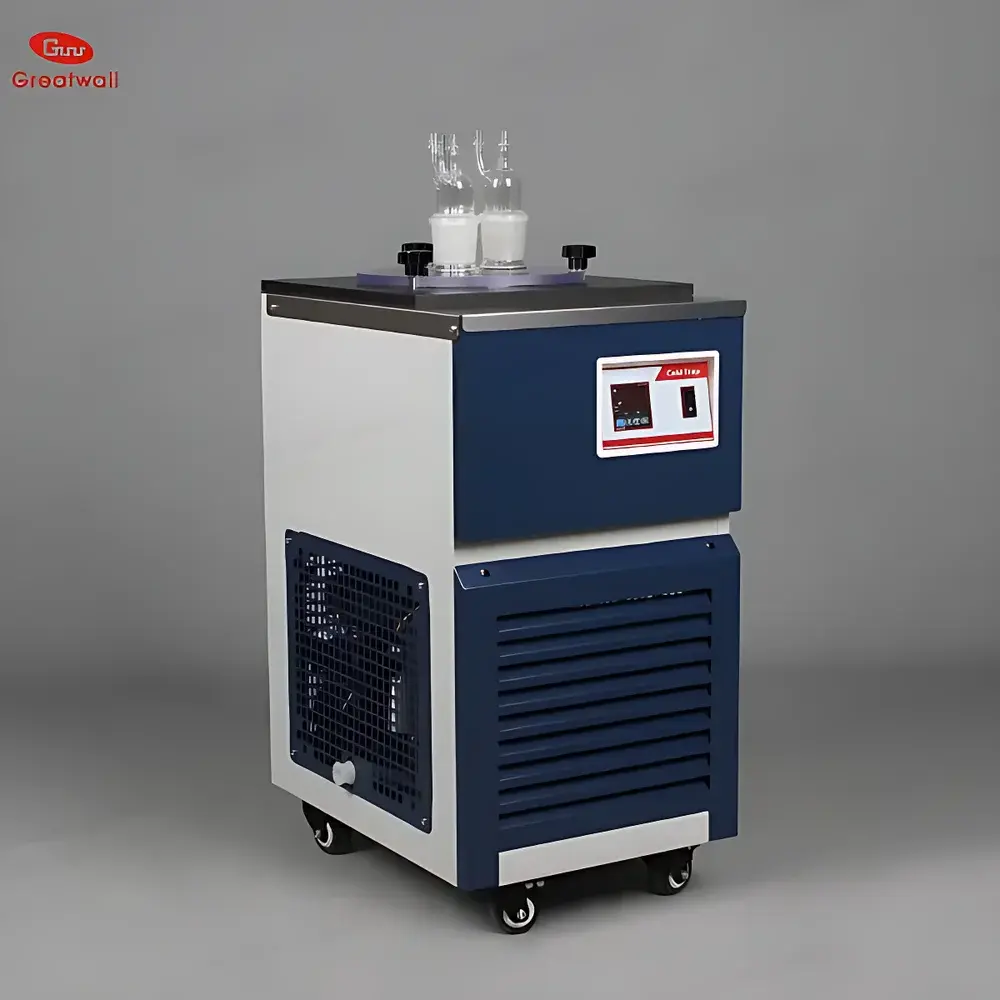
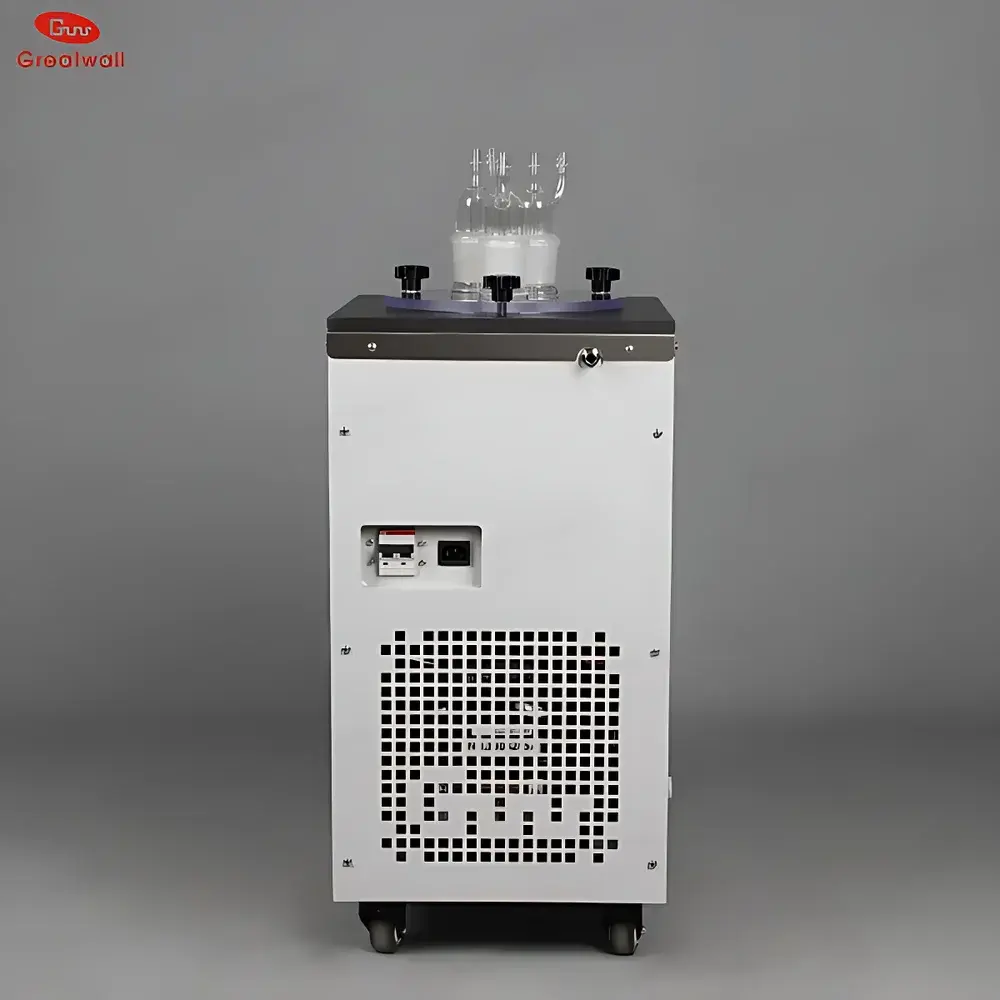
VT-40 Water Vapor Trap by The Great Wall
| Key Features | Dual-mode operation (direct bath trapping & glass condenser trapping) |
|---|---|
| Construction | 304 stainless steel cold trap bath + three 3.3 borosilicate glass condensers (Ø50×300 mm) |
| Temperature Range | -40°C (no-load) |
| Cooling Method | Indirect refrigeration with R404A refrigerant |
| Temperature Display | Digital readout with Pt100 sensor |
| Adjustable Setpoint | Within full operating range |
| Safety Protections | Delayed start, overcurrent, overtemperature, high-pressure cutoff |
| Refrigeration Capacity | 300 W at -10°C, 250 W at -20°C, 150 W at -30°C, 50 W at -35°C |
| Cold Bath Dimensions | Ø160×250 mm |
| Vacuum Interface | Flexible hose connector, OD Ø12 mm |
| Ambient Operating Conditions | 5–35°C, ≤70% RH |
| Power Supply | 220 V~, 50 Hz |
| Power Consumption | 530 W |
| Input Current | 2.9 A |
| Unit Dimensions (W×D×H) | 350×470×805 mm |
| Net Weight | 45 kg |
Overview
The VT-40 Water Vapor Trap by The Great Wall is a laboratory-grade cryogenic cold trap engineered for efficient condensation and removal of water vapor and volatile solvents during vacuum-based processes—including freeze drying (lyophilization), rotary evaporation, vacuum distillation, and solvent recovery workflows. It operates on the principle of cryocondensation: vapors contacting sub-zero surfaces undergo phase transition from gas to solid or liquid, thereby preventing backstreaming into vacuum pumps and safeguarding pump integrity, ultimate vacuum performance, and process reproducibility. Unlike passive traps relying solely on dry ice or liquid nitrogen, the VT-40 integrates a closed-cycle refrigeration system with precise digital temperature control, enabling stable, repeatable operation across extended durations without consumables. Its dual-capture architecture—comprising a stainless steel cooling bath and interchangeable borosilicate glass condensers—supports method flexibility across aqueous, alcoholic, acidic, and organic solvent systems while maintaining material compatibility and chemical resistance.
Key Features
- Dual capture configuration: Select between direct immersion in the 304 stainless steel cooling bath (optimized for water and ethanol-based samples) or use of three standardized 3.3 borosilicate glass condensers (Ø50×300 mm) for aggressive media including HCl, acetic acid, acetone, ethyl acetate, and chlorinated solvents.
- Precise thermal management: Digital Pt100 temperature sensor with 0.1°C resolution and programmable setpoint control across the full -40°C to ambient range; real-time display enables dynamic monitoring during vacuum ramp-up and condensation onset.
- Refrigeration performance calibrated per ISO 8573-1: Compressor-driven indirect cooling using environmentally compliant R404A refrigerant delivers 300 W cooling capacity at -10°C, degrading predictably to 50 W at -35°C—enabling accurate thermal load estimation for system integration.
- Integrated safety architecture: Hardware-level protections include compressor delay circuitry, thermal cutouts on motor windings and condenser coils, current-sensing overload relays, and high-pressure switch shutdown—meeting IEC 61000-6-2 EMC immunity requirements.
- Modular vacuum interface: Standardized Ø12 mm flexible hose connection simplifies integration with common lab vacuum manifolds, lyophilizers, and rotary evaporators; no adapters or custom fittings required.
Sample Compatibility & Compliance
The VT-40 accommodates diverse sample chemistries through material-segregated capture paths. The 304 stainless steel bath complies with ASTM A240 for corrosion resistance in neutral and mildly alkaline aqueous environments. Glass condensers conform to DIN ISO 3585 specifications for 3.3 borosilicate glass, ensuring hydrolytic class HGB 1 resistance (per ISO 719) and thermal shock tolerance up to 120 K ΔT. For regulated environments—including GLP-compliant QC labs and GMP-manufacturing support—the unit supports audit-ready operation when paired with validated vacuum controllers; temperature logging (via optional RS485/Modbus output) aligns with FDA 21 CFR Part 11 data integrity expectations for electronic records.
Software & Data Management
While the VT-40 operates as a standalone instrument with front-panel controls, its analog temperature output (0–10 V DC) and digital communication interface (RS485, Modbus RTU protocol) allow seamless integration into centralized lab automation platforms. Third-party SCADA or LIMS systems can acquire real-time bath temperature, compressor status, and fault codes. When deployed in networked freeze-drying suites, the trap’s temperature trajectory serves as a critical process analytical technology (PAT) parameter—correlating directly with primary drying endpoint detection per USP and Ph. Eur. 2.2.45 guidance.
Applications
- Primary and secondary drying stage protection in pharmaceutical lyophilization cycles
- Solvent trapping during high-boiling-point compound concentration under reduced pressure
- Preventing oil contamination in oil-sealed rotary vane pumps during ethanol or DMSO removal
- Condensing acidic vapors (e.g., trifluoroacetic acid) in peptide synthesis vacuum lines
- Water vapor suppression in high-vacuum coating chambers and electron microscopy sample prep stations
FAQ
Can the VT-40 be used continuously at -40°C?
No—its rated no-load minimum is -40°C, but sustained operation below -35°C significantly reduces refrigeration capacity and increases compressor duty cycle; continuous use is recommended between -20°C and -35°C for optimal reliability.
Is the glass condenser assembly autoclavable?
The 3.3 borosilicate glass components are autoclave-compatible (121°C, 2 bar), but the O-rings and hose connectors are not; disassembly and separate sterilization are required.
Does the unit meet CE or UL certification standards?
The VT-40 complies with EN 61000-6-3 (EMI emission) and EN 61000-6-2 (immunity); UL listing is not held, but design adheres to UL 61010-1 third-edition safety principles for laboratory equipment.
What vacuum level is achievable when paired with a typical two-stage rotary vane pump?
With proper pump selection (≥4 m³/h free air displacement) and dry gas ballast, ultimate pressures below 5×10⁻² mbar are routinely achieved in clean, low-outgassing systems.
How often does the R404A refrigerant require servicing?
Under normal operation and absence of leaks, the sealed refrigeration circuit requires no periodic refrigerant replenishment; annual verification of charge integrity via pressure gauge readings is recommended as part of preventive maintenance.



