
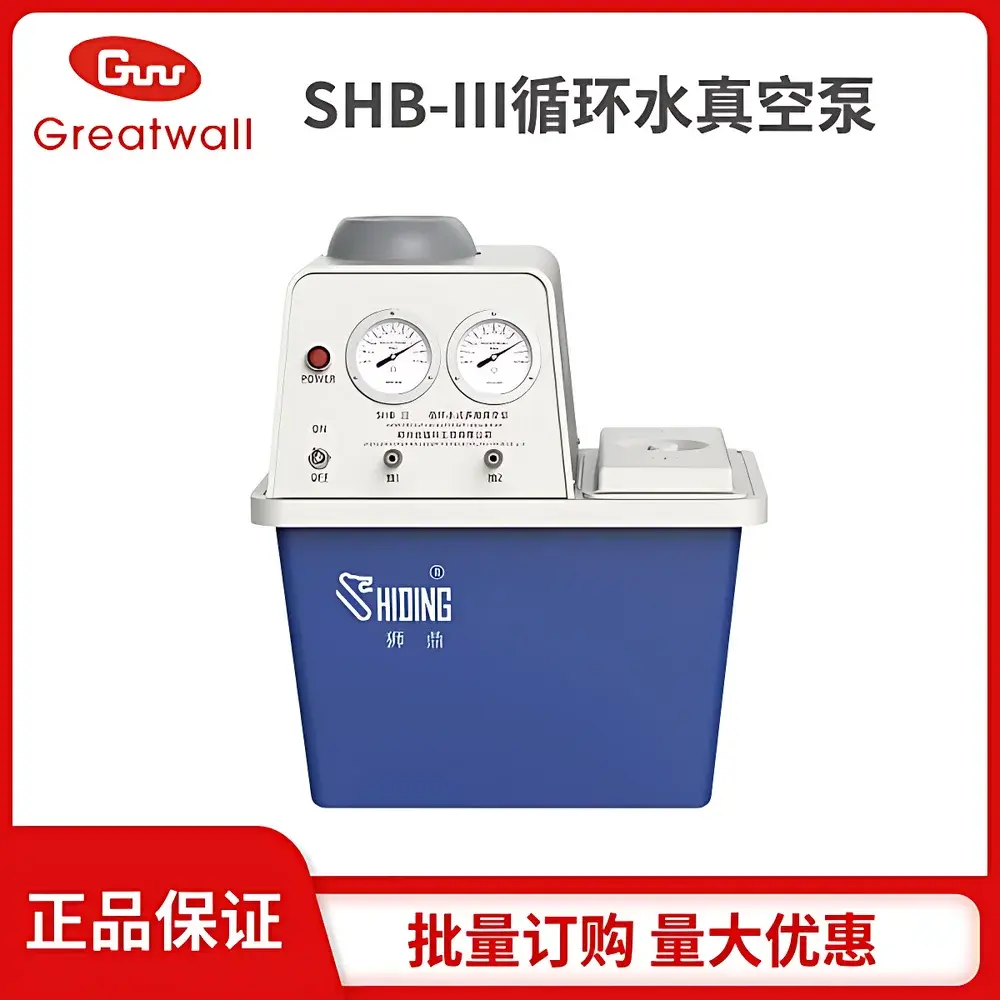
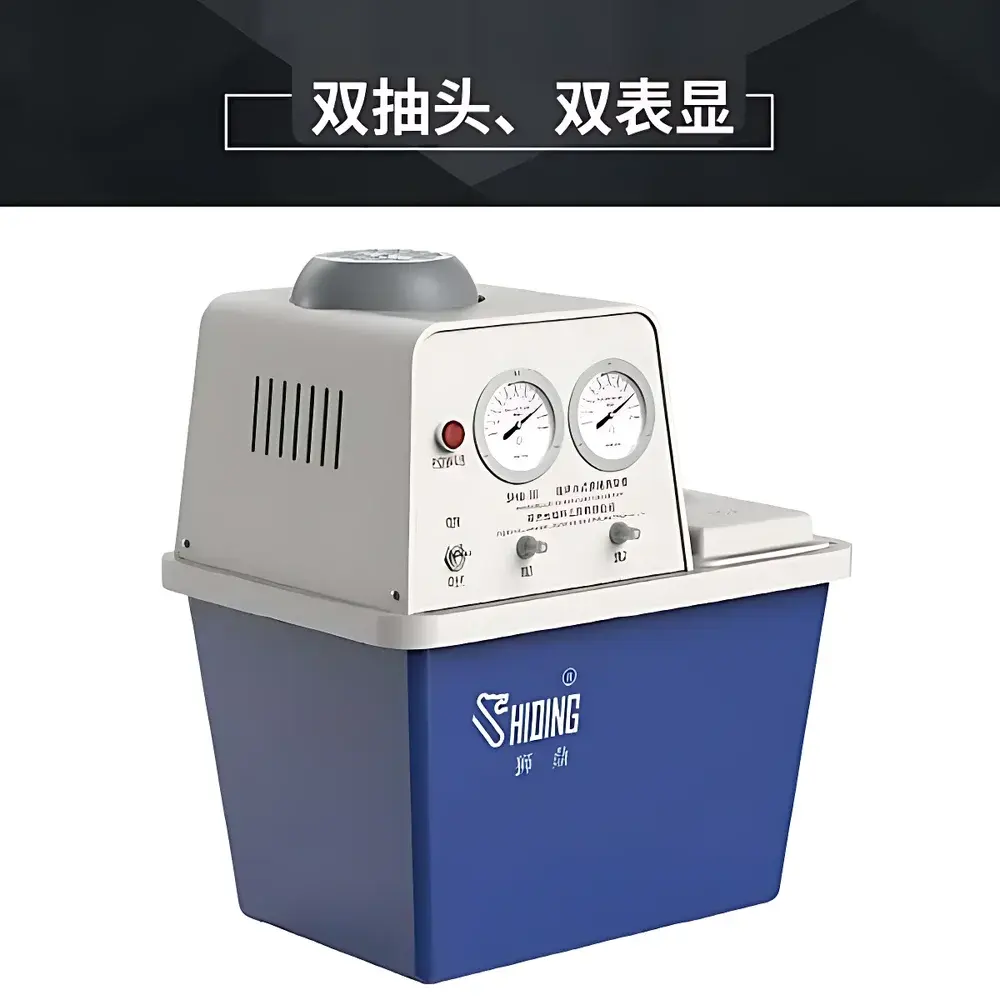
Great Wall SHB-III Benchtop Circulating Water Vacuum Pump
| Brand | The Great Wall |
|---|---|
| Origin | Henan, China |
| Manufacturer Type | Direct Manufacturer |
| Instrument Type | Circulating Water Vacuum Pump |
| Product Type | Oil-Free Vacuum Pump |
| Ultimate Vacuum | 0.098 MPa (20 mbar) |
| Single-Head Pumping Rate | 10 L/min |
| Motor Power | 180 W |
| Weight | 9.5 kg |
| Water Circulation Flow Rate | 7 L/min |
| Pump Flow Rate | 80 L/min |
| Water Tank Capacity | 15 L |
| Max Lift Head | 10 m |
| Operating Temperature Range | 5–35 °C |
| Relative Humidity Limit | ≤70% |
| IP Rating | IP20 |
| Pollution Degree | Class 2 |
| Dimensions (W×D×H) | 385 × 280 × 420 mm |
Overview
The Great Wall SHB-III is a benchtop circulating water vacuum pump engineered for reliable, oil-free vacuum generation in academic, pharmaceutical, and industrial laboratory environments. It operates on the principle of water-ring aspiration: ambient air is drawn into a rotating impeller chamber where centrifugal force creates a liquid ring against the pump housing; this ring forms sealed cavities that expand to draw gas and contract to compress and exhaust it. Unlike mechanical or diaphragm vacuum pumps, the SHB-III uses deionized or tap water as both the working fluid and coolant—eliminating lubricant contamination risks and enabling safe operation with organic solvents, acids, and bases commonly encountered during rotary evaporation, vacuum filtration, distillation, and solvent recovery workflows. Its dual-head configuration supports independent or parallel vacuum control across two experimental stations, making it ideal for integration with rotary evaporators, vacuum ovens, and continuous-flow reaction systems.
Key Features
- Oil-free operation ensures zero hydrocarbon contamination—critical for GC sample preparation, lyophilization pre-treatment, and analytical chemistry applications requiring high-purity vacuum conditions.
- Dual independent suction ports with individual vacuum gauges allow simultaneous operation of two instruments (e.g., one rotary evaporator + one vacuum filtration manifold), each with real-time pressure monitoring.
- Integrated water-level sensor and check valve assembly prevent backflow into connected apparatus during power interruption or pump shutdown—protecting sensitive glassware and preventing solvent siphoning.
- 304 stainless steel motor shaft and fluororubber shaft seals provide corrosion resistance and extended service life under humid or mildly aggressive chemical exposure.
- Acoustic-dampening water ejector design reduces turbulence-induced noise and degasses incoming water, improving ultimate vacuum stability and lowering operational sound pressure to ≤62 dB(A) at 1 m distance.
- Modular construction enables material customization: SHB-III (PP pump body), SHB-IIIA (PP body + 304 SS impeller), SHB-IIIS (full 304 SS wetted parts), and SHB-IIIG (copper/PTFE-coated nozzles for enhanced acid resistance).
Sample Compatibility & Compliance
The SHB-III is compatible with aqueous, alcoholic, chlorinated, and moderately acidic or basic vapors when used within its specified temperature (5–35 °C) and humidity (≤70% RH) limits. Its PP, PA, or 304 stainless steel wetted-path configurations meet ISO 8573-1 Class 2 particulate purity requirements for non-oil-lubricated vacuum sources. While not certified to IEC 61000-6-3 (EMC) or UL 61010-1 out-of-the-box, the unit complies with general laboratory safety principles aligned with ANSI Z9.5 and EU Directive 2006/42/EC for machinery. For GLP/GMP-regulated environments, users may configure audit-ready logging via optional RS485 interface (not included) and maintain calibration records per ISO/IEC 17025 guidelines.
Software & Data Management
The SHB-III operates as a standalone analog device without embedded firmware or digital controls. Vacuum level is monitored visually via dual Bourdon-tube gauges calibrated to ±0.005 MPa accuracy. For traceable data capture, third-party pressure loggers (e.g., Vaisala BAROCAP® or Omega DP25B) can be installed inline with NPT 1/4″ vacuum ports. When integrated into automated systems, analog 0–10 V or 4–20 mA output modules (available as OEM add-ons) support PLC-based process interlocks and centralized vacuum monitoring per FDA 21 CFR Part 11 Annex 11 requirements for electronic record integrity.
Applications
- Rotary evaporation of heat-sensitive compounds (e.g., natural product extracts, polymer precursors) under controlled sub-atmospheric pressure.
- Vacuum-assisted crystallization and recrystallization in synthetic organic chemistry labs.
- Gas-phase extraction and headspace sampling prior to GC-MS analysis.
- Supporting cold-trap condensation in freeze-drying pilot systems.
- Providing stable low-pressure environments for thin-film deposition setups and vacuum desiccation of hygroscopic reagents.
FAQ
Is the SHB-III suitable for use with aggressive solvents such as concentrated HCl or HF?
No—standard SHB-III units (PP-bodied) are incompatible with hydrofluoric acid and highly oxidizing agents. Select the SHB-IIIG variant with copper/PTFE-coated nozzles and verify compatibility using ASTM D543 immersion testing protocols.
Can the pump operate continuously for 24 hours?
Yes, provided ambient temperature remains below 35 °C, water level is maintained above minimum mark, and inlet water quality meets conductivity <500 µS/cm to prevent scaling.
What maintenance intervals are recommended?
Inspect water tank cleanliness and check valve function every 100 operating hours; replace fluororubber shaft seals every 12 months under typical lab usage (8 h/day, 5 days/week).
Does the SHB-III comply with energy efficiency standards such as ENERGY STAR or EU Ecodesign?
It does not carry ENERGY STAR certification, but its 180 W motor meets Tier 2 IE2 efficiency classification per IEC 60034-30-1, delivering optimal power-to-vacuum ratio for benchtop applications.
Can vacuum level be regulated automatically?
Not natively—the SHB-III lacks built-in pressure control. However, external vacuum controllers (e.g., Vacuubrand VACUU·SELECT) can be interfaced via its dual-port architecture to enable closed-loop setpoint regulation.



