
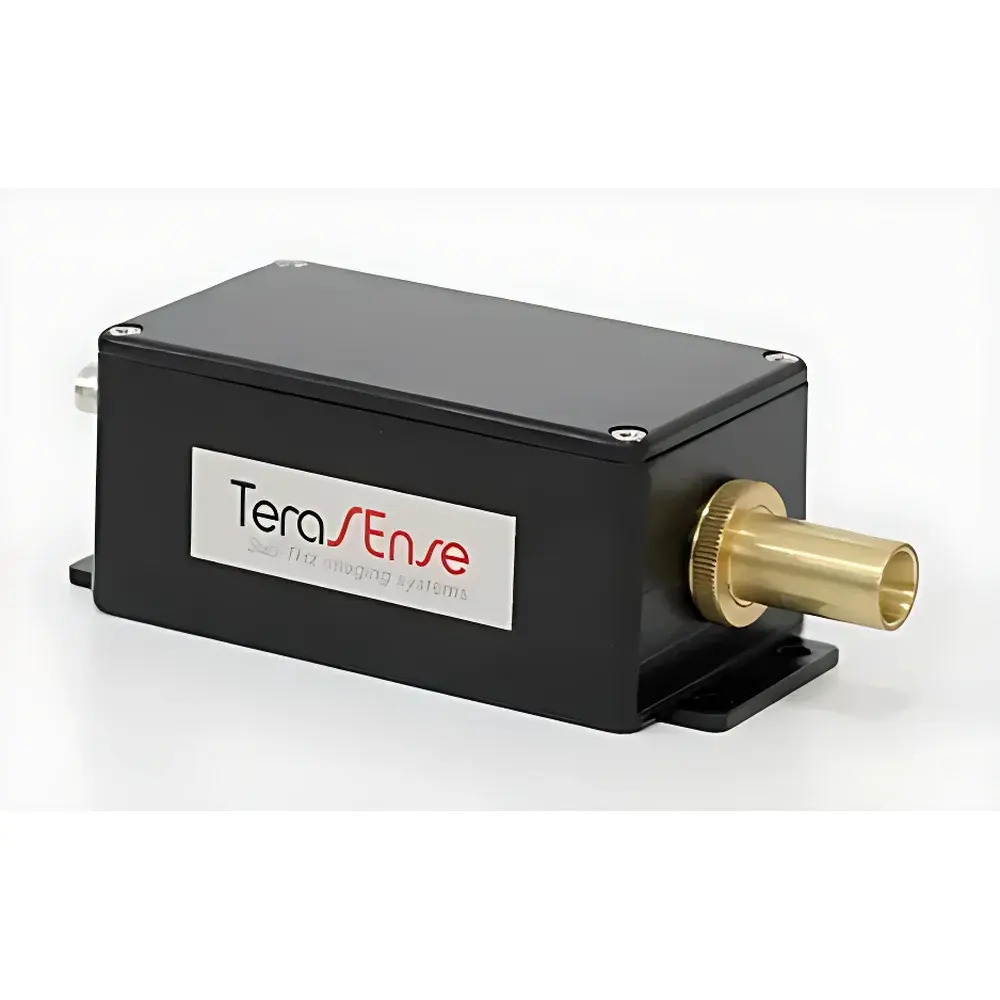
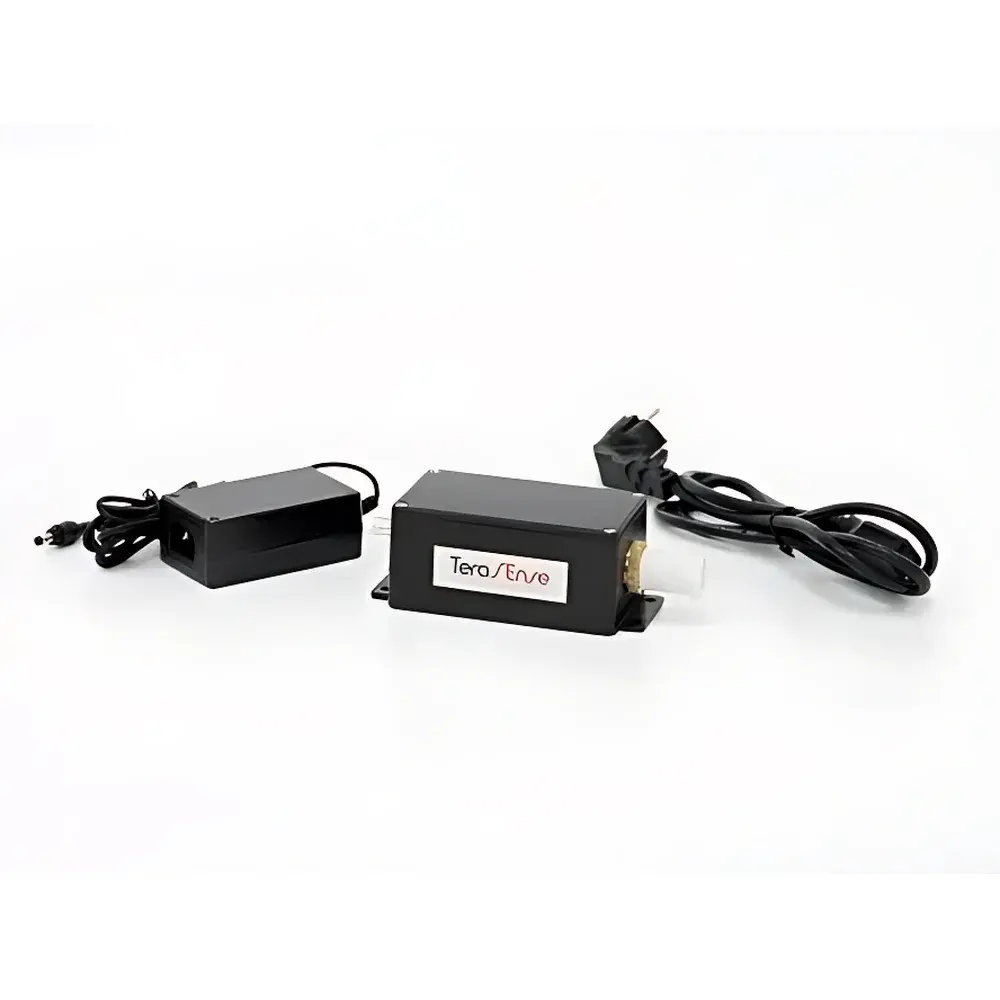
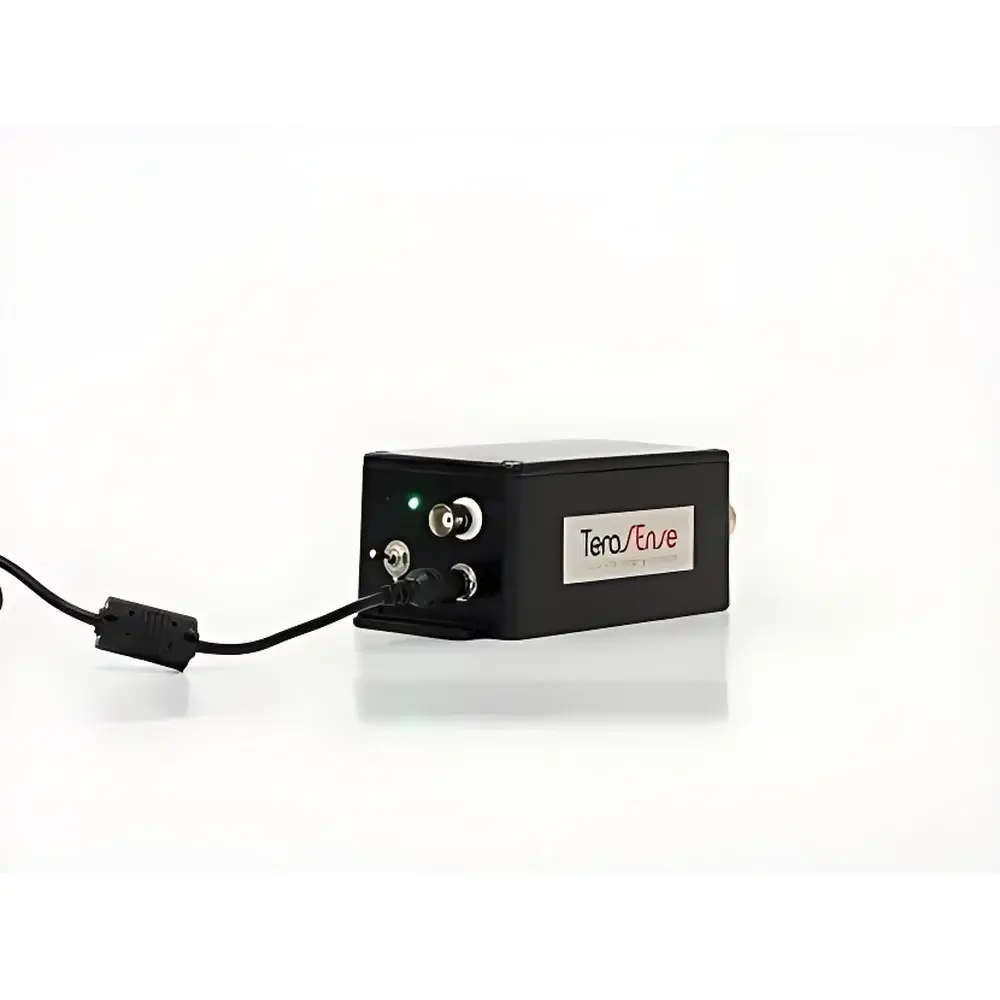
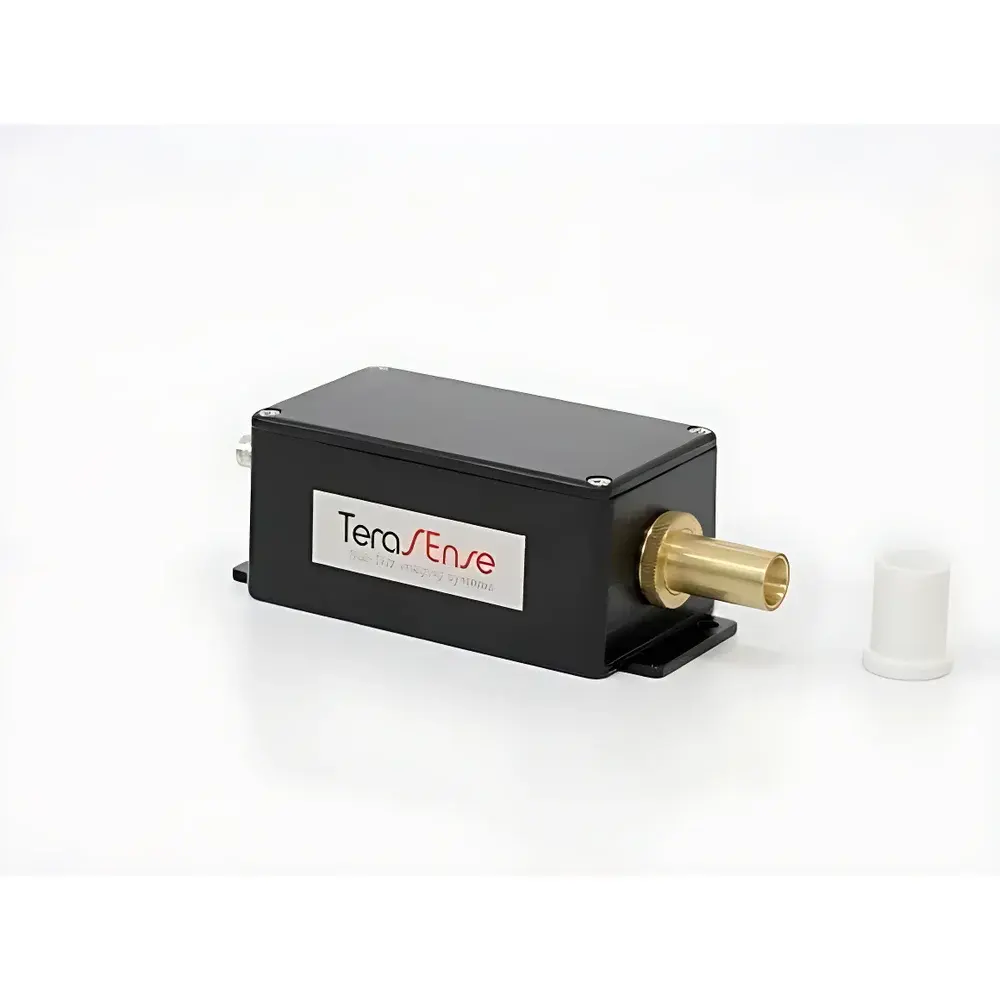
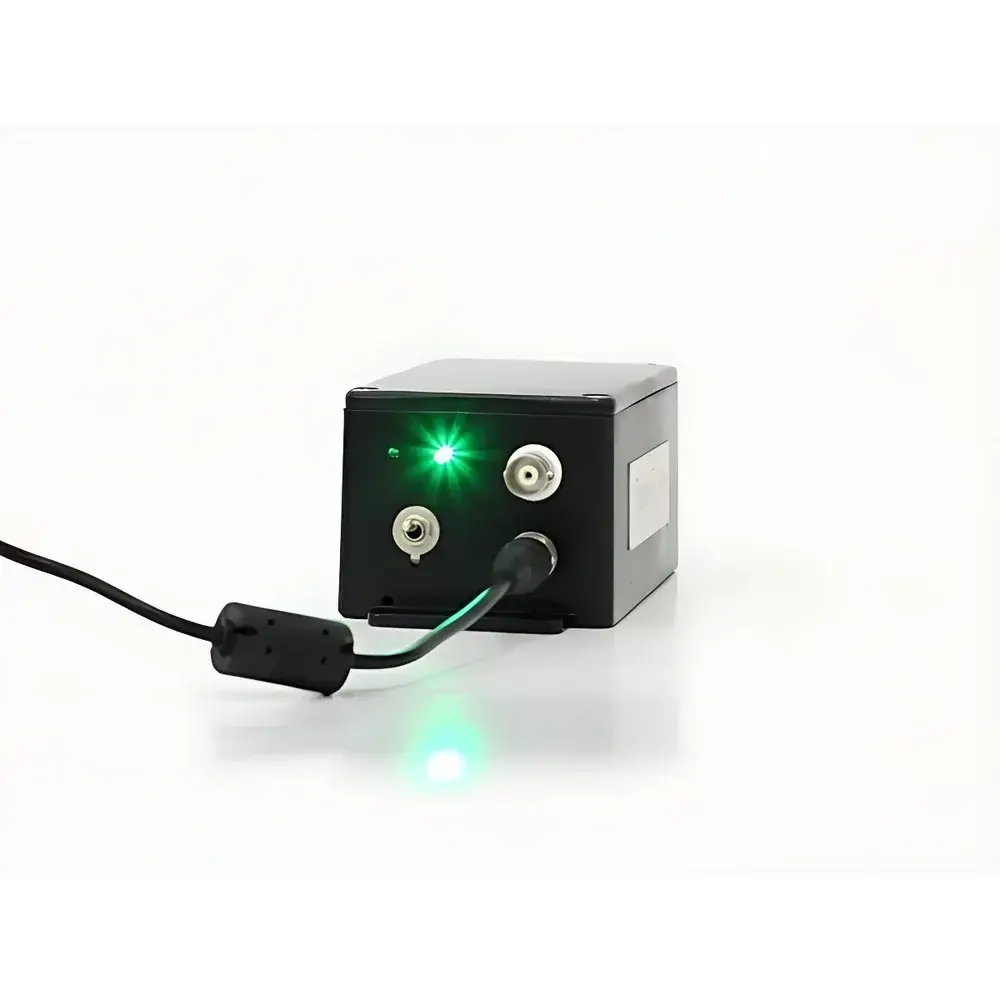
TeraSense IMPATT Diode Terahertz Emitter
| Brand | TeraSense |
|---|---|
| Origin | Russia |
| Model | IMPATT Diode |
| Frequency Options | 100 GHz / 140 GHz |
| Output Power | 80 mW @ 100 GHz, 30 mW @ 140 GHz |
| Isolator | Integrated protective isolator |
| Modulation | TTL (1 µs rise/fall time) |
| Output Interface | Conical horn antenna (fixed) or WR-8/WR-10 flange (100 GHz), WR-6 flange (140 GHz) |
| Operating Current | 150–180 mA |
| Supply Voltage | 24 V DC |
| Power Consumption | ≤2 W |
| Linewidth | ≤1 MHz |
| Semiconductor Structure | Si double-drift diode with 0.6 µm transit region |
| Mounting | Copper heatsink |
Overview
The TeraSense IMPATT Diode Terahertz Emitter is a solid-state, continuous-wave (CW) source engineered for stable, compact, and cost-effective generation of terahertz radiation in the sub-terahertz to low-THz regime. Based on the principle of impact ionization avalanche multiplication combined with transit-time delay in a silicon double-drift structure, this device leverages negative differential resistance to sustain high-frequency oscillation without requiring external cavity feedback. Unlike photoconductive or optical rectification sources, the IMPATT diode operates as a self-contained electronic oscillator—eliminating the need for femtosecond lasers or complex optical alignment. Its optimized 0.6 µm drift region enables efficient carrier transport and phase coherence at fundamental frequencies of 100 GHz and 140 GHz, making it suitable for applications demanding moderate power, narrow spectral linewidth (<1 MHz), and rapid electronic modulation.
Key Features
- High-output CW emission: 80 mW at 100 GHz and 30 mW at 140 GHz—among the highest power levels available from uncooled solid-state THz sources in this frequency band.
- Integrated protective isolator: Significantly improves long-term output stability and protects the diode from reflected power, enhancing reliability under varying load conditions.
- TTL-compatible modulation: Fast switching with ≤1 µs rise/fall time enables direct integration into pulsed spectroscopy, lock-in detection, and time-resolved measurement systems.
- Thermally robust packaging: Mounted on high-conductivity copper heatsink for passive thermal management—no active cooling required under nominal operating current (150–180 mA).
- Flexible output coupling: Available with either fixed conical horn antenna (for free-space beam collimation) or precision waveguide flanges (WR-8/WR-10 for 100 GHz; WR-6 for 140 GHz), ensuring compatibility with standard microwave/THz test benches.
- Compact footprint and low power consumption: Total input power ≤2 W at 24 V DC—ideal for portable instrumentation, embedded sensing modules, and OEM integration into multi-sensor platforms.
Sample Compatibility & Compliance
The IMPATT diode emitter is designed for use with non-ionizing, non-destructive THz characterization setups. It complies with IEC 61000-6-3 (EMC emission limits) and meets RoHS Directive 2011/65/EU requirements for hazardous substance restriction. While not certified for medical or industrial safety-critical environments per IEC 62471, its output power falls well below Class 1 exposure limits defined in IEEE C95.1-2019 for occupational THz exposure (≤10 mW/cm² averaged over 6 minutes). The device supports GLP-aligned calibration traceability when paired with NIST-traceable power meters (e.g., Gentec-EO XLP12-3S-H1-D0) and vector network analyzers equipped with harmonic mixer receivers (e.g., Keysight PNA-X with R&S FSWP options).
Software & Data Management
As a hardware-level RF source, the IMPATT diode does not include embedded firmware or proprietary control software. It interfaces directly via analog voltage/current supply and TTL trigger lines—enabling full integration into existing LabVIEW, Python (PyVISA), or MATLAB-based automation frameworks. Users may implement real-time power monitoring using external thermopile sensors and closed-loop current regulation to maintain output stability across ambient temperature variations (±0.5°C). Audit trails for operational parameters—including bias voltage, current, and cumulative runtime—can be logged in accordance with FDA 21 CFR Part 11 requirements when deployed within validated QC/QA workflows.
Applications
- Sub-THz spectroscopy: Gas-phase rotational spectroscopy of polar molecules (e.g., H₂O, NH₃, CH₃OH) and isotopic analysis in environmental monitoring systems.
- Non-destructive testing (NDT): Thickness mapping of polymer coatings, delamination detection in composite laminates, and moisture content assessment in pharmaceutical tablet coatings.
- Security imaging: Active illumination for concealed object detection in mail screening and personnel scanning—leveraging 100–140 GHz’s superior penetration through dry textiles and plastics compared to mmWave radar.
- Plasma diagnostics: Localized electron density probing in low-temperature plasma reactors via interferometric phase shift measurements.
- OEM system integration: Core excitation source in compact THz time-domain spectrometers (when synchronized with photoconductive detectors) or as local oscillator in heterodyne receivers.
FAQ
What is the typical lifetime of the IMPATT diode under continuous operation?
Based on accelerated life testing at rated current (165 mA) and case temperature <50°C, median operational lifetime exceeds 10,000 hours with <10% power degradation.
Can the output frequency be tuned?
No—the device operates at fixed fundamental frequencies (100 GHz or 140 GHz) determined by epitaxial layer thickness and doping profile. Frequency tuning is not supported; however, harmonics up to ~500 GHz may be extracted using nonlinear waveguide components.
Is external heat sinking required?
Passive copper heatsinking is sufficient for standard operation; forced-air cooling is recommended only for extended duty cycles (>8 hours/day) at maximum current.
Does the isolator affect insertion loss?
Yes—the integrated isolator introduces ≤0.8 dB insertion loss at the design frequency but provides >20 dB reverse isolation, which outweighs the marginal loss in most system-level SNR calculations.
Are calibration certificates provided with shipment?
Factory-measured output power, V-I curve, and linewidth data are included in the delivery package. NIST-traceable calibration is available upon request as an optional service (lead time: 10 business days).




