
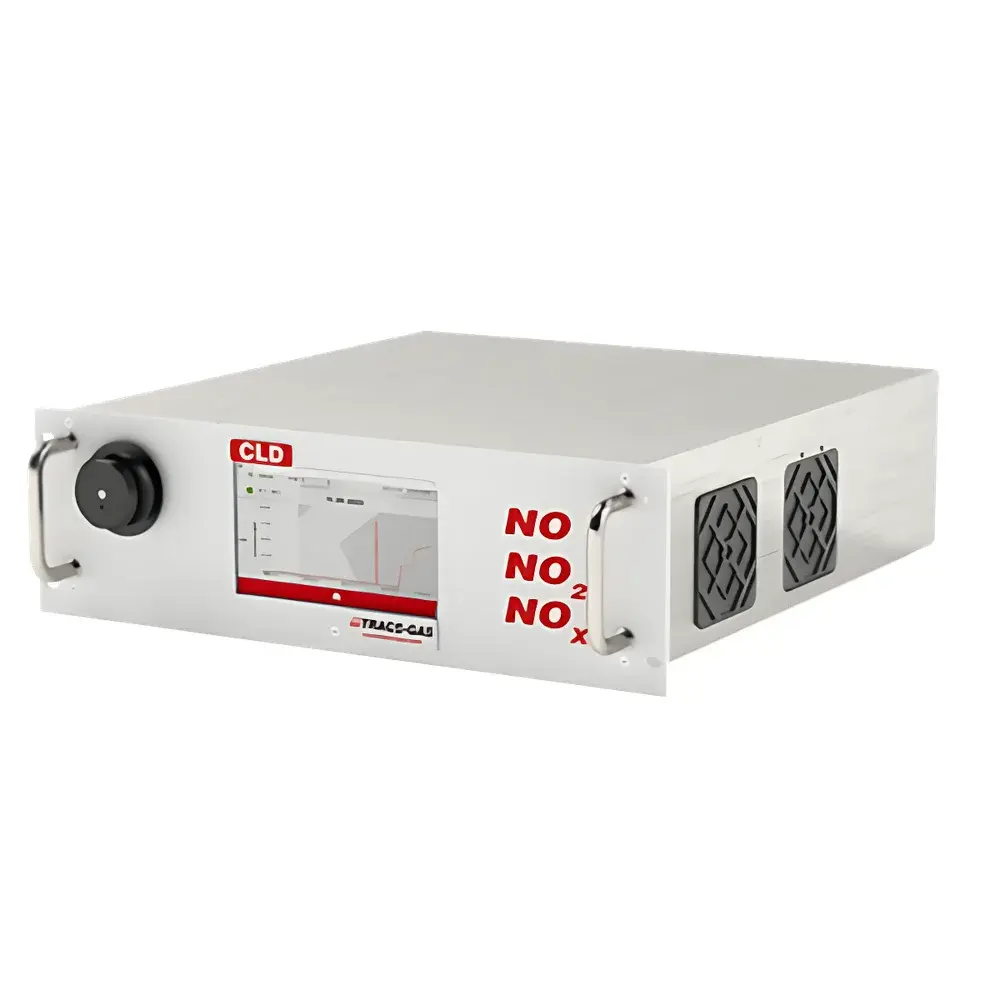
ONUEE CLD-Dual Dual-Channel Chemiluminescence Nitrogen Oxides Analyzer
| Brand | ONUEE |
|---|---|
| Origin | Germany |
| Model | CLD-Dual |
| Detection Principle | Chemiluminescence (CLD) |
| Instrument Type | Online Fixed-Station Analyzer |
| Configuration | Dual-Channel (NO + NOₓ simultaneous measurement) |
| Measurement Range | 0–500 ppb (standard), extendable to 0–3000 ppm (FS) |
| Response Time (t₉₀) | ≤1 s (for NO), ≤10 s (t₁₀–t₉₀ for full-scale step) |
| Limit of Detection (LOD) | 0.1 ppb (3σ, typical) |
| Accuracy | ±1 % FS |
| Zero Drift | ≤±1 ppm over 10 h |
| Span Drift | ≤±1 % FS over 10 h |
| Linearity | ±5 ppm or ±1 % of reading (whichever is greater, at FS = 3000 ppm) |
| Operating Temperature | 10–35 °C (non-condensing) |
| Inlet Pressure | 800–1100 mbar |
| Sample Flow Rate | 30–200 mL/min per channel |
| Heater Temperature Range | 70–190 °C |
| Display | 7" resistive touchscreen LCD |
| Interface | Modbus TCP/IP + 4–20 mA analog output |
| Dimensions (L×W×H) | 543 × 485 × 143 mm (19", 3 HU) |
| Weight | ~23 kg |
| Power Supply | 230 V AC, 50–60 Hz |
Overview
The ONUEE CLD-Dual is a high-performance, dual-channel online nitrogen oxides (NOx) analyzer engineered for continuous, real-time monitoring of nitric oxide (NO) and total reactive nitrogen oxides (NOx = NO + NO2) in ambient air, stack emissions, and process gas streams. It operates on the well-established chemiluminescence detection (CLD) principle: NO molecules react quantitatively with ozone (O3) to form electronically excited nitrogen dioxide (NO2*), which decays to its ground state by emitting photons in the near-UV to visible range (~600–3000 nm). This photon emission is directly proportional to NO concentration and measured via a cooled photomultiplier tube (PMT) with high quantum efficiency. For NO2 determination, a catalytic molybdenum (Mo) converter reduces NO2 to NO prior to reaction with ozone; subtraction of the NO signal from the total NOx signal yields NO2. The dual-channel architecture enables independent, simultaneous measurement of NO and NOx, eliminating time-lag artifacts and supporting dynamic emission profiling required in regulatory compliance, combustion optimization, and atmospheric research.
Key Features
- Dual-channel design with dedicated optical paths and flow control for true parallel NO and NOx analysis — no switching valves or sequential sampling delays
- Sub-ppb detection capability (0.1 ppb LOD, 3σ) validated under stable thermal and pressure conditions per IEC 61261 and EN 14211
- Ultra-fast response: t90 ≤ 1 s for NO; optimized pneumatic design minimizes residence time and memory effects
- Integrated heated sample path (70–190 °C) prevents condensation and adsorption losses of reactive nitrogen species, critical for low-concentration urban air or low-temperature flue gas applications
- Robust 19-inch rack-mount chassis (3 HU) with industrial-grade power supply (230 V AC, 50–60 Hz) and EMI-shielded electronics compliant with EN 61326-1
- Self-diagnostic firmware with real-time status monitoring of ozone generator output, PMT voltage, converter efficiency, and flow stability
Sample Compatibility & Compliance
The CLD-Dual accepts gaseous samples across a broad operational envelope: inlet pressure 800–1100 mbar, temperature 10–35 °C (non-condensing), and flow rate 30–200 mL/min per channel. It is compatible with standard EPA Method 7E, EN 14792 (ambient air), and ISO 11565 (stationary source emissions) sampling interfaces. All wetted materials — including stainless-steel manifolds, PTFE-lined tubing, and ceramic converters — are selected for chemical inertness toward NOx, SO2, CO, and hydrocarbons. The instrument meets CE marking requirements for electromagnetic compatibility (EMC) and low-voltage directive (LVD), and supports audit-ready data logging aligned with ISO/IEC 17025 quality management systems. Optional NIST-traceable calibration certificate and factory performance verification report are available upon request.
Software & Data Management
Data acquisition and system control are managed via an embedded Linux-based platform with a 7-inch resistive touchscreen interface. Local operation includes real-time trend plots, alarm configuration (high/low, rate-of-change), and manual zero/span validation. Remote access is enabled through native Modbus TCP/IP protocol (register mapping provided), allowing seamless integration into SCADA, DCS, or centralized environmental monitoring platforms. Analog 4–20 mA outputs support legacy PLC interfacing with configurable scaling per channel. All measurements are timestamped with internal RTC (±1 s/day accuracy) and stored in non-volatile memory with circular buffering (≥30 days at 1-min intervals). Audit trails record user actions, calibration events, and parameter changes — supporting GLP/GMP-aligned workflows and FDA 21 CFR Part 11 readiness when paired with external identity management.
Applications
- Continuous emission monitoring systems (CEMS) for coal-, gas-, and biomass-fired power plants per EU IED and US EPA 40 CFR Part 60 Subpart Da
- Ambient air quality networks (AAQNs) measuring urban NO2 hotspots, traffic corridors, and background stations per EU Directive 2008/50/EC
- Automotive R&D laboratories performing exhaust gas analysis during engine dynamometer testing (e.g., WLTP, RDE)
- Industrial process control in nitric acid production, semiconductor etching, and fertilizer manufacturing
- Research applications in atmospheric chemistry, photochemical smog formation studies, and NOx deposition modeling
FAQ
How does the CLD-Dual differentiate between NO and NO2?
It measures NO directly via CLD reaction with ozone. NO2 is quantified indirectly: a fraction of the sample stream passes through a heated Mo converter where NO2 is reduced to NO; the difference between total NOx and native NO yields NO2 concentration.
Is converter efficiency monitored in real time?
Yes — the firmware calculates converter efficiency daily using a built-in NO2 permeation source or optional external calibration gas, logging results and triggering alerts if efficiency falls below 95 %.
Can the instrument operate unattended for extended periods?
Yes — designed for 24/7 operation with automatic zero/span scheduling, ozone generator health monitoring, and predictive maintenance alerts based on runtime and component aging models.
What calibration gases are required for routine operation?
Certified NO-in-N2 (e.g., 100 ppb, 1 ppm) for zero/span; optional NO2-in-air for converter efficiency verification. All calibrations follow ISO 6141 traceability protocols.
Does the CLD-Dual comply with data integrity requirements for regulatory reporting?
Yes — all raw and processed data include digital signatures, immutable timestamps, and full change history. When deployed with secure network authentication and role-based access control, it satisfies EU Annex 11 and FDA 21 CFR Part 11 electronic records criteria.







