
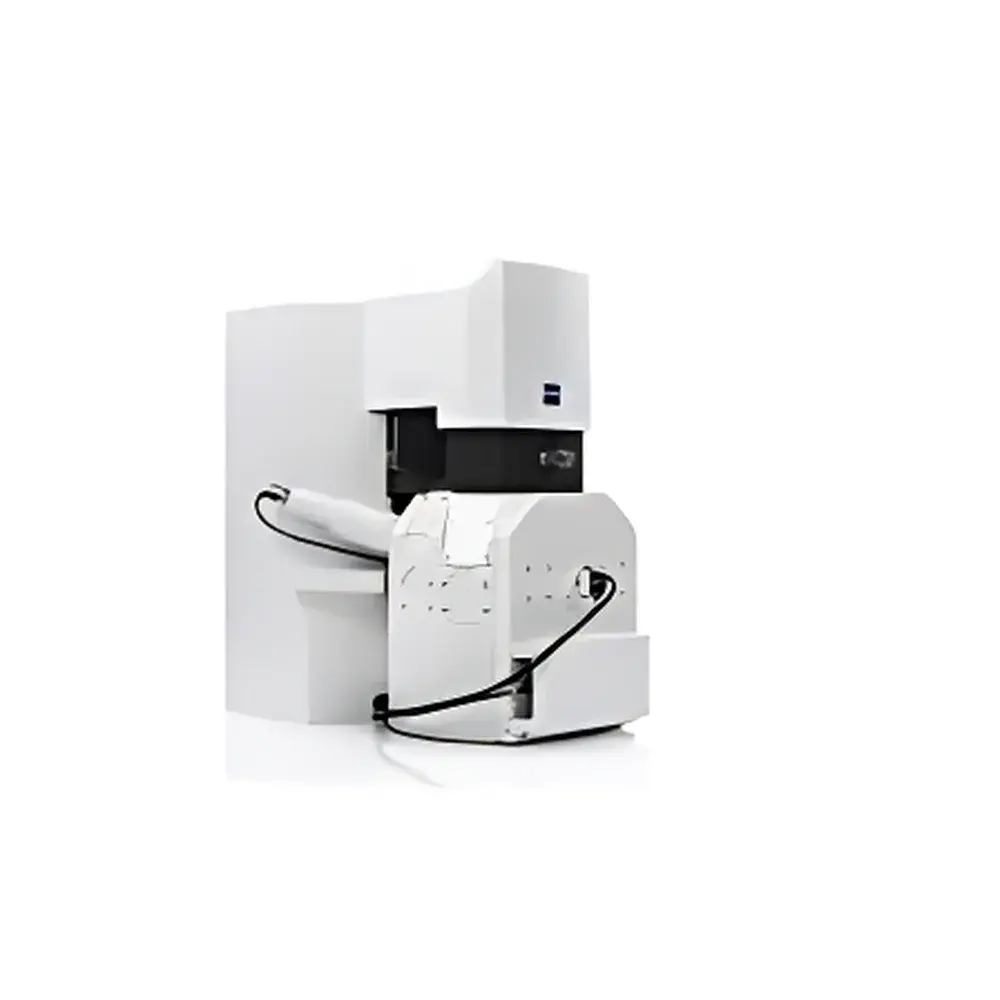
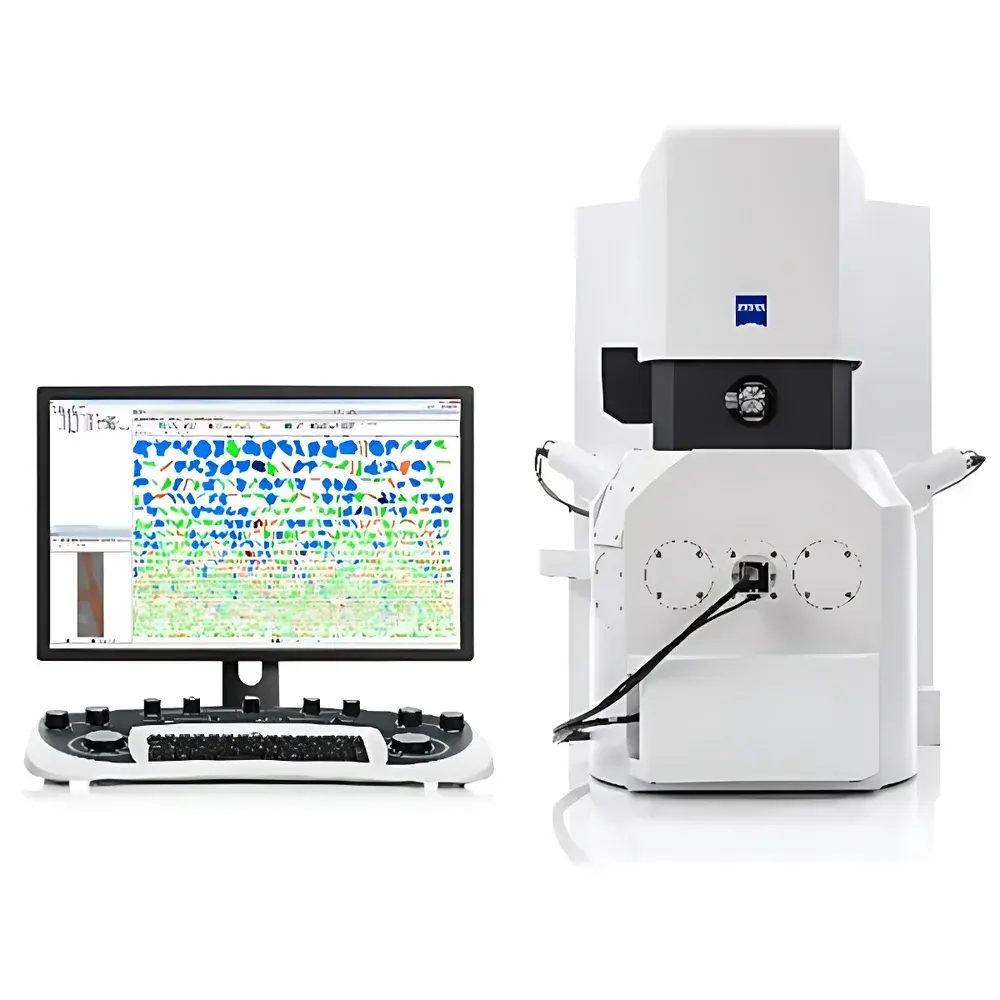
ZEISS EVO Series Tungsten-Filament Scanning Electron Microscope
| Brand | ZEISS |
|---|---|
| Origin | Germany |
| Manufacturer Type | Authorized Distributor |
| Origin Category | Imported |
| Model | EVO |
| Pricing | Available Upon Request |
Overview
The ZEISS EVO Series is a high-performance tungsten-filament scanning electron microscope (SEM) engineered for precision, reliability, and operational accessibility across diverse laboratory and industrial environments. Based on thermionic emission from a robust tungsten hairpin filament, the EVO platform delivers stable beam current and consistent imaging performance under variable vacuum conditions—enabling both high-vacuum secondary electron (SE) imaging and low-vacuum or variable-pressure operation for non-conductive or hydrated specimens without mandatory metal coating. Its modular architecture integrates a fully motorized stage, large-chamber design, and intuitive user interface to support routine characterization tasks in quality assurance, failure analysis, and academic research. Designed for compliance with international laboratory standards—including ISO/IEC 17025 workflows—the EVO series serves as a foundational SEM platform for GLP-compliant documentation, traceable metrology, and reproducible microstructural assessment.
Key Features
- Secondary electron resolution of ≤3.0 nm at 30 kV acceleration voltage—validated per ISO 16700 Annex A using Au/Pd standard particles
- Large specimen chamber accommodating samples up to 300 mm in diameter and 210 mm in height—compatible with multi-axis tilt, rotation, and extended working distance configurations
- Integrated navigation camera system providing real-time optical overview for rapid region-of-interest selection and positional correlation
- Native interoperability with ZEISS optical microscopy platforms (e.g., Axio Imager, SteREO Discovery) via ZEN software, enabling correlative light and electron microscopy (CLEM) workflows
- ZEN core software suite supporting acquisition parameter logging, metadata embedding (EXIF-compliant), image annotation, quantitative morphometry, and batch processing with audit-trail capability compliant with FDA 21 CFR Part 11 requirements
- Automated workflow templates—including auto-focus, auto-stigmation, and stage calibration routines—reducing operator dependency and minimizing inter-user variability
Sample Compatibility & Compliance
The EVO series supports a broad spectrum of specimen types: conductive metals, ceramics, polymers, biological tissues, geological thin sections, forensic evidence (e.g., gunshot residue, fiber traces), and archaeological artifacts. Low-vacuum mode (up to 300 Pa) permits direct imaging of uncoated insulators such as textiles, plant epidermis, or polymer films—demonstrated in validated applications including citrus tissue ultrastructure at 10 kV and synthetic fiber morphology under 100 Pa water vapor pressure. All hardware and software modules conform to CE marking directives, IEC 61000-6-3 EMC standards, and are compatible with ISO 9001-certified QA/QC environments. Routine maintenance protocols align with ZEISS Service Level Agreements (SLA) and support GMP-aligned instrument qualification (IQ/OQ/PQ).
Software & Data Management
ZEN software provides end-to-end digital microscopy management—from acquisition through analysis and reporting. It enables synchronized metadata capture (accelerating voltage, working distance, detector gain, vacuum level, stage coordinates), hierarchical project organization, and export to standardized formats (TIFF, JPEG2000, HDF5). Built-in measurement tools comply with ASTM E1245–22 for particle size distribution analysis; grain boundary detection follows ASTM E112–22 guidelines. Audit trails record user actions, timestamped parameter changes, and report generation history—essential for regulatory submissions and internal quality audits. Remote access capabilities allow secure off-site collaboration while preserving data integrity under TLS 1.2 encryption.
Applications
- Automotive: Cleanliness analysis per VDA 19.1, fatigue crack initiation mapping, coating adhesion evaluation
- Metallurgy: Inclusion classification per ASTM E45, phase quantification in duplex steels, decarburization depth measurement
- Semiconductors: Cross-section inspection of BEOL structures, defect localization in Si wafers, solder joint void analysis
- Geosciences: Automated mineral liberation analysis (MLA) via backscattered electron segmentation, porosity quantification in reservoir rocks
- Materials Science: Fractography of composites, wear track profiling of tribological surfaces, nanofiber network topology
- Life Sciences: SEM-based histomorphometry of bone scaffolds, pollen morphology, biofilm architecture
- Forensics & Cultural Heritage: Toolmark comparison, pigment layer stratigraphy, corrosion product identification on historical artifacts
FAQ
What vacuum modes does the EVO support, and how do they affect imaging performance?
The EVO operates in high vacuum (≤1 × 10⁻³ Pa) for maximum resolution SE imaging and low vacuum (up to 300 Pa) for charge-free imaging of insulating specimens—without sputter coating.
Is the EVO compatible with energy-dispersive X-ray spectroscopy (EDS)?
Yes—optional integration with ZEISS-compatible EDS detectors (e.g., Oxford Instruments X-MaxN) is supported via standardized SEM-EDS interface protocols and synchronized stage control.
How is calibration traceability maintained for quantitative measurements?
Calibration references include NIST-traceable grating standards (e.g., SPI Supplies 100 nm pitch) and certified reference materials (CRMs); ZEN software logs calibration date, operator ID, and uncertainty values per ISO/IEC 17025 clause 6.5.
Can the EVO be integrated into an automated lab environment?
Yes—via Ethernet/IP or Modbus TCP interfaces, the EVO supports scheduled acquisitions, LIMS integration, and remote diagnostics through ZEISS Remote Service Portal.
What training and service options are available?
ZEISS offers on-site installation qualification, operator certification programs (including ISO 15189-aligned competency assessment), and global 24/7 technical support with SLA-governed response times.




