
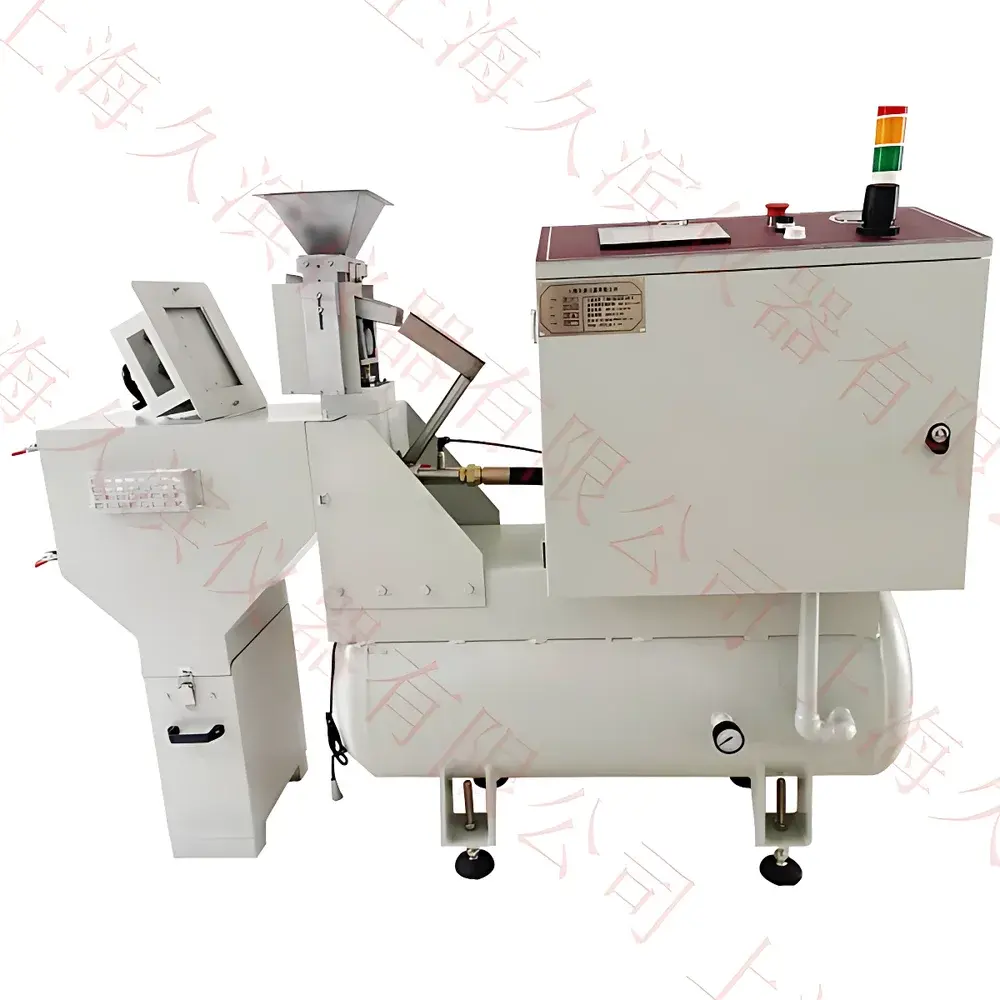
Jiubin MGT Stone Chip Impact Tester JB-JM5
| Brand | Jiubin Instruments |
|---|---|
| Origin | Shanghai, China |
| Manufacturer Type | Authorized Distributor |
| Country of Origin | China |
| Model | JB-JM5 |
| Instrument Type | Stone Chip Impact Tester |
| Operating Pressure Range | 0–0.8 MPa (adjustable) |
| Test Temperature | Ambient (optional low-/high-temperature chamber available) |
| Air Hose Inner Diameter | 20 mm / 15 mm |
| Air Reservoir Volume | 136 L |
| Nozzle Tube Inner Diameter | 30 mm / 53 mm |
| Specimen Orientation Angles | 45°, 54°, or 90° (flat specimens) |
| Sound Pressure Level | ≤120 dB(A) |
| Operation Mode | Continuous duty cycle |
| Impact Media | Gravel, crushed stone, calibrated abrasive particles |
| Feed Rate Control | Electromagnetic vibratory feeder |
| Airflow Pressure Control | Manual needle valve |
| Required Compressed Air Supply | User-provided |
Overview
The Jiubin MGT Stone Chip Impact Tester JB-JM5 is an engineered solution for simulating and quantifying mechanical degradation caused by high-velocity particulate impact—specifically gravel, crushed stone, and angular abrasives—on coated and uncoated substrates. Based on standardized pneumatic propulsion principles, the system accelerates calibrated impact media through a controlled air stream into a precisely oriented test specimen, replicating real-world road debris strike conditions encountered by automotive exterior components, aerospace composites, protective coatings, and architectural cladding systems. Unlike generic impact testers, the JB-JM5 implements a dual-nozzle configuration (30 mm and 53 mm internal diameters) and modular specimen mounting to support both flat-panel evaluation per ASTM D3170/D3170M (Standard Test Method for Chipping Resistance of Coatings) and three-dimensional component testing via its integrated 3D impact chamber. Its design prioritizes repeatability in impact energy delivery, traceable to regulated airflow dynamics and gravimetric feed control.
Key Features
- Adjustable operating pressure (0–0.8 MPa) enables precise calibration of impact velocity and kinetic energy across material classes—from soft elastomeric coatings to tempered glass and fiber-reinforced polymers.
- Dual interchangeable nozzle assemblies (30 mm and 53 mm ID) accommodate varying particle size distributions and impact area requirements, supporting both localized chip assessment and broad-area erosion profiling.
- Tri-angled specimen fixture (45°, 54°, 90°) complies with OEM specifications for automotive paint chip resistance validation, including Ford CETP 00.00-L-467 and GMW 14872.
- 136 L pressurized air reservoir ensures stable airflow during extended continuous-duty cycles, minimizing pressure decay and maintaining consistent impact intensity over multi-hour test sequences.
- Electromagnetically driven vibratory feeder delivers metered, pulse-free media flow—critical for achieving statistically robust chipping density measurements per ISO 20567-1 (Paints and varnishes — Determination of stone-chip resistance).
- Acoustically damped enclosure and structural isolation reduce transmitted vibration, while operator safety protocols—including mandatory hearing protection at ≤120 dB(A)—align with OSHA 29 CFR 1910.95 and EU Directive 2003/10/EC.
Sample Compatibility & Compliance
The JB-JM5 accommodates planar specimens up to 300 × 300 mm and irregular 3D parts (e.g., bumpers, mirror housings, sensor covers) within its configurable test chamber. Substrate materials include steel, aluminum, magnesium alloys, thermoplastics (PP, PC, ABS), thermosets (epoxy, polyurethane), laminated glass, and ceramic-coated surfaces. The system supports test execution under ambient conditions; optional environmental chambers extend operational range to –40 °C to +80 °C for low-temperature brittleness or high-temperature adhesion studies. All mechanical and pneumatic subsystems conform to CE machinery directive (2006/42/EC) and meet electromagnetic compatibility requirements per EN 61326-1. Calibration procedures follow traceable metrological practices aligned with ISO/IEC 17025–accredited laboratories.
Software & Data Management
While the JB-JM5 operates via analog/manual controls (needle valve pressure regulation, mechanical angle indexing, and manual feed rate tuning), it is fully compatible with third-party data acquisition systems via 4–20 mA pressure transducer outputs and digital TTL signals from the vibratory feeder controller. Users may integrate the instrument into centralized laboratory networks using Modbus RTU or Ethernet/IP protocols (via optional I/O module). Audit trails for test parameters—including pressure setpoint, exposure duration, media batch ID, and operator login—are maintainable in external LIMS platforms compliant with FDA 21 CFR Part 11 and EU Annex 11 when paired with validated electronic record systems. Routine maintenance logs and calibration certificates are structured to support GLP and IATF 16949 audit readiness.
Applications
- Automotive OEM and Tier-1 supplier validation of basecoat/clearcoat chip resistance per SAE J400 and VDA 621-412.
- Evaluation of interlayer adhesion failure modes in multilayer polymer films and functional barrier coatings.
- Quantification of critical brittle thickness in tempered glass used in side windows and panoramic roofs.
- Comparative assessment of anti-spall performance in ballistic-transparent composites and armored vehicle panels.
- Development testing of self-healing polymer coatings and sacrificial erosion shields for wind turbine blades.
- Correlation studies between laboratory chip patterns and field-deployed component damage in accelerated durability programs.
FAQ
Is compressed air supply included with the JB-JM5?
No. Users must provide an externally sourced oil-free compressed air system delivering ≥2 m³/min at 0–0.8 MPa.
Can the JB-JM5 be used for non-automotive applications?
Yes. It is routinely deployed in aerospace, renewable energy, construction materials, and defense R&D for impact resistance benchmarking of composites, ceramics, and thin-film systems.
What standards does the JB-JM5 directly support?
ASTM D3170/D3170M, ISO 20567-1, SAE J400, VDA 621-412, Ford CETP 00.00-L-467, and GMW 14872.
Is temperature-controlled testing possible?
Ambient operation is standard; low- and high-temperature environmental chambers are available as factory-installed options.
How is impact media consistency ensured between tests?
Calibrated gravel or crushed stone must be pre-sieved to defined size fractions (e.g., 3–6 mm per ISO 20567-1 Annex A); batch traceability and moisture content documentation are required for method reproducibility.



