
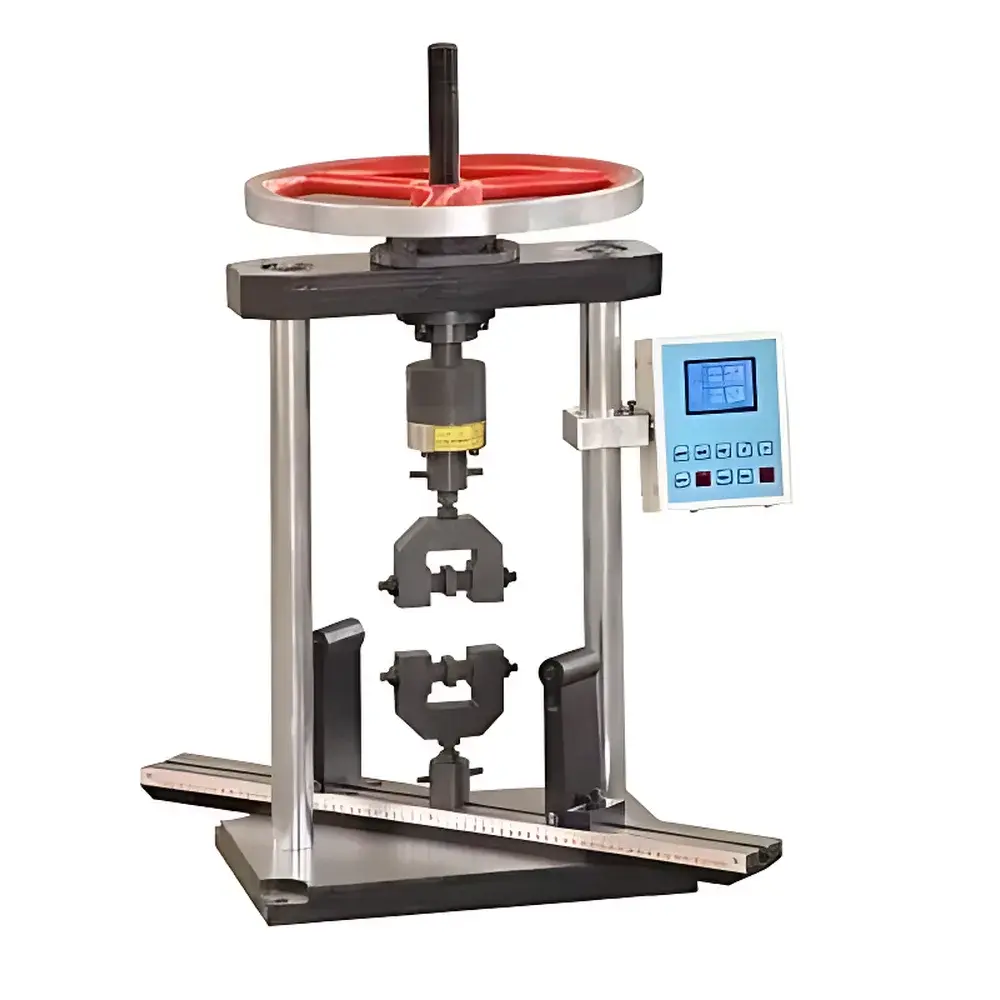
Jiubin JB-T Manual Wood-Based Panel Testing Machine
| Key | Load Capacity: 10 kN |
|---|---|
| Force Accuracy | ±1% of reading |
| Tensile Stroke | 0–350 mm |
| Compression Space | 0–400 mm |
| Power Supply | 220 V, 50 Hz, 100 W |
| Dimensions (W×D×H) | 600 × 450 × 400 mm |
| Weight | 60 kg |
| Control System | Embedded MCU with LCD interface |
| Standard Fixtures | 6 sets (for internal bond strength, glue bond strength, modulus of rupture, modulus of elasticity, screw withdrawal resistance, and surface bond strength) |
Overview
The Jiubin JB-T Manual Wood-Based Panel Testing Machine is a dedicated mechanical testing system engineered for standardized evaluation of structural and bonding performance in engineered wood products. It operates on the principle of quasi-static uniaxial loading—applying controlled tensile, compressive, or bending forces to specimens according to internationally recognized test protocols including ISO 16978, ISO 13910, EN 319, EN 317, EN 312, and ASTM D1037. Unlike servo-controlled electromechanical testers, the JB-T employs a manually actuated mechanical drive train coupled with high-fidelity load sensing, offering reproducible force application without dependency on complex motion control algorithms or variable-frequency drives. This architecture ensures long-term stability, minimal maintenance, and compliance with GLP-aligned laboratory practices where traceability, operator independence, and method transparency are prioritized over automation speed.
Key Features
- Robust dual-column steel frame with precision-machined load train, designed to maintain alignment under repeated loading cycles up to 10 kN.
- High-stability load cell calibrated to ±1% of full-scale reading, traceable to national metrological standards via factory certification report.
- Manual handwheel-driven crosshead with fine-pitch lead screw mechanism, enabling smooth, jerk-free displacement at user-defined rates—critical for fracture-sensitive tests such as surface bond strength or internal bond evaluation.
- Integrated embedded microcontroller unit (MCU) with backlit LCD display provides real-time force readout, peak-hold function, and zero-tracking compensation—eliminating need for external data acquisition hardware.
- Self-contained power requirement (220 V, 50 Hz, 100 W) allows deployment in standard laboratory outlets without dedicated circuitry or cooling infrastructure.
- Modular fixture mounting interface compatible with ISO/EN-specified specimen geometries and clamping configurations.
Sample Compatibility & Compliance
The JB-T accommodates standard-sized specimens per major international standards: 50 mm × 50 mm squares for internal bond strength (ISO 13910), 25 mm × 100 mm strips for glue bond testing (EN 314-1), 20 mm × 50 mm × 500 mm beams for static bending (ISO 16978), and 50 mm × 50 mm blocks for screw withdrawal (EN 320). All six included fixture sets conform to dimensional tolerances specified in EN 326-1 and ASTM D1037 Annex A. The machine supports both flatwise and edgewise orientation during flexural testing and enables precise center-point or third-point loading via interchangeable loading noses. Its mechanical design meets ISO 7500-1 Class 2 requirements for static force measurement systems, and its operational documentation supports audit readiness for ISO/IEC 17025-accredited laboratories conducting routine quality control in panel manufacturing and regulatory verification environments.
Software & Data Management
The JB-T operates without proprietary PC-based software; all measurement functions are executed locally within the onboard MCU. Force values are displayed in real time with 0.1 N resolution and updated at ≥10 Hz sampling rate. Peak force capture is triggered automatically upon load drop exceeding 5% of maximum value—a threshold aligned with ISO 16978’s definition of failure onset. Calibration parameters are stored in non-volatile memory and can be reloaded after power cycling. While no direct USB or Ethernet interface is provided, test records—including date/time stamp, peak load, and operator ID input—are exportable via optional RS-232 serial module (sold separately) for integration into LIMS or QA databases. The system supports 21 CFR Part 11-compliant audit trails when paired with validated third-party data logging software and electronic signature workflows.
Applications
- Quality assurance testing of particleboard, MDF, plywood, OSB, and laminated veneer lumber (LVL) in production facilities.
- Verification of adhesive cure efficacy and interlayer bonding integrity across hot-press cycle validation studies.
- Comparative analysis of raw material substitutions—e.g., bio-based resins or recycled fiber blends—against baseline mechanical specifications.
- Regulatory conformance testing for CE marking (under EN 13986), CARB ATCM compliance, and JIS A 5908 certification pathways.
- Educational use in wood science and materials engineering curricula for hands-on instruction in ASTM/ISO test methodology and mechanical property interpretation.
FAQ
Is the JB-T compliant with ISO 7500-1 for force measurement accuracy?
Yes—the load cell and signal conditioning chain meet ISO 7500-1 Class 2 requirements, verified by factory calibration certificate with uncertainty budget.
Can the machine perform cyclic or fatigue testing?
No—the JB-T is designed exclusively for monotonic quasi-static tests; it does not support programmed load reversal or dwell sequences.
Are replacement fixtures available for non-standard specimen geometries?
Custom fixture designs can be commissioned through Jiubin’s engineering support team, subject to minimum order quantities and dimensional feasibility review.
Does the system require annual recalibration?
Per ISO/IEC 17025 and internal QA policy, annual verification against certified reference loads is recommended; the embedded auto-calibration routine validates zero and span points but does not replace traceable recalibration.
What safety features are integrated?
The machine includes mechanical overload stop limits, guarded handwheel operation zone, and emergency stop button wired directly to power cutoff—fully compliant with EN 61000-6-2 electromagnetic compatibility and EN 60204-1 electrical safety directives.



